Do You Need a License for an ATV in Mississippi?
You've just bought a shiny new ATV or maybe inherited a trusty old quad, and a burning question hits you: "Do I need a license to ride this thing in Mississippi?" It's a common point of confusion, and frankly, the rules around ATVs in the Magnolia State aren't always crystal clear, often blending with assumptions from car laws or other states. This guide is here to untangle that knot for you, explaining exactly what's required so you can ride confidently and legally.
The Blunt Truth: No "License" for Off-Road ATVs on Private Land
Let's cut right to the chase because this is where a lot of folks get tripped up. For the vast majority of ATV riding in Mississippi – that is, on private land with the owner's permission – you do not need a state-issued "license" in the way you'd need one to drive a car. There's no special ATV operator's license that Mississippi issues, and the state doesn't have a registration system for off-road vehicles like it does for automobiles.
What "License" Actually Means Here
When most people ask about needing a "license" for an ATV, they're usually thinking about the kind of document that permits them to operate a motor vehicle on public roads. But ATVs, by their very definition in Mississippi law, are designed for off-road use. This fundamental distinction is key. For riding on your own property, or on a friend's land with their blessing, the state doesn't require you to hold a driver's license or any other specific ATV permit. The expectation is that the landowner sets the rules for their property. The state of Mississippi, unlike many others, does not register ATVs, which further separates them from highway-bound vehicles. This means there's no yearly sticker, no specific license plate, and no corresponding operator license tied to a registration system.
So, if you're planning a weekend of mudding at a private park, riding trails on your hunting lease, or simply buzzing around your farm, the state itself isn't demanding to see your driver's license. Your ability to operate the machine safely and responsibly in that environment is generally between you and the landowner. However, this doesn't mean you can just hand the keys to anyone without a thought for safety – especially when it comes to younger riders.
The Driver's License vs. Safety Card Distinction
While a general driver's license isn't a blanket requirement for all ATV operation, it becomes relevant under specific circumstances. For instance, if you're 16 or older and plan to ride on certain public lands, like designated trails within a national forest, carrying a valid driver's license (or a state-issued identification card) is often considered sufficient proof of age and general operating competence. It's not an "ATV license" per se, but it serves the purpose.
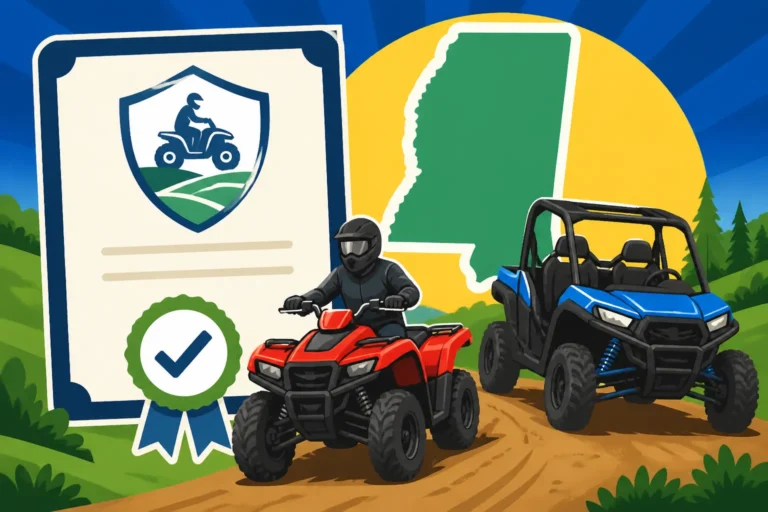
For riders under the age of 16, Mississippi takes a different approach on public lands. Instead of a driver's license (which they wouldn't have anyway), the law stipulates that these younger operators must possess a valid ATV safety course certificate. This "safety card" demonstrates that they've completed an approved training program designed to teach safe ATV operation. So, in a nutshell: 16 and up on public trails? Driver's license is fine. Under 16 on public trails? Safety card is a must. [Mississippi Requires a License or a Safety Card]
Riding on Public Land: When a Driver's License (or Safety Card) Matters
Alright, so if you're venturing beyond private property and heading to public lands, the rules shift a bit. It’s not about needing a "license to drive an ATV" but rather about demonstrating that you meet the state’s requirements for operating a motor vehicle on shared public spaces, even if those spaces are designated off-road trails.
National Forests and State Parks
Mississippi is home to some fantastic riding opportunities within its national forests, like the De Soto and Holly Springs National Forests, which offer designated OHV trails. State parks might also have specific areas for ATV use, though these are less common. When you visit these public lands, the authorities – usually Forest Service rangers or park staff – want to ensure that riders are capable and meet basic safety standards. For any rider who is 16 years old or older, simply possessing a valid driver's license is typically all you need. It serves as proof that you are of an age generally considered capable of operating a motor vehicle and have demonstrated a basic level of road knowledge (even if you're not on a road).
However, the game changes for younger enthusiasts. If your child, nephew, or any rider under the age of 16 wants to hit the trails in a Mississippi National Forest or a state park that permits ATVs, they absolutely must carry a valid ATV safety course certificate. This is often referred to as a "safety card." This certification proves they've undergone formal training focused on the unique challenges and safety protocols of off-road riding. Furthermore, Mississippi has a helmet law that requires all ATV riders under the age of 16 to wear an approved helmet when operating a machine. This isn't just a suggestion; it's a legal requirement designed to protect our younger riders. [Mississippi Helmet Law for Riders Under 16]
The Importance of Age and Certification
The age cutoffs are fairly clear: 16 years old is the magic number. If you're 16 or older, your standard driver's license acts as your "permission slip" to ride on these public trails. If you're under 16, that safety card is your ticket. These safety courses are often offered by various organizations, sometimes through university extension services or certified instructors who follow national ATV Safety Institute (ASI) guidelines. They cover everything from basic machine controls and proper riding posture to understanding trail etiquette and environmental responsibility. It's not just a hoop to jump through; it's genuinely valuable instruction that can make riding safer and more enjoyable. [Mississippi Safety Certificates as an Alternative]
Parents and guardians of riders under 16 also have a crucial role to play. Even with a safety card, young riders should always be supervised by a responsible adult when on public lands. It's about ensuring their safety and adherence to rules. Don't assume that because they have a certificate, they're ready for every challenge. Mississippi is a fantastic place to enjoy the outdoors, but responsible riding, especially for the younger generation, is paramount. If you're planning a trip to a national forest, make sure you know the local rules, as some areas may have additional restrictions on machine type or width. For example, Bethel OHV Trails in Mississippi has a width limit for machines.
| Age Group | Riding Location | Required Document | Additional Requirement |
|---|---|---|---|
| 16 and Older | Private Land | None | N/A |
| 16 and Older | Public OHV Trails | Valid Driver's License/ID | N/A |
| Under 16 | Private Land | None (Parental Consent) | N/A |
| Under 16 | Public OHV Trails | ATV Safety Course Certificate | Approved Helmet |
| All Ages | Public Roads | N/A (Illegal to Ride) | N/A |
Public Roads: The "No Go" Zone for ATVs in Mississippi
Here’s where many riders face a harsh reality check. While there's flexibility on private land and clear guidelines for public trails, when it comes to Mississippi's public roads, the answer is usually a resounding "no." This is probably the biggest source of frustration for ATV owners, who often just want to get from one section of their property to another, or to a nearby store.
Mississippi's Strict Road Ban
Mississippi law is quite direct and, some might say, unforgiving when it comes to ATVs on public roadways. The state's off-road vehicle chapter, which is surprisingly brief, essentially states that ATVs are not to be operated on public streets, roads, or highways. This isn't a gray area; it's a clear prohibition. [Mississippi Law Flatly Bars ATVs From Public Roads] This means that no matter how experienced you are, no matter if you have a driver's license and a safety certificate, and no matter how many modifications you've made to your machine (even if it rivals a side-by-side from SuperATV), it does not grant you permission to ride your ATV down Main Street or even a quiet county gravel road.
There are extremely limited exceptions, such as directly crossing a highway at a 90-degree angle to get to another section of private property, provided it's done safely and legally. But these are brief crossings, not sustained riding. Any other use on a public road could lead to a citation, fines, and potentially even your machine being impounded. The idea that you can get an "ATV license" to make it road legal simply doesn't exist in Mississippi. The state views these machines as off-road only, and that's that for state law.
Local Ordinances and Their Limitations
You might hear whispers about towns where people ride ATVs on the streets, and while some municipalities have passed ordinances allowing golf carts or low-speed vehicles (LSVs) on certain local roads, these rarely, if ever, apply to traditional ATVs or UTVs. The legal definitions of golf carts and ATVs are distinct, and just because a town says "golf carts are okay" doesn't mean your Polaris RZR or Kawasaki Brute Force is suddenly street legal. [Why a Cart Ordinance Does Not Cover a UTV]
It's crucial to understand that these local ordinances are very specific. They typically define the exact type of vehicle allowed, the speed limits of the roads where they can be operated (often 30 mph or less), and other safety requirements. If you're caught riding your ATV on a public road where it's not explicitly permitted by a very specific and rare local ordinance, you're likely to face a fine. These fines might not break the bank, but they're still an unnecessary expense and hassle. [Mississippi Fines for Road Riding] Always check with local authorities – like the county sheriff's office or the town clerk – if you believe there's an exception in your specific area. Don't rely on hearsay or what a buddy told you.
Titling vs. Licensing: Clearing Up the Confusion
One last area that causes significant head-scratching is the difference between "titling" and "licensing" an ATV. These terms are often used interchangeably by mistake, but they refer to completely different aspects of vehicle ownership and operation.
The New Titling Requirement (Post-2025)
Starting in July 2025, Mississippi is implementing a new requirement: all new ATVs and UTVs purchased or brought into the state that were manufactured after that date will need to be titled. This is a significant change for Mississippi riders, as before this, titles were generally not required for ATVs. [Mississippi ATV Titling Starts July 2025] A title is essentially a legal document that proves who owns a piece of property. Think of it like the deed to your house or the title to your car. It establishes legal ownership, which is incredibly important for preventing theft, proving a sale, and dealing with insurance.
What a title is not, however, is a license to operate your ATV on public roads or even a permit to ride off-road. It doesn't magically make your machine street legal, nor does it grant you permission to ride on any land you choose. It's purely about proving ownership. The $9 fee for a Mississippi ATV title buys you that proof of ownership, nothing more and nothing less. It's a completely separate concept from the idea of an operator's license or vehicle registration for road use. [What the $9 Title Fee Actually Buys You]
Why Titling Matters (Even Without a "License")
Even though a title doesn't act as a "license" to ride, it's a hugely beneficial document to have. For one, it makes proving ownership much simpler, which is vital if your ATV is ever stolen. Without a title, tracing ownership can be a nightmare, and recovering a stolen machine is far more difficult. It also streamlines the process of buying and selling used ATVs. A clear title provides peace of mind for both the buyer and seller, proving that the machine isn't stolen and that the seller has the legal right to transfer ownership. For older machines manufactured before the July 2025 cutoff, voluntary titles are available, offering the same ownership benefits without being a mandatory requirement. [Mississippi Voluntary Titles for Older Machines]
So, while you might not need a "license" to ride your ATV on private land in Mississippi, and even on public trails it's more about a driver's license or safety card, the upcoming titling requirement is a crucial development for all owners. This is a legal document about who owns the machine, not about who can drive it or where. Think of it like a title to a SuperATV winch – you own it, but it doesn't grant you permission to use it on public property where it's not allowed. Understanding the distinction between titling and licensing is key to being a well-informed ATV owner in Mississippi.
Disclaimer
This article is for general informational purposes only and does not constitute professional advice. Laws, prices and regulations vary by location and change over time. Consult a qualified professional for guidance on your specific situation.