Reading the Sign Board at a Forest Trailhead
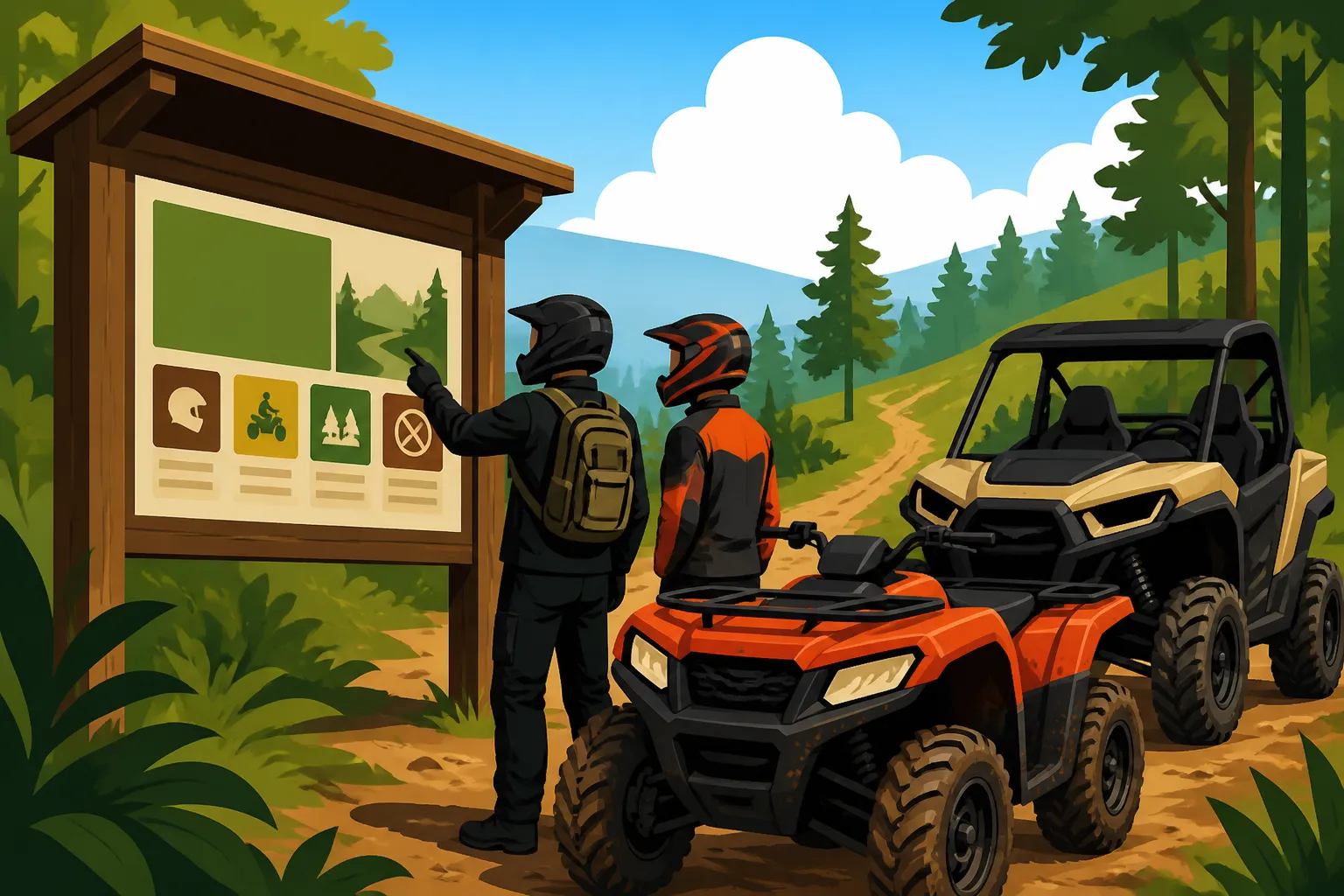
A forest trailhead sign board can answer the questions that matter before you unload: whether the route is open, what pass applies, and whether your ATV or UTV fits the rules. It can also be easy to misread a general forest notice as permission to ride anywhere nearby. Use the board as a checklist, then confirm anything unclear before you start.
Start With the Boundary of the Area You Are Entering
First, identify who manages the land and which riding area the sign describes. A trailhead may sit near a forest road, a wildlife management area, private property, or a route managed under different rules. A sign that applies to one trail system does not automatically authorize riding on every road or parcel beyond it.
Look for the area name, trail name, managing agency, and any map or boundary marking. Check whether the sign says the route is an OHV trail, a forest road, a multi-use path, or a route for another activity. Do not assume that a visible track is open to ATVs and UTVs simply because it begins at a public trailhead.
The distinction matters in Mississippi. A national forest OHV pass applies to eligible riding areas, not as blanket permission to use every road or piece of national forest land. Mississippi National Forest OHV Passes explains the pass requirement; What a Mississippi Forest Pass Does Not Cover is useful for understanding its limits. If the board identifies a wildlife management area instead, check the rules for that site rather than carrying over the forest rules. Mississippi WMA Rules for Riders covers that separate setting.
A practical first check is to match the sign’s map and route name to the trail you intend to ride. If you cannot tell whether the route is included, ask the managing office before unloading. Which Forest Office to Call About Trail Access can help you direct the question to the right office.
| What the board identifies | What to check before riding |
|---|---|
| Managing agency or land unit | Confirm that the rules apply to the area where you plan to ride |
| Trail or route name | Match it to the map and intended route |
| Trail type | Check whether ATVs or UTVs are allowed, rather than assuming every marked route is an OHV trail |
| Boundary or access notice | Look for nearby private land, closed areas, or routes managed separately |
| Contact information | Save it if the map, pass rule, or closure notice is unclear |
A posted boundary can be more important than the trail’s appearance. A gravel road might continue past an OHV trail, for example, but that does not mean the same pass or vehicle rules apply beyond the marked route. If the board does not make the boundary clear, do not treat the uncertainty as permission.
Read Pass and Machine Rules as Separate Checks
A pass and a vehicle’s eligibility answer different questions. The pass addresses whether the rider has the required authorization for the designated riding area. Vehicle rules address whether the particular ATV or UTV is allowed on that route. Satisfying one does not guarantee the other.
Check the board for the name of the pass, where it must be displayed or carried, and whether it is valid for the route you are entering. Do not assume that a pass bought for one type of public recreation covers OHV riding. If the board points to a specific trail system, confirm that the pass covers that system. How to Buy a Mississippi Forest Pass and Mississippi Forest Pass Coverage offer more detail on those questions.
Next, look for any width restriction. Some riding access is tied to a machine-width limit, and a UTV that is too wide may not qualify even if the rider has the correct pass. The 50-Inch Width Limit Written Into the Pass explains why checking the machine’s actual width matters. Do not rely only on a model name or what a seller called the vehicle. If the board gives a limit, compare it with the manufacturer’s specifications or measure the machine as directed by the applicable rule.
A sign may also state which routes are open to particular vehicle types. Read the exact wording: “trail,” “road,” and “area” are not interchangeable. If an ATV route is marked but a nearby forest road is not, do not assume the route permission extends to that road.
Out-of-state riders should make two separate checks. Mississippi not requiring a state sticker from a visiting machine does not mean a visitor can skip a forest pass or ignore trail-specific conditions. Mississippi Has No OHV Registration to Reciprocate and Mississippi Rules for an Out-of-State Machine address different parts of the question. Check the board for the permit required at that location, regardless of where the ATV or UTV is registered or usually ridden.
When you cannot resolve a rule from the board, use the phone number or office information posted there. Describe the exact route and machine, including its width if that is relevant. A broad question such as “Are UTVs allowed?” may not get a useful answer if permission depends on the trail, machine dimensions, or current closure status.
Check Closures, Seasonal Notices, and Route Conditions
A trail may be normally open but temporarily closed. Read the entire board for notices about wet weather, maintenance, fire danger, hunting activity, or other temporary restrictions. A closure notice can be attached to a specific trail or section, so check the map and route name rather than relying on a general impression of the area.
Pay close attention to the date, if one is shown, and whether the notice gives an end date or says the closure continues until further notice. A faded notice or a handwritten update can be hard to interpret. If the board appears inconsistent, do not choose the more convenient reading. Confirm the status with the responsible office before riding.
Weather deserves particular attention. Heavy rain can make trails unsafe or lead to short-notice closures, and a route that appears passable from the parking area may be muddy, damaged, or blocked farther in. Check Mississippi Trail Closures After a Storm and Checking Trail Conditions Before You Load the Trailer before making a long drive. At the trailhead, look again for a newer notice before unloading.
Keep the posted map in view while checking for route-specific markings. A closed branch may be easy to miss if you focus only on the main trail. If a gate, barrier, berm, or closure sign blocks a route, do not go around it to “see whether it opens up.” The restriction may protect riders, wildlife, property, or work crews, and passing a barrier can put you beyond the area where your pass applies.
A short pre-ride routine helps:
- Read every current notice, including small or temporary postings.
- Find your intended trail on the map and check its status.
- Note closed branches, one-way sections, and any route-specific vehicle limits.
- Confirm the pass and machine rules for that route.
- Save the office contact details and a map you can use away from the trailhead.
A paper or offline map is useful if cell service is limited. A waterproof map sleeve, including one available from Amazon, can help keep a printed map readable in damp conditions. It does not replace the official map or current closure information.
Check Rider Requirements Before Leaving the Parking Area
The sign board may list requirements for the rider as well as the machine. Look for age rules, license or safety-certificate requirements, helmet notices, passenger restrictions, and any site-specific safety rules. These requirements can vary by land manager and riding area, so do not assume that a rule from another trailhead applies here.
For a young rider, check the required certificate and helmet information before the trip, not after reaching the gate. Mississippi Forest Rules for Riders Under 16 and The Safety Certificate a Young Rider Must Carry explain why a parent or accompanying adult should confirm the requirements in advance. A child’s ability to operate a machine safely is important, but it does not replace a posted or applicable eligibility requirement.
Passengers are another point to check. A second seat or passenger allowance should not be assumed based on the machine’s size. Follow the board’s wording and the manufacturer’s seating design; do not carry someone on a rack or other place not designed for a passenger.
Also scan for equipment or conduct rules. The board may mention noise, spark arrestors, speed, fire restrictions, or other conditions of use. If the sign refers to a separate rule sheet or trail map, read that material too. A board is often a summary, not the complete set of operating rules.
Before you leave the lot, make sure each rider knows the route and the closure points. Agree on where to stop if someone becomes separated, and keep the posted contact information accessible. If you reach a junction where the signs no longer match the map, stop and reassess rather than taking an unmarked route.
The key is to treat the trailhead sign as a set of separate checks: land boundary, route status, permit, machine eligibility, and rider requirements. If any one of those is unclear, pause and ask the managing office. That small delay is better than discovering deep in the forest that the route, pass, or vehicle was not covered.
Disclaimer
This article is for general informational purposes only and does not constitute professional advice. Laws, prices and regulations vary by location and change over time. Consult a qualified professional for guidance on your specific situation.