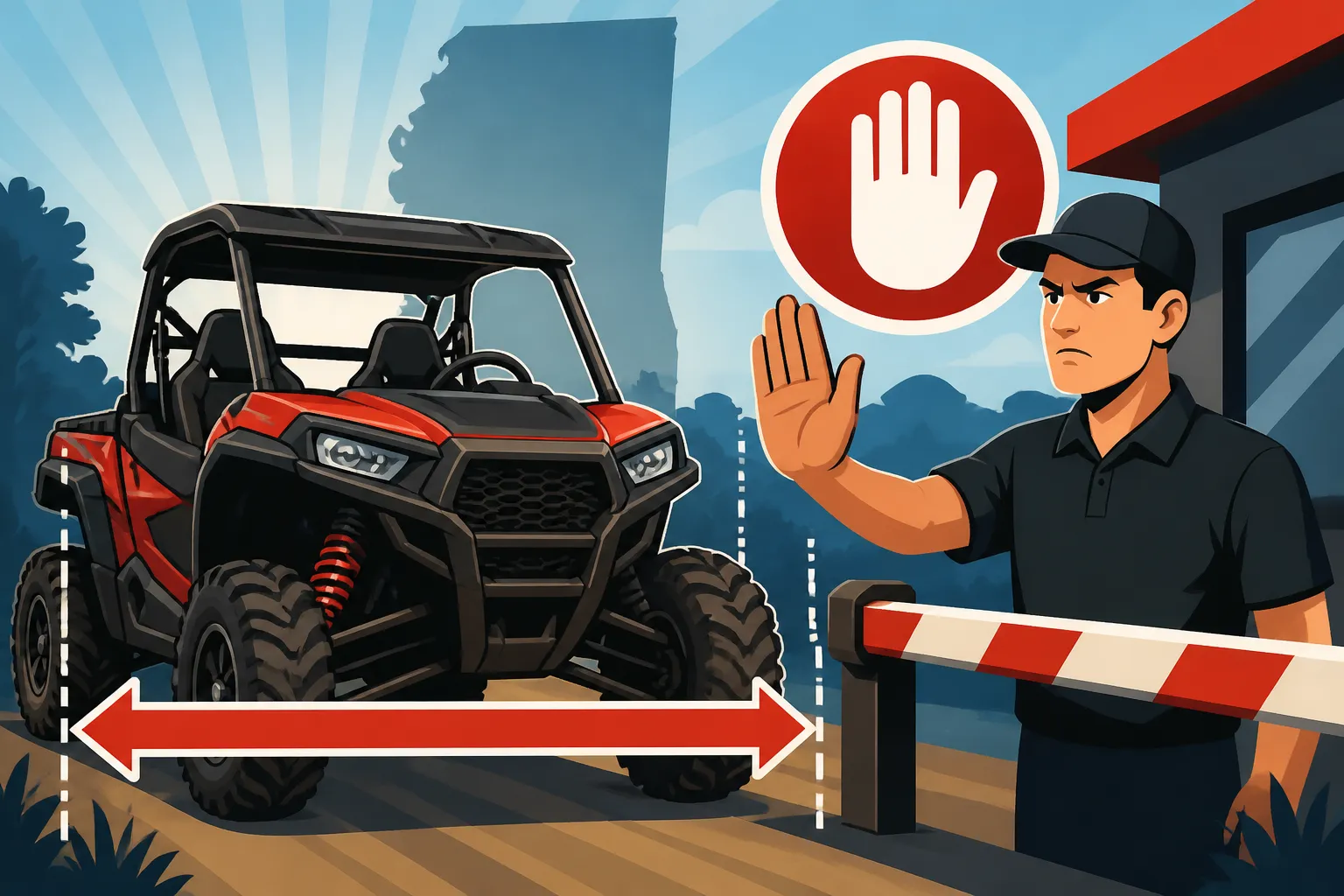
Turned Away for a Machine Over 50 Inches
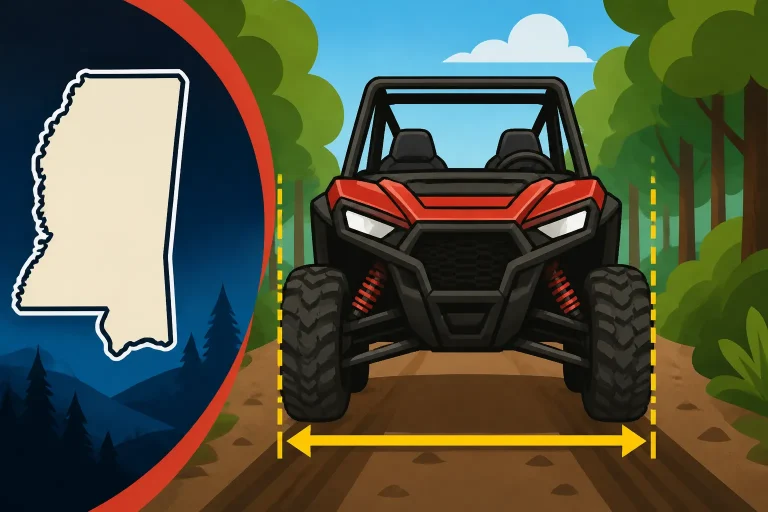
A wide side-by-side can be ready for the trailer and still fail the check at a Mississippi National Forest trail. The key issue is whether the machine fits the width limit attached to the pass and the trail—not whether it is called an ATV or UTV. Here’s how to check before you haul it, what to ask the Forest Service, and what to do if your machine is too wide.
Why a machine over 50 inches can be turned away
The Mississippi Annual Forest-wide OHV Pass allows use of trails open to vehicles that are 50 inches wide or narrower, according to the Forest Service. A machine wider than 50 inches does not fit that pass condition. Having a pass, or qualifying for a discount on one, does not make a wider vehicle eligible for trails restricted to that width.
That does not automatically tell you whether a wider machine can ride anywhere else. It means you should not assume the annual OHV pass covers it or that a trail will admit it. Trail access depends on the specific area and its current rules. Check with the relevant Forest Service ranger district before loading up, and ask directly whether your machine’s width is allowed on the trail you plan to use.
The width rule can catch UTV owners by surprise. A machine’s category or model name is not a substitute for checking its actual width against the pass condition. Nor should you assume that a vehicle marketed for off-road use will fit every designated OHV trail. If you are shopping or comparing machines, Mississippi Trails With Width Limits and Mississippi Trails That Allow Side-by-Sides can help frame the questions to ask—but confirm current access with the Forest Service before traveling.
Check the machine, not just the brochure
Look up the manufacturer’s specifications for the exact model and configuration. Accessories such as wider tires, wheel changes, or other modifications may affect the machine’s overall width. A brochure figure may describe a standard setup, so it may not settle the question for a modified vehicle.
For a practical pre-trip check:
- Identify the exact model and any modifications that could change its width.
- Find the manufacturer’s stated width for that configuration, if available.
- Measure the machine at its widest point as a preliminary check. A basic tape measure from a hardware store or Amazon can help.
- Ask the ranger district how it applies the width rule and whether it uses a particular measurement method.
- Confirm that the specific trail is open to your vehicle and that conditions allow riding.
A tape measurement is useful for spotting an obvious mismatch, but it should not be treated as an official ruling. If your result is close to the limit, ask the Forest Service how to interpret it before making the trip. Do not rely on a seller’s description, a registration label, or a general model name as proof that the machine qualifies.
Which Mississippi forest trails to check
The Forest Service identifies designated OHV trail riding areas on several ranger districts. These locations are useful starting points when you are checking access, but their names alone do not establish that a particular machine is allowed. Ask about both the trail and your machine’s width.
| Ranger district | Designated OHV riding area listed by the Forest Service | What to confirm before you go |
|---|---|---|
| Chickasawhay | Little Tiger ATV/Motorcycle Trail | Whether your machine’s width is allowed and the trail is open |
| De Soto | Bethel OHV Trails and Rattlesnake Bay ATV Trail | Whether the trail’s current rules fit your machine and plans |
| Tombigbee | Chickasaw ATV/Motorcycle Trail | Whether the route is open to your vehicle and current conditions permit riding |
For Bethel, check Bethel’s Width Limit in Mississippi as you prepare, but verify the current rule and access details with the Forest Service. You can also review Mississippi National Forest OHV Passes and Which Trails the $60 Forest Pass Opens to understand the pass and trail questions to raise.
A listed OHV area is not a guarantee that every vehicle can use every route in it. The pass condition applies to trails open to vehicles 50 inches wide or narrower, and access can depend on the specific trail. Ask whether a wider vehicle is permitted on any route you are considering rather than assuming that the area’s general OHV designation means it is.
The Forest Service also closes motorized vehicle trails when conditions are wet to prevent trail damage and erosion into streams. That makes a last-minute check worthwhile even if you have already confirmed the machine’s width. A trail can be a poor choice—or closed—because of conditions, regardless of whether your vehicle fits the width rule. See Mississippi Trail Conditions After Rain for more on planning around wet weather.
Questions to ask before you leave
Be specific when you contact the ranger district. “Can I ride a UTV?” may not give you a useful answer if the restriction depends on width or on the particular route. Instead, explain the machine’s make, model, configuration, and measured width, then ask:
- Is the trail I plan to ride open now?
- Is my vehicle’s width allowed on that trail?
- How does the Forest Service measure or determine vehicle width?
- Does the pass I intend to use cover this vehicle and trail?
- Are wet conditions or other closures affecting access?
If the person you reach cannot confirm the exact trail, ask which office can. Record the trail name and the guidance you receive so you can check that you are following the same plan when you arrive. Trail conditions and access can change, so an earlier answer should not replace checking before departure.
Passes, discounts, and the limits they do not remove
Special passes for the National Forests in Mississippi include the Mississippi Adventure Pass and the Mississippi Annual Forest-wide OHV Pass, according to the Forest Service. These are distinct pass options; do not assume that one has the same purpose or coverage as the other. Ask which pass applies to your planned activity and vehicle.
The Forest Service says the Mississippi Annual Forest-wide OHV Pass allows use of trails open to vehicles 50 inches wide or narrower. The Forest Service lists the pass at $60 as of November 2026. That price does not change the width condition: paying for the annual pass does not, by itself, authorize a wider machine on trails covered by that condition.
The Forest Service also offers a 50% discount on any National Forests in Mississippi Pass for holders of the Interagency Senior Pass, Interagency Access Pass, Golden Age Passport, or Golden Access Passport. A discount affects the pass cost, not the vehicle-width requirement. If you qualify, confirm how to obtain the discount and which pass is appropriate for your trip.
If you are comparing an annual OHV pass with another pass, get the coverage details directly from the Forest Service. Ask whether it applies to your planned activity, which trails it covers, and whether your machine meets the requirements. The Mississippi Forest Pass Coverage and The 50-Inch Width Limit Written Into the Pass topics may also help you prepare those questions.
Do not treat a pass as a substitute for checking trail access. A pass can be valid while a particular trail is closed, unsuitable for your vehicle, or subject to a width condition your machine does not meet. Confirm each part separately: the pass, the trail, the machine, and current conditions.
What to do if your machine is too wide
If your machine exceeds the width allowed for your planned trail, the safest choice is to change the plan before you arrive. Ask the Forest Service whether another trail or riding area permits your vehicle. If you cannot confirm an appropriate option, choose a different destination rather than trying to enter a trail that does not fit the pass condition.
Avoid relying on workarounds that do not change the actual vehicle or the trail’s rules. A different pass, a friend’s pass, or arriving at a quieter time does not establish that a wider machine is allowed. Do not assume that removing an accessory will make the vehicle compliant unless the Forest Service confirms how it measures width and that the resulting configuration qualifies.
If you are already at a trailhead and staff say the machine cannot use the route, stop and ask what options are available. Do not enter a closed or restricted trail while trying to resolve the issue. You may need to turn around, use a different permitted area, or reschedule with a machine that meets the trail’s conditions.
For future trips, save the machine’s specifications, your own pre-trip measurement, the ranger district’s contact details, and the name of the trail you checked. Recheck before each visit, particularly after modifying the vehicle or when weather may affect access. This is more reliable than assuming a machine that was accepted somewhere else will be accepted on every Mississippi National Forest route.
Sources
- Forest Service — National Forests in Mississippi | Passes | Forest Service (checked November 3, 2026)
Disclaimer
This article is for general informational purposes only and does not constitute professional advice. Laws, prices and regulations vary by location and change over time. Consult a qualified professional for guidance on your specific situation.