Spark Arrestor Checks at a State Park Gate
A spark arrestor check can be the difference between unloading your ATV or UTV and turning around at the gate. Mississippi park rules and riding access can vary by destination, so a machine that is ready for one trail system may not meet another site’s requirements. Here’s what to inspect, what to ask before leaving home, and how to avoid confusing a spark arrestor check with other gate rules.
What a spark arrestor check at the gate involves
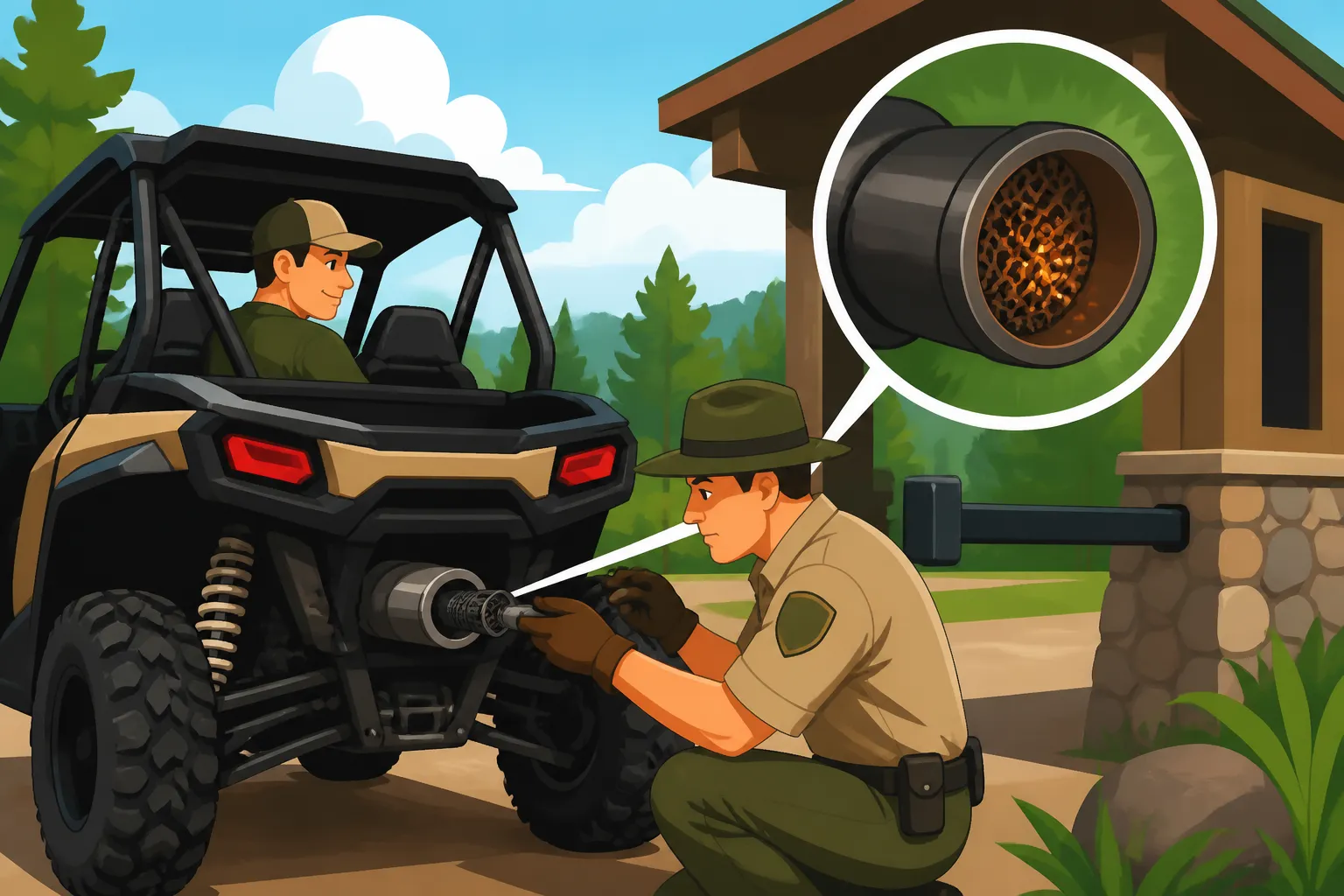
A spark arrestor is a device in the exhaust system designed to reduce the chance that hot particles will escape and ignite dry vegetation. On an ATV or UTV, it is generally part of the muffler or exhaust assembly. It is not the same thing as the muffler itself: a muffler reduces exhaust noise, while a spark arrestor addresses escaping sparks and particles.
At a Mississippi state park or park riding area that allows off-highway machines, staff may ask to see that the machine has a spark arrestor that meets the site’s requirements. The check may be a visual inspection, a request to identify the component, or another procedure established by that location. Do not assume every gate handles inspections in the same way.
A gate check is also not a guarantee that the machine is acceptable in every other respect. Parks can have separate requirements for helmets, passengers, noise, waivers, age, permits, and the areas where machines may be ridden. Review the destination’s full Mississippi State Park ATV Rules rather than treating the spark arrestor as the only equipment question.
| Gate issue | What it concerns | What to check before you go |
|---|---|---|
| Spark arrestor | Whether the exhaust system has the required spark-control component | Confirm the park’s rule and inspect the muffler or exhaust assembly |
| Muffler and noise | How loud the machine is | Check the park’s noise limits separately; a spark arrestor does not make a loud machine compliant |
| Helmet and rider eligibility | Rider safety and access conditions | Check age, helmet, supervision, and passenger requirements |
| Waiver or permit | Permission to use a specific riding area | Ask what forms or passes are needed and whether they must be completed at the park |
| Riding-area access | Which trails or roads are open to machines | Confirm the park actually permits your machine type and that the intended route is open |
The relevant requirement can depend on the particular park and riding area, not simply on the fact that the site is in Mississippi. Some state parks have limited or no access for ATVs and UTVs, while a designated riding area may have its own admission and equipment procedures. Confirm that the site permits your type of machine before you focus on packing for the inspection.
For a closer look at equipment expectations, see Mississippi State Park Spark Arrestor Rules. If your trip involves other riders, it is also worth checking State Parks Require a Helmet for Every Rider and State Parks Cap ATV Mufflers at 90 Decibels. Noise and spark control are separate issues: a compliant spark arrestor does not automatically satisfy a sound limit, and a quiet exhaust does not prove that it has the required spark-control component.
How to prepare your ATV or UTV before the trip
The most useful preparation happens before the machine is on the trailer. Start by finding the park’s current official rules or contacting the park office or riding-area operator directly. Ask whether spark arrestors are required for your vehicle type, how staff verify them, and what happens if the component is missing or cannot be confirmed. If there is a designated riding area within a larger park, make sure you are asking about that area’s requirements.
Next, locate the exhaust system and determine whether the spark arrestor is installed. Use the owner’s manual or information from the manufacturer to identify the correct component and how it should appear. Do not rely only on a seller’s description, a sticker, or the assumption that a stock exhaust must be acceptable. If the equipment has been replaced, modified, or repaired, verify that the current setup still meets the park’s stated rule.
Before departure, look for obvious damage or changes that could raise questions at the gate. A loose or broken exhaust part, an improvised repair, or a component removed during maintenance can turn a quick check into a denied entry. Keep the exhaust in its normal operating condition, and do not remove a screen or other spark-control part to increase airflow or sound. If you are unsure whether a part is present or correctly installed, ask a qualified repair shop or the manufacturer before the ride.
When ordering a replacement, match the part to the exact make, model, and year of the machine, and check the manufacturer’s fitment details. Online marketplaces such as Amazon can help you find parts, but a listing that says “fits ATV” is not enough to establish that a component is correct for your specific exhaust or meets the park’s requirements. Keep the product details or installation documentation available if they help explain what was fitted, but do not assume paperwork substitutes for a compliant component.
Use this pre-trip sequence:
- Confirm access. Verify that the destination permits your ATV or UTV and that the riding area is open to your vehicle’s size and type.
- Ask about the spark arrestor. Confirm the exact rule with the park or riding-area office, including how an inspection is handled.
- Inspect the exhaust. Check that the required component is present, secure, and not visibly damaged or altered.
- Check separate equipment rules. Ask about noise limits, helmets, passenger seating, age restrictions, and any other gate checks.
- Prepare required paperwork. Find out whether you need a waiver, permit, proof of identity, or another document before arriving.
- Recheck close to departure. Access and trail conditions can change, so verify that the riding area is open and its requirements have not changed.
If a repair is needed, complete it before the trip rather than hoping staff will let you fix the machine in the parking area. A park may not have the right parts, tools, or permission to let you make an exhaust modification on site. A last-minute repair can also leave you with a component that has not been properly installed or checked.
What to expect when staff inspect the machine
At the gate, be ready to follow staff instructions and show the exhaust area if requested. Keep the machine off unless staff ask you to start it. Starting or revving an ATV or UTV to demonstrate the exhaust can create a noise or safety problem, and it does not establish that a spark arrestor is installed. If staff cannot identify the component, calmly explain what you know and ask what evidence or inspection method they accept.
If the machine passes the spark arrestor check, that only resolves that part of entry. You may still need to complete a waiver, show required documents, pay the applicable admission or permit charges, or meet other equipment rules. State park procedures can include paperwork and safety checks beyond the exhaust inspection; review Mississippi State Park Waiver Steps before you arrive so you are not trying to sort out forms while a group waits behind you.
If staff say the machine does not meet the requirement, do not argue that a muffler is “close enough” or that the machine passed inspection somewhere else. Ask which requirement is not met and whether there is a way to resolve it on site. If not, the practical choices may be to leave the machine behind or return after making the repair. A prior visit or an approval from a different park may not carry over, because locations can apply separate rules.
If you believe there has been a misunderstanding, ask politely for the park’s written rule or for a supervisor who can clarify it. Keep the discussion focused on the machine and the stated requirement. Do not alter or remove exhaust parts at the gate in an attempt to satisfy an inspection. If a rule is unclear, document the answer you receive and follow up with the park office before returning.
For the related muffler issue, State Parks Cap ATV Mufflers at 90 Decibels covers why noise checks should not be confused with spark arrestor checks. A spark arrestor is not a sound meter, and a quiet machine is not proof that the arrestor is present. Treat each requirement as a separate item on your pre-ride checklist.
Check the park’s access and permit rules separately
Spark arrestor compliance does not give you permission to ride anywhere you choose. A state park may restrict which machines can enter, which routes are open, and where riding is allowed. Some rules apply to the park as a whole; others apply only to a designated trail or riding area. Check the exact destination and planned route before hauling your machine.
Do not assume a national forest pass or another state’s permit replaces a state park’s requirements. Forest riding and park riding can use different access systems, and a pass for one location does not automatically grant entry to another. If you are planning multiple stops, check each one individually. Mississippi Forest Pass Coverage explains a separate access question for national forest trails, while Mississippi Private Park Waivers and Rules is relevant when your destination is privately operated.
Access conditions can change after weather, maintenance, or other closures. Confirm that the riding area is open shortly before departure, especially if rain could affect trail use. Mississippi Trail Conditions After Rain can help with the broader planning question, but the specific park remains the best source for current gate instructions.
A short call can prevent a wasted trip. Ask the park office these questions:
- Are ATVs and UTVs allowed at this location, and is the riding area open?
- Is a spark arrestor required for my machine?
- How does staff check it at the gate?
- Are there separate sound, helmet, passenger, age, or equipment rules?
- Is a waiver, permit, or proof of identity required?
- If my machine does not pass, is there any on-site repair option, or must it leave the property?
Write down the answers and the name of the location you contacted. If the rule depends on the vehicle or riding area, describe your machine clearly, including its type and any exhaust changes. This is especially helpful when traveling with a side-by-side, a modified machine, or several riders whose vehicles may not have identical equipment.
The simplest approach is to treat a spark arrestor as one part of a larger entry check. Confirm the park’s access rules, make sure the exhaust is complete and in good condition, and have any required forms ready. That preparation will not override a park’s decision, but it can help you avoid arriving with a machine that cannot be admitted.
Disclaimer
This article is for general informational purposes only and does not constitute professional advice. Laws, prices and regulations vary by location and change over time. Consult a qualified professional for guidance on your specific situation.