Mississippi Supervision on Public Land
A child riding an ATV or UTV on Mississippi public land needs more than an adult somewhere nearby. Age, safety credentials, the machine’s seating, and the rules for the specific riding area all matter. Here’s how to think about supervision before you leave home, and what to confirm with the land manager so a family ride doesn’t end at the gate.
What supervision means for a young rider
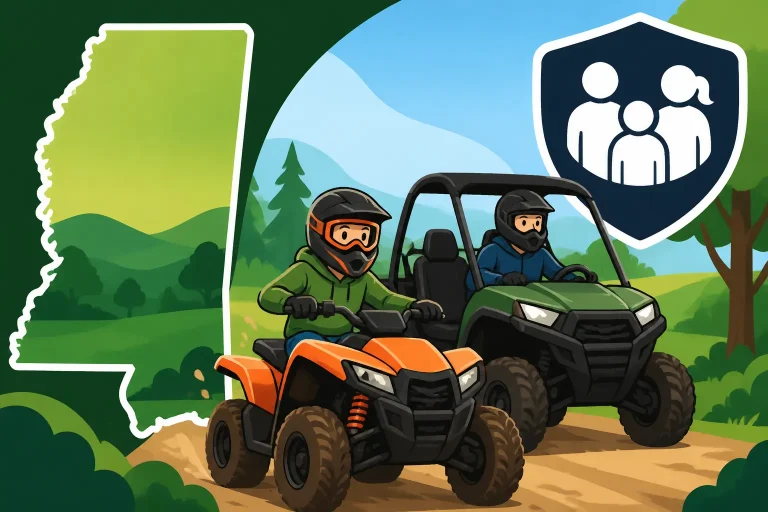
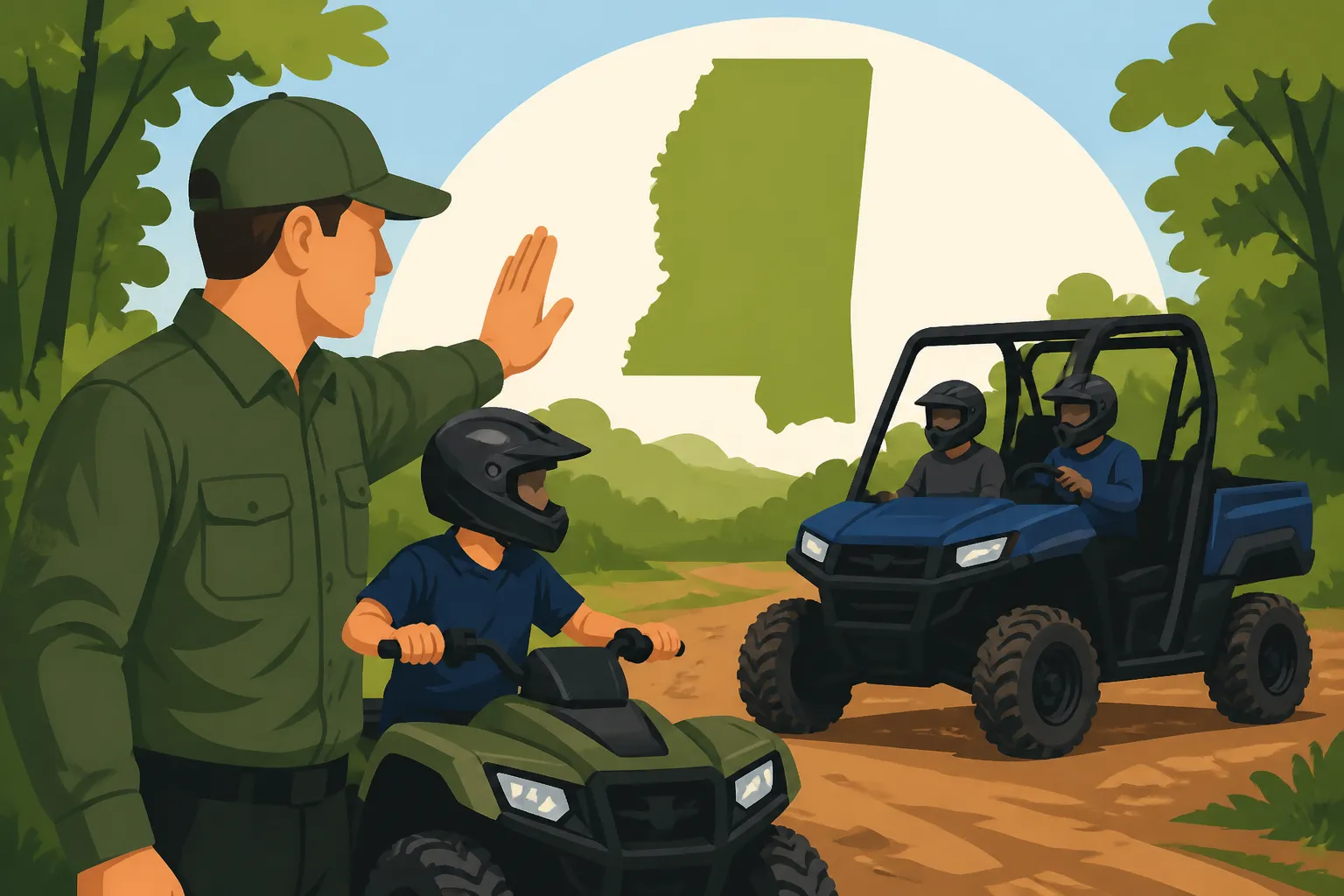
Mississippi’s public-land rules distinguish young riders from adults. Riders under 16 should expect to need adult accompaniment, an appropriate safety credential, and a helmet. The adult’s presence does not replace the young rider’s own requirements: a parent’s driver’s license or safety certificate does not automatically qualify a child to operate a machine.
The word “supervision” can be easy to misread. It should not be treated as permission for a child to ride alone while a parent waits at the parking area or stays at camp. As a practical safety standard, the supervising adult should remain close enough to see the child and respond promptly. Before riding, ask the land manager whether its rule requires an adult to ride alongside the young operator or whether another form of accompaniment is allowed.
For details about age-related rules, see [Mississippi Rules for Riders Under 16] and Mississippi Forest Rules for Riders Under 16. The precise requirements can vary by riding area, so check the rules for the location you plan to visit as well as the state baseline.
A young rider may also need to show a safety certificate. Mississippi recognizes safety credentials for public-land riding, but do not assume every course card from another state or organization will be accepted. Confirm that the specific credential meets the riding area’s requirements. Mississippi Safety Certificates for Young Riders and Driver’s License or Safety Card on Public Land explain why it is important to check the operator’s own paperwork.
Supervision and credentials are separate questions:
- Supervision: Is the rider required to be accompanied by an adult, and how close must that adult stay?
- Qualification: Does the operator have the required license or accepted safety certificate?
- Protective equipment: Does the operator need a helmet or other gear under state or site rules?
- Machine suitability: Is the ATV or UTV designed for the rider and the number of people aboard?
- Access: Is that machine allowed on the land’s designated routes?
Being supervised does not answer whether the machine is suitable or whether the rider is allowed on a particular trail. A child should not operate a machine simply because an adult is present. Choose a machine the child can control, follow the manufacturer’s age and size guidance, and keep the rider off routes or conditions beyond their ability.
Public land is not one rulebook
“Public land” can mean a national forest, a wildlife management area, a state park, or land managed by a county or city. Each can have its own access rules. A state credential or pass does not necessarily grant permission to ride every road or trail, and an adult’s supervision does not override a closed gate, posted restriction, or machine limit.
| Riding area | What to check before taking a young rider |
|---|---|
| National forest | Whether the route is open to OHVs, pass requirements, age and safety-card rules, machine limits, and current closures |
| Wildlife management area | Whether riding is allowed on the specific road, seasonal restrictions, hunting-related rules, and supervision requirements |
| State park | Whether the park allows the machine, required waivers or safety checks, age rules, and passenger restrictions |
| County or city property | Whether riding is permitted at all, any posted conditions, and any local rules that add to state requirements |
| Private riding area | The operator’s age, supervision, helmet, waiver, and machine rules, even if the site is open to the public |
National forests
A forest pass may be necessary for designated OHV routes, but a pass is not a general permit to roam anywhere in the forest. Routes may have machine-width limits, seasonal closures, or other restrictions. A young rider’s credentials and adult accompaniment are separate from the pass and from route access.
Review Mississippi National Forest OHV Passes before traveling, then verify the current route and age rules with the relevant forest office. Conditions and access can change, so a map or pass from an earlier visit is not a guarantee that a route is open today.
Wildlife management areas
A wildlife management area may allow vehicles only on designated roads, and access can be affected by hunting seasons, closures, or other site rules. Do not assume that a road is open to an ATV because it is physically passable or because it appears on a map. Check the specific area’s current rules before unloading.
Mississippi WMA Rules for Riders provides more context. When a child is riding, make sure the adult can keep the group together without blocking other users or entering a closed area.
State parks and local property
State parks can set additional requirements for helmets, waivers, passengers, sound, or equipment. A park may also restrict which machines can enter. County and city property can have different rules again, including a complete prohibition on riding. Check the site’s own instructions rather than relying on another park’s policy.
See [Mississippi State Park ATV Rules] for state park considerations. If staff give you a rule that differs from what you expected, ask which requirement applies to that location before riding. Do not treat a general state rule as a promise of access.
Plan the ride around the child, not just the machine
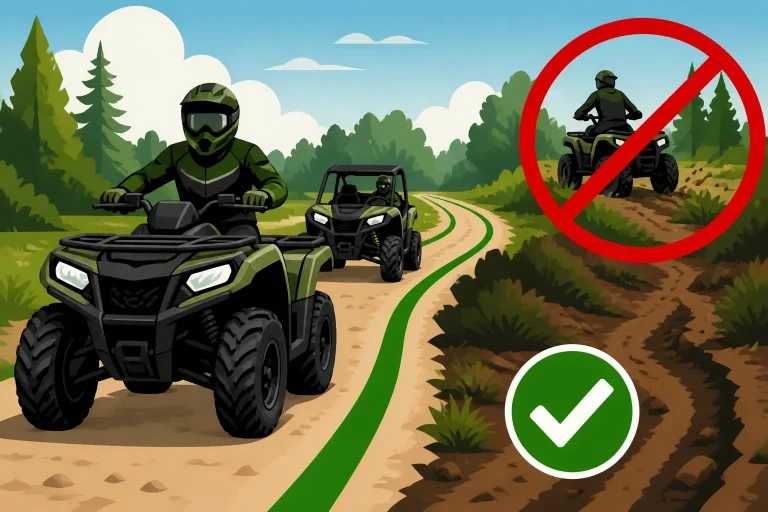
Good supervision is active. The adult should be able to watch the young rider, communicate clearly, and intervene if conditions change. A large group, a fast pace, poor visibility, or a route with deep mud can make that difficult even when the child has the right equipment.
Before leaving, work through this checklist:
- Choose a legal riding area. Confirm that the site allows the machine and that the route is open to its type and size. Check for temporary closures and seasonal restrictions.
- Confirm age and supervision rules. Ask whether the young rider must be accompanied by an adult and whether the adult must ride on a separate machine or stay within a specified distance.
- Check the rider’s credential. Verify what license or safety certificate the operator must carry and whether the site accepts the certificate the child has.
- Bring proof and identification. Keep required documents accessible. If the site asks for proof of ownership, know what it accepts; Mississippi Proof of Ownership on the Trail covers that issue.
- Match the machine to the rider. Follow the manufacturer’s recommendations, confirm the rider can reach and use the controls, and do not add passengers unless the machine is designed for them.
- Set a group plan. Agree on a pace, stopping points, signals, and what to do if anyone becomes separated. The adult should lead or follow in a way that keeps the young rider in view.
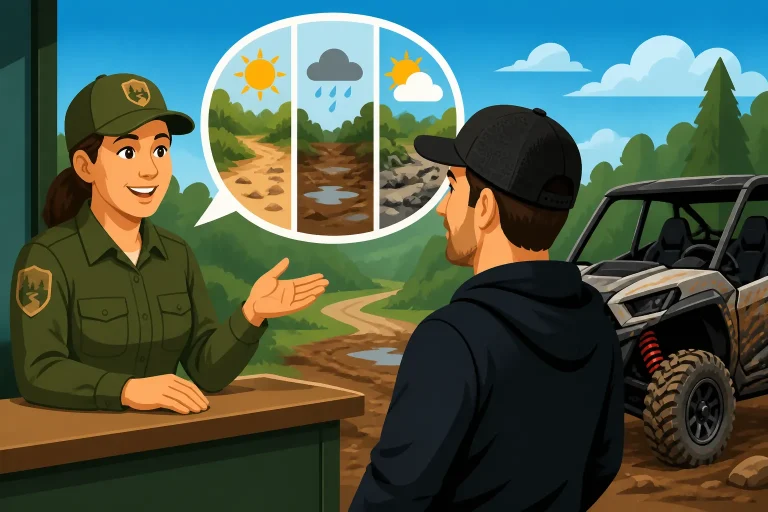
- Recheck conditions at the trailhead. Look for signs, barriers, staff instructions, and weather-related changes. If the route looks different from what you expected, stop and ask.
A child who is learning should ride at a pace that leaves room to react. Avoid letting an experienced adult group pull a young rider into a faster pace, a difficult mud hole, or a route that exceeds the child’s skill. On a UTV, use only manufacturer-provided seating and restraints, and do not assume that a passenger seat makes a child eligible to operate the vehicle.
Plan for fatigue as well as skill. Heat, dust, noise, and long stretches without a comfortable stopping place can affect a young rider’s attention. Build in breaks, carry water, and be ready to turn back. If the supervising adult is riding a separate machine, it may be harder to help with a mechanical problem or an upset child; keep the group small enough to manage safely.
Visiting riders and questions to settle before arrival
A family visiting Mississippi may have a safety card or riding permit from another state. Do not assume that it automatically satisfies Mississippi or a particular land manager. The site may require a specific credential, and a forest pass or local permit may still be needed even when the rider has documentation from home. Ask the land manager what it accepts before making the trip.
This matters especially when an adult assumes the child can ride because they have ridden at home. Riding eligibility can depend on the child’s age, the credential carried, the land type, and the specific route. A visitor should check both Mississippi’s requirements and the rules of the destination. Mississippi Visitors From Alabama, Mississippi Visitors From Louisiana, and Mississippi Visitors From Tennessee address related questions for riders crossing state lines.
When contacting a land manager or park office, be specific. Give the child’s age, the type of machine, whether the child will operate or ride as a passenger, and the route or area you plan to use. Ask:
- Does this location allow a rider of this age to operate an ATV or UTV?
- Must an adult accompany the rider, and what does “accompany” mean here?
- What license or safety certificate must the child carry?
- Are out-of-state certificates accepted?
- Are there rules for helmets, passengers, waivers, or machine dimensions?
- Which routes are open to this machine, and are there temporary closures?
- Does the adult need a separate pass or permit?
Write down the answer and check posted instructions when you arrive. Staff may apply rules specific to that property, and a general answer about public land may not cover every trail or season. If a rule is unclear, pause and ask before riding rather than relying on another visitor’s interpretation.
The simplest approach is to treat supervision as one part of a broader access check: the child needs to be properly accompanied, qualified, equipped, and riding in an area that allows that machine. Confirm those points with the land manager, then keep the adult close enough to make supervision real throughout the ride.
Disclaimer
This article is for general informational purposes only and does not constitute professional advice. Laws, prices and regulations vary by location and change over time. Consult a qualified professional for guidance on your specific situation.