A Course Taught With 4-H Materials
A Mississippi ATV safety course may use 4-H materials, but the curriculum alone does not prove that a rider has completed an accepted course. Before enrolling, check who teaches it, what certificate it provides, and whether the place you plan to ride accepts that certificate. Those checks help families avoid showing up with the wrong paperwork.
What it means when a course uses 4-H materials
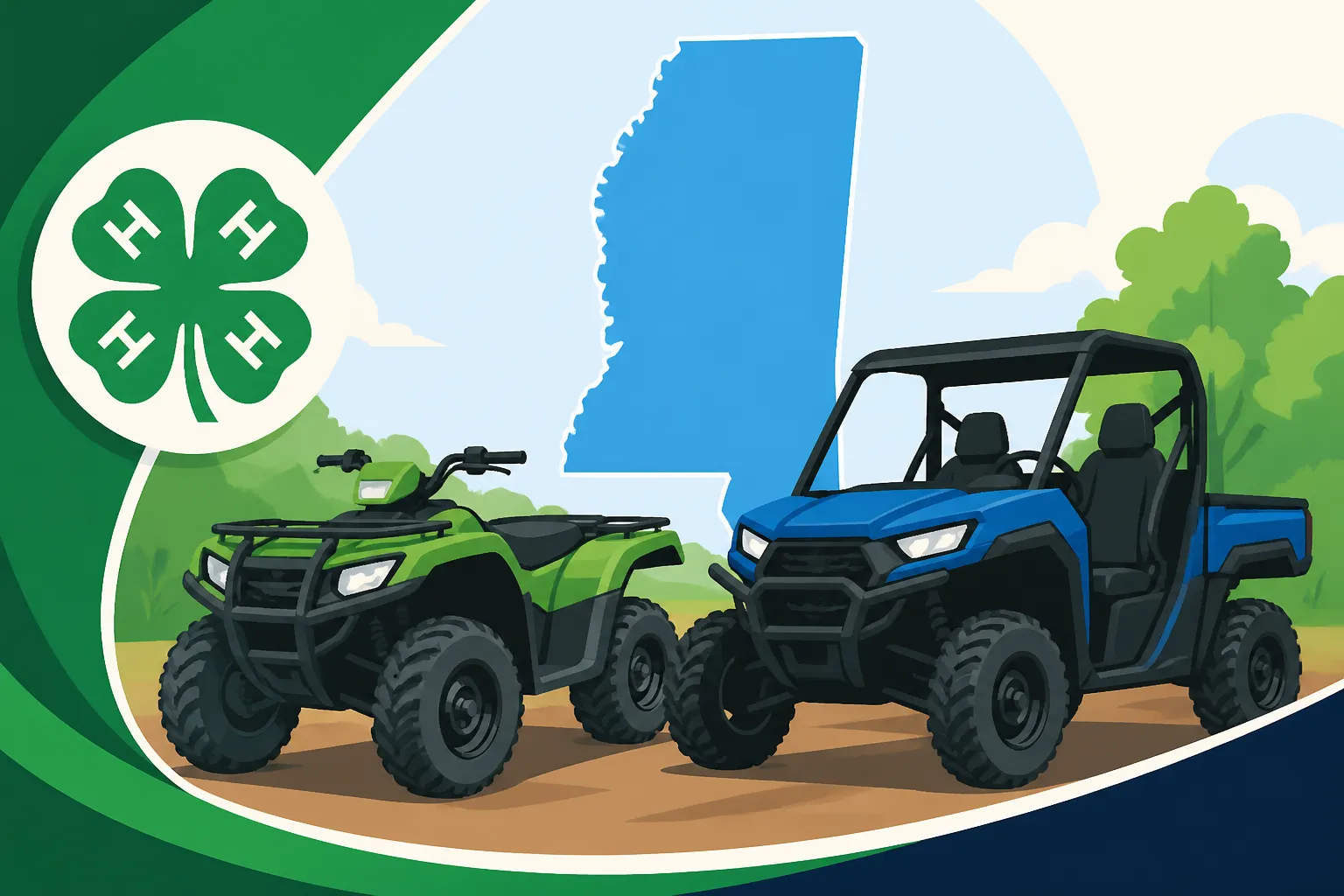
A course taught with 4-H materials uses instructional resources developed for youth safety education. That can help organize lessons on responsible riding, protective equipment, machine operation, and risk awareness. It does not automatically mean the course is run by 4-H, offered through a 4-H club, or recognized for every Mississippi riding requirement.
The distinction is important: the curriculum is not necessarily the credential. A course can use familiar youth-education materials while being taught by a different organization or instructor. Whether a rider receives an accepted safety certificate depends on the course provider, the instructor’s qualifications, the course requirements, and the documentation issued at completion.
For families, the practical question is not simply, “Does the class use 4-H materials?” Ask instead:
- Who is responsible for the course?
- Is the instructor authorized to teach the course being offered?
- Does the course issue a safety certificate or other completion record?
- Is that certificate accepted for the Mississippi requirement or riding area you have in mind?
- What proof should the rider carry?
These questions matter because course attendance and recognized certification are not always the same thing. A classroom talk, club activity, or general safety lesson may be valuable without satisfying a specific rule. Likewise, a course that is accepted for one setting may not replace every requirement at a different park, public-land trail system, or private riding area.
Mississippi’s rules distinguish between the credential a rider may need and the rules of the place where the rider operates a machine. A safety certificate may be relevant to riding on public property, but it does not grant road access or override local land-use rules. For an overview of the broader requirement, see Mississippi Requires a License or a Safety Card. The key is to confirm the exact requirement for the planned ride rather than assuming that one course or card works everywhere.
The phrase “taught with 4-H materials” can also describe the educational approach rather than a formal partnership. A provider may borrow or adapt youth-oriented lessons while administering its own course. That is not necessarily a problem; it simply means the provider’s identity and the certificate’s status need to be checked separately.
Who may need a safety course or certificate
A course can be useful for a new rider even when a particular rule does not require that rider to take it. Training helps make basic safety practices more deliberate, especially for children and teens who are still learning how machine size, speed, terrain, and stopping distance interact.
Mississippi riding requirements can depend on factors such as the rider’s age, the land being used, and the rules of a particular site. Requirements for public land may differ from those on private property. A private park can also set its own entry conditions, including age, supervision, equipment, or proof of training. Check those rules directly before making plans.
For riders under 16, safety training deserves particular attention. The state and individual riding locations may require a safety certificate or impose additional conditions. Do not assume that a parent’s presence, a 4-H activity, or a completed class automatically satisfies the applicable rule. Confirm what documentation the rider must have and whether it must be carried on the ride. More detail on the age-related requirement is available in Mississippi Riders Under 16 Need a Safety Certificate.
A course may also be a helpful option for an adult who does not have the driver’s license or other credential accepted for a specific public-land setting. But the availability of a course does not mean every course is an acceptable substitute. Before enrolling, compare the provider’s course details with the requirement for the destination. Driver’s License or Safety Card on Public Land explains why the distinction matters.
A certificate does not replace other rules. A trained rider still needs to follow requirements for machine access, helmets, passengers, trail width, closures, and landowner permission. For example, a certificate does not make a road legal to ride, and it does not open a trail closed to the machine’s width or type. Check the site’s current rules as well as the statewide requirements.
| Situation | What to check before riding |
|---|---|
| Rider is under 16 | Whether a safety certificate is required, what course is accepted, and what proof the rider must carry |
| Rider is 16 or older | Whether the destination requires a license, certificate, or another form of proof |
| Ride is on public land | The land manager’s current age, training, and access requirements |
| Ride is at a private park | The park’s entry rules, including any course, age, or supervision conditions |
| Course uses 4-H materials | The provider, instructor, certificate issued, and whether that certificate is accepted |
| Rider has completed training elsewhere | Whether the particular certificate is recognized for the planned ride |
This table is a planning aid, not a substitute for checking the official rule or destination policy. A certificate may be useful evidence of training, but acceptance depends on the requirement that applies where the rider will operate the ATV or UTV.
What a course can teach and what it cannot authorize
A well-run safety course should help riders understand how to make safer decisions before and during a ride. Depending on its format, it may cover protective gear, basic controls, pre-ride checks, riding posture, braking, turning, terrain awareness, passenger limits, and what to do when conditions change. A course using 4-H materials may present those topics in a youth-focused way, but families should ask the provider for the actual course outline.
Training is most useful when it connects general safety principles to the machine a rider will use. ATVs and side-by-sides differ in how they are operated, how many riders they are designed to carry, and how they respond to uneven ground. A general lesson does not make every machine suitable for every rider. Match the machine’s size and controls to the rider’s abilities, and follow the manufacturer’s limits.
Practical instruction also has limits. A classroom lesson cannot by itself prepare a rider for every condition, such as deep mud, steep slopes, water crossings, or changing trail surfaces. Riders need to understand when to slow down, turn back, or avoid an obstacle rather than treating a certificate as proof that they can handle any terrain.
Most importantly, a safety course does not grant permission to ride somewhere. It does not:
- Register or title a machine.
- Provide a license plate or make a machine street legal.
- Allow a rider onto closed land or a restricted trail.
- Replace permission from a private landowner.
- Override a park’s age, helmet, passenger, or equipment rules.
- Convert a public road into an approved ATV route.
Mississippi does not generally allow ATVs on public roads simply because a rider has completed training. For the road issue, see Mississippi Bans ATVs on Public Roads. Before a trip, check the destination’s access rules, since training and access are separate questions.
Riders planning to use a forest trail should also confirm whether the site requires a pass, what machines the trail allows, and whether there are additional conditions for young riders. A course certificate is only one part of readiness. Mississippi National Forest OHV Passes and Which Trails the $60 Forest Pass Opens address the separate access questions. Verify current pass details and trail conditions with the land manager before loading the machine.
How to verify the course and its certificate
Before signing up, ask the provider specific questions in writing or by phone. A short confirmation can prevent confusion later, particularly if the course is advertised mainly by its teaching materials rather than by the credential it provides.
- Identify the course provider. Ask which organization is responsible for the class and who handles registration, instruction, and completion records. Do not rely on the name of a curriculum alone.
- Ask what the student receives. Find out whether successful completion results in a certificate, card, or another record. Ask whether the record names the student, course, instructor, or completion date.
- Confirm acceptance. Describe the rider’s age and the place where the family expects to ride. Ask whether that destination or relevant authority accepts this exact course or certificate for its requirement.
- Check how completion is earned. Ask whether students must attend the full course, pass an assessment, complete hands-on instruction, or satisfy other conditions. Do not assume that registering or attending part of a lesson is enough.
- Clarify how proof is provided. Ask whether the student receives a paper certificate, digital record, or both, and how to replace it if it is lost.
- Verify practical arrangements. Confirm the location, schedule, age limits, required equipment, parent or guardian involvement, and any fee directly with the provider.
If the course is offered through a local Extension or youth program, contact the local office or organizer to confirm the next session and the credential issued. Course schedules and delivery can vary, so a listing from a prior season may not reflect current availability. The useful question is not just whether lessons are offered, but whether the particular class meets the need you have.
The Mississippi State University Extension Service is a relevant place to check for local educational offerings, but confirm the details with the office or organizer responsible for the session. The presence of 4-H materials in a class does not, by itself, establish that it is an Extension course or that it issues a state-accepted certificate. For related information on where and how courses may be offered, see Mississippi Safety Courses Through Extension and [Mississippi Extension Office Course Schedules].
If you are uncertain whether a certificate will be accepted, ask the agency or site manager responsible for the requirement before enrolling. Provide the exact course name, provider, and certificate description. A general answer such as “we accept safety courses” may not settle whether this specific class qualifies. Which ATV Safety Courses the State Will Accept is a useful related topic, but confirm the current decision with the appropriate authority.
Keep the response with the student’s records. If you receive confirmation by phone, note the date and the name or office of the person who answered. That record is not a substitute for the certificate, but it helps if a gate attendant or land manager has questions about an unfamiliar course name.
A practical checklist for families
A little preparation makes the course more useful and reduces the chance of a problem at the trailhead. Start by choosing the ride location, not by assuming the same certificate will satisfy every destination. Then confirm the course and the site’s rules together.
Before enrolling, make sure you can answer these questions:
- What is the rider’s age, and are there age-specific rules at the destination?
- Is the intended ride on public land, private property, or at a managed park?
- Does that destination require a safety certificate, a driver’s license, or other proof?
- Is the proposed course recognized for that particular requirement?
- Does the course provider issue proof of successful completion?
- Will the rider need to carry the certificate during the ride?
- Are there separate helmet, passenger, supervision, pass, or machine-access rules?
After the course, check that the student’s name and completion information are correct. Store the certificate somewhere it can be found, and keep a digital copy if the provider allows it. If the student changes their name or the record contains an error, ask the provider how to correct it rather than altering the document yourself.
Before each trip, check the destination again. A course certificate may remain valid as proof of completion, but site rules, trail availability, and access conditions can change. A trail may be closed after weather, restricted during a particular season, or limited to certain machine sizes. Check the official site or contact the manager before traveling.
It also helps to teach the rider that a certificate is a starting point, not a promise of safety. Adults should continue supervising riders as appropriate, match the machine to the rider, and set clear boundaries about speed, terrain, passengers, and stopping. New skills need practice in a controlled setting before a rider takes on unfamiliar trails.
For a broader checklist of papers and practical items riders may need, see Mississippi Proof of Ownership on the Trail. That is separate from training: ownership documents, access passes, and safety certificates serve different purposes. Keep them organized rather than treating one document as a substitute for another.
Frequently Asked Questions
Does using 4-H materials mean a course is officially a 4-H course?
Not necessarily. The materials identify the course content or teaching approach, but the provider and instructor may be a different organization. Ask who administers the class and what completion record it issues.
Does a 4-H-based course automatically satisfy Mississippi’s safety requirement?
Do not assume so. Confirm whether the specific course and certificate are accepted for the rider and the place where they plan to ride. The teaching materials alone do not establish acceptance.
Can a safety certificate let an ATV ride on a public road?
No. Training does not grant road access or make an ATV street legal. Check the road rules separately from course and certificate requirements.
Should the rider carry the certificate?
Ask the relevant land manager or riding-area operator. Some settings may require proof to be available, and carrying the certificate or a permitted copy can help avoid uncertainty at entry.
Where should families ask about local courses?
Contact the organization responsible for the course or the local Extension office if the session is offered through an Extension program. Confirm the schedule, eligibility, instructor, and certificate details directly.
Disclaimer
This article is for general informational purposes only and does not constitute professional advice. Laws, prices and regulations vary by location and change over time. Consult a qualified professional for guidance on your specific situation.