Mississippi Private Park Age Minimums
A child may be old enough to ride at one Mississippi ATV or UTV park and still be turned away at another. Private parks set their own admission and riding policies, and the minimum can depend on the machine, the rider’s role, supervision, and required gear. Check the park’s current rules before loading up so there are no surprises at the gate.
Why private park age minimums differ
There is no single age minimum that automatically applies to every Mississippi private riding park. A privately operated trail system, mud park, motocross facility, or event venue can set its own conditions for entry and riding. Rules may also differ between activities at the same property: a child might be permitted on an adult’s machine as a passenger, for example, but not allowed to operate one.
The operator’s policy is only part of the picture. Applicable laws and safety requirements still matter, and public-land rules should not be confused with a private venue’s admission rules. A park may impose conditions that are stricter than a general legal minimum, or it may require documents and equipment that a visitor did not expect. The details should be confirmed with the park itself.
A useful first step is to identify what you mean by “age minimum.” It might mean:
- The youngest age allowed through the gate.
- The youngest age allowed to ride as a passenger.
- The youngest age allowed to operate a machine.
- A minimum age for a particular class, track, or trail.
- A minimum age to ride without a parent or guardian.
- A minimum age to operate a specific size or type of machine.
Those are separate questions. A park that admits young children may still restrict which machines they can use, where they can ride, or whether an adult must accompany them.
Policies can also change. A park may update its rules for a new season, a special event, a particular trail area, or a change in insurance or operating practices. An old social media post, a friend’s recollection, or a rule from another park is not a reliable substitute for the current policy. For a broader explanation of how private venues handle entry and operating rules, see Mississippi Private Park Waivers and Rules.
What to ask about the rider, machine, and supervision
When asking about age, give the park enough context to answer accurately. “Can my 12-year-old ride?” is often too broad. The answer may depend on whether the child will drive or ride as a passenger, the machine’s design, and the area of the park being used.
Rider versus passenger
Ask separately about operating a machine and riding as a passenger. A park might allow a child to ride with an adult on a machine designed for two people while not allowing the child to drive. Another venue may set a minimum age for passengers or limit passenger riding to machines with factory-installed passenger seating.
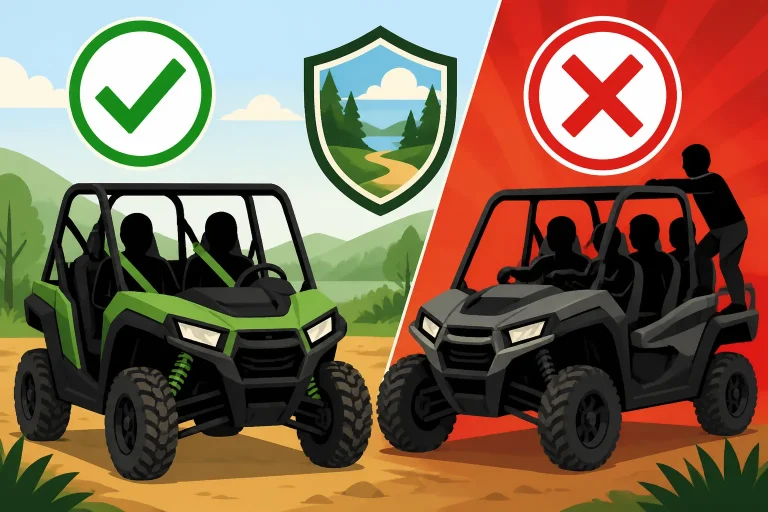
Do not assume that a UTV’s extra seat makes every child an acceptable passenger under the park’s rules. Ask whether the vehicle must be designed for passengers, whether each passenger needs a seat belt, and whether the venue has a minimum age or size requirement. The machine’s owner’s manual and the park’s own policy can both be relevant to safe passenger use.
Never treat a cargo bed, fender, rack, or improvised seat as a passenger position. If a child cannot sit securely in a proper seat and use the machine’s required restraint, do not take them as a passenger. A park’s permission to enter does not make an unsuitable seating arrangement safe.
Machine class and riding area
Some venues may set different conditions for youth machines, full-size ATVs, side-by-sides, motocross tracks, beginner areas, and advanced trails. Ask about the specific machine you intend to bring, not just whether the park “allows kids.” A park might have a separate youth track, restrict young riders from certain trails, or require an adult to remain nearby.
Be ready to describe the machine in practical terms:
- Is it an ATV, dirt bike, or side-by-side?
- Is the child operating it or riding as a passenger?
- Does the machine have one seat or factory passenger seating?
- Is it a youth-sized machine or a full-size model?
- Which area or activity does the family plan to use?
- Will the child ride independently or with an adult nearby?
A short description helps staff distinguish the situation from one involving a different machine or activity. If the venue uses written categories, ask which category applies and whether the restriction is based on age, machine size, rider experience, or a combination.
Parent or guardian supervision
“Adult supervision required” can mean different things. It might mean an adult must be on the property, at the trailhead, within sight, riding alongside, or directly supervising the child. Ask what the park means rather than assuming that dropping a child off with another family meets the requirement.
Also check whether the supervising adult must be the child’s parent or legal guardian, or whether another responsible adult can accompany them. If a grandparent, relative, coach, or family friend is bringing the child, confirm whether the park requires written permission, a signed waiver, or a parent to be present at check-in.
Supervision does not replace the child’s ability to operate safely. A young rider should be able to understand basic instructions, control the machine, stop when asked, and respond to changing trail conditions. If the child is overwhelmed by noise, traffic, mud, speed, or other riders, use a quieter and simpler area or end the ride.
Training and experience
A minimum age is not the same as readiness. A park may permit a child to ride, but the child still needs appropriate practice and judgment for the machine and terrain. Ask whether the park has beginner areas, a youth course, or restrictions on where novice riders can go. If the venue does not provide a suitable learning area, consider whether the child has enough experience for the trails available.
For public-land requirements that may apply outside private venues, see [Mississippi Rules for Riders Under 16] and Mississippi Safety Certificates for Young Riders. Those topics are not a substitute for asking a private park about its own admission and riding policies.
How to confirm the rules before you arrive
A few targeted questions can prevent a wasted trip. Contact the park through a current official channel, such as its own website or phone number, and ask for the policy that applies to your specific rider and machine. If the answer is unclear, ask for the wording in writing or request a link to the current rules.
Use this checklist:
- Give the rider’s age. If the park sets different rules by age group, a precise age helps staff answer.
- Say whether the child will drive or ride as a passenger. Do not treat the two roles as interchangeable.
- Describe the machine. Identify whether it is an ATV, UTV, dirt bike, youth model, or full-size vehicle, and mention the seating arrangement.
- Name the planned area or activity. A youth track and a difficult trail may have different conditions.
- Ask what supervision is required. Confirm whether an adult must be on site, nearby, or riding with the child.
- Ask which documents are needed. Find out who must sign waivers and whether a parent or guardian needs to be present.
- Confirm equipment rules. Ask about helmets, eye protection, seat belts, footwear, and any other required gear.
- Check whether rules differ on event days. A race, group ride, or special program may use different conditions from ordinary open riding.
- Confirm the policy close to the visit. Weather, closures, or an updated operating policy can affect access.
| Situation | What to ask the park |
|---|---|
| Child will operate an ATV | Is the child’s age allowed for this machine and riding area? Are there experience or supervision conditions? |
| Child will ride in a UTV | Are child passengers allowed, and what seat, restraint, or age conditions apply? |
| Child is bringing a youth machine | Is the machine permitted, and is there a designated area or any machine-class restriction? |
| Another adult is bringing the child | Can that adult sign the required forms, or must a parent or guardian attend? |
| Family plans to use multiple areas | Do the age and supervision rules change by track, trail, or activity? |
| The visit is part of an organized event | Are the event rules different from the park’s normal rules? |
If a staff member gives a verbal answer, repeat the details back: the child’s age, the machine, whether the child is driving, and the planned riding area. This helps catch misunderstandings such as an answer that applied only to passengers or only to a beginner track.
When the rules are posted online, read the entire relevant section. A short social post may highlight an age restriction without explaining supervision, equipment, or area limits. Look for separate pages or documents covering youth riding, waivers, admission, machine requirements, and event conditions. If two sources appear to conflict, contact the park and ask which one controls for your planned date.
For public land, designated trails, or other managed areas, check the rules that apply to that specific location rather than assuming a private park’s policy carries over. The requirements for state parks, wildlife management areas, and national forest trails can differ. [Mississippi State Park ATV Rules] and Mississippi WMA Rules for Riders cover different settings from a privately operated park.
Prepare for a child’s first visit
Once the park confirms that the child can attend, plan for the actual ride—not just the check-in. A permitted rider still needs a machine and route that fit their ability. A child who is new to off-road riding generally benefits from starting slowly in a controlled, low-traffic area rather than being taken straight onto a crowded or challenging trail.
Choose a suitable machine and route
Use a machine the child can control comfortably. The child should be able to reach and operate the controls, maintain a stable riding position, and stop reliably. The machine should not be selected solely because the park allows it or because an adult in the family owns it.
Before leaving the staging area, go over basic controls and signals. Agree on how the child will communicate that they want to stop, and explain that they should slow down or stop when conditions change. A route that looks easy to an experienced adult may still be difficult for a young rider if it includes deep mud, steep slopes, loose surfaces, water, or other machines moving quickly.
Keep the first outing short enough that the child can remain attentive. Tiredness, frustration, and overheating can affect judgment and control. Build in breaks and be willing to end the ride early. A child’s willingness to continue is not proof that the conditions remain safe.
Check safety gear and fit
Ask the park what protective gear it requires, and check that each item fits the rider. A helmet that is too loose or shifts during movement is not a good fit. Make sure the child can see and hear instructions while wearing the gear, and that clothing will not snag on controls or moving parts.
For a helmet or other replacement gear, a local riding shop can help with sizing; online retailers such as Amazon may offer additional options, but the family still needs to check that the item fits and meets the park’s requirements. Do not rely on a product description alone when the venue specifies a particular type of equipment.
For a passenger, check the seat and restraint before moving. Explain that the passenger must stay seated and follow the driver’s instructions. If the child cannot use the seat belt or other required restraint properly, do not carry them.
Complete check-in carefully
The adult responsible for the child should read the waiver and the park rules rather than treating the signature as a formality. Confirm who is signing for the child and whether the park requires the parent or guardian to be physically present. Make sure the child understands the key rules too, especially where they may ride, what signals staff use, and when they must stop.
If the venue checks age or identity, bring the requested documents. Do not assume that a phone photograph of a document will be accepted; ask beforehand if the park has a specific check-in process. Keep the park’s contact information available in case the group gets separated or needs help.
A waiver, admission ticket, or staff approval does not guarantee that a particular trail is appropriate for a child. It also does not override posted closures or instructions from park staff. If the park closes an area or redirects riders, follow the current direction.
Common assumptions that cause problems
The most common mistake is treating one park’s age policy as a Mississippi-wide standard. A friend may have taken a child to another venue, but that does not establish the rules at the park you plan to visit. Confirm the policy at the property where you will ride.
Another mistake is asking only whether children are allowed. The answer may be yes, with restrictions on machine type, age, supervision, passenger seating, or riding area. Ask about the exact combination that applies to your family.
It is also easy to assume that a child who is allowed to enter can drive any machine. Admission, passenger eligibility, and operator eligibility are distinct. Likewise, permission to use one trail does not imply permission to use every trail or track.
Do not assume a private park follows the same rules as a Mississippi state park or a public trail system. Public sites may have their own age, helmet, training, or access conditions. Check the relevant rules for the place where the machine will be used. [Mississippi Private Park Helmet Rules] addresses private-park equipment policies, while public-land requirements should be checked separately.
Finally, avoid relying on a waiver to settle an age question. A signed form does not necessarily mean the park will admit a rider who does not meet its current policy. Ask before travelling, especially if the group is driving a long distance or has booked a site, cabin, or event.
Frequently Asked Questions
Is there one age minimum for every private ATV park in Mississippi?
No single minimum necessarily applies to every privately operated venue. Each park may set its own conditions, and rules can differ by machine, activity, rider role, and supervision. Confirm directly with the park.
Can a child ride as a passenger if they are too young to drive?
Possibly, but do not assume so. Ask whether the park allows child passengers and what seating, restraint, age, or supervision conditions apply. The machine must also have a suitable passenger seat.
Does a private park have to use the same age rules as a state park?
Private parks and state parks are different settings and may have different operating rules. Requirements that apply to a public facility do not automatically describe a private venue’s admission policy. Check the rules for the specific location.
Can another adult bring my child?
That depends on the park’s check-in and waiver requirements. Ask whether a parent or guardian must attend, whether another adult may supervise, and what written permission or documents are required.
What should I do if the park’s online information is unclear?
Contact the park and describe the rider’s age, machine, role, and planned riding area. Ask for the current rule in writing or for a link to the policy that applies.
Disclaimer
This article is for general informational purposes only and does not constitute professional advice. Laws, prices and regulations vary by location and change over time. Consult a qualified professional for guidance on your specific situation.