Riding Discouraged in Hunting Season
When hunting season arrives, an ATV ride can put you on the same narrow woods road as hunters heading to a stand—or near land where riding is restricted. In Mississippi, access depends on the specific trail, public-land rules, posted closures, and local conditions. This guide explains why riding may be discouraged, how to check before loading up, and how to plan a safer trip.
Why ATV riding is discouraged during hunting season
Riders and hunters may be using the same access routes
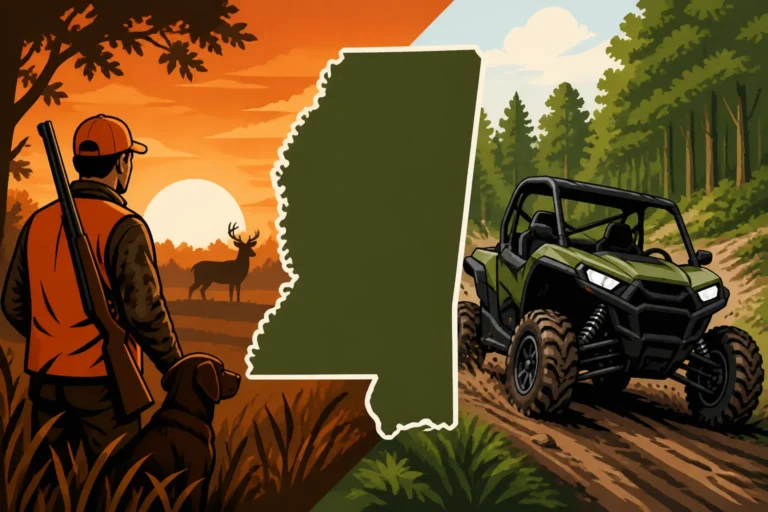
A trail that feels quiet on a summer afternoon can be busy during hunting season. Hunters may walk or drive along forest roads to reach a hunting area, carry equipment, or retrieve game. ATV riders may be traveling through those same woods, sometimes with limited sightlines around bends and through thick vegetation.
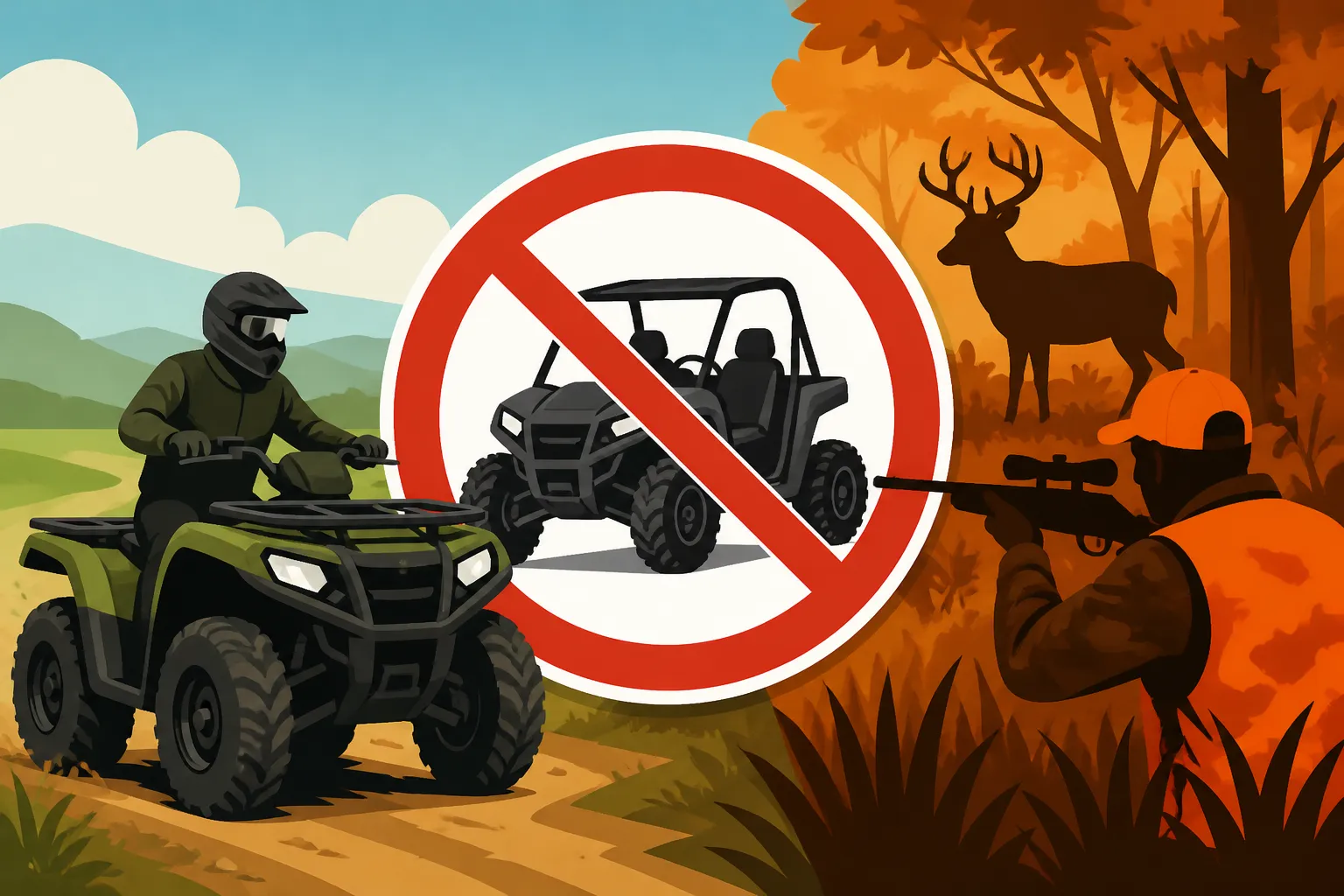
That overlap can create real hazards. An approaching machine may surprise someone on foot, while a hunter may be difficult to see from an ATV—especially in dense pine, hardwood bottoms, or low light. Engine noise can also make it harder for people in the woods to hear another party approaching. Even when a route is legally open, sharing it safely takes extra care.
Some riders choose to avoid popular hunting areas at dawn and dusk, when people are often traveling to or from a hunting spot. Others skip a route entirely if they see parked trucks, hunters, fresh activity, or signs that the area is in use. The right choice depends on the setting, but a ride is rarely worth creating a conflict or putting someone at risk.
A route being open does not mean every nearby area is open to riding
Mississippi has different kinds of riding areas, and their rules are not interchangeable. A designated OHV trail, a national forest road, a wildlife management area road, and a private timber road may each have different access rules. A route that appears on a map may not be open to ATV use, and a road open for some kinds of travel may still be closed to recreational riding.
This distinction matters particularly on public hunting land. On wildlife management areas, riders should not assume they can leave a road or ride a cut-through simply because it looks passable. Check the rules for the specific area and follow signs, gates, and berms. [Mississippi WMA Designated Roads Only] explains why identifying an authorized route matters, while [Mississippi WMA Road Closure Signs] is a useful reminder that a closed road stays closed even if tire tracks are visible.
National forest access also requires care. A forest boundary does not mean all roads and trails are open to ATVs. Look for designated routes and current closure information before riding. For a broader look at where riding is allowed, see [Mississippi National Forest Riding Explained].
“Discouraged” may be a practical warning, not a statewide closure
When people say ATV riding is discouraged during hunting season, they may be describing a local recommendation, a landowner’s request, a seasonal trail condition, or a safety concern—not necessarily a rule that applies everywhere in Mississippi. Conversely, a route that is normally available may have a temporary closure or specific restrictions during a particular period.
Treat the wording as a reason to verify, not as permission to guess. Ask who issued the warning and which trail, road, or property it applies to. A notice from a park manager, forest office, landowner, or wildlife-area authority may have a different scope from an informal comment in a riding group.
This is especially important when hunting dates vary by game, location, and the rules for the area. Rather than relying on a general assumption about when hunting season starts or ends, check the applicable notices and regulations for the land you plan to visit.
How to check whether your planned route is open
Confirm the rules with the agency or property manager
Start by identifying exactly where you intend to ride. “In the national forest” or “near a WMA” is not specific enough to establish that a particular trail is open to ATVs. Find the named trail, road, park, or management area, then check with the agency or manager responsible for it.
For a public riding area, check its official trail information and look for closures, seasonal restrictions, wet-weather notices, or hunting-related advisories. If the details are unclear, contact the relevant office or park staff before you drive out. If riding on private land, get permission from the landowner and ask directly whether access is allowed during hunting season. Permission to enter the property does not automatically mean every road or area is available for riding.
A useful rule is to check twice: once while planning and again before leaving home. Conditions can change after rain, a management decision, or a newly posted closure. [Checking Trail Conditions Before You Load the Trailer] offers a helpful planning habit, and [Mississippi WMA Rules for Riders] can help you think through the separate considerations that apply on wildlife management areas.
Use maps as a planning aid, not proof of access
A digital map can help you understand the area, identify nearby roads, and plan a route. Riders may use tools such as onX Offroad to review mapped routes and organize a ride, but a map should not be treated as confirmation that a trail is open or that you have permission to cross private property. Map information can be incomplete, and access rules can change.
Before relying on any route shown in an app, compare it with official trail or land-management information. Pay attention to property boundaries, posted signs, gates, and the difference between a road and a designated ATV trail. If the map and the sign disagree, follow the sign and confirm the route with the responsible authority.
A paper map or downloaded offline map can also help when cell service is weak. That is useful in wooded areas where a rider may lose a signal, but offline access does not replace checking the latest closures before the trip. Keep a clear turnaround plan in case the route is closed or occupied by hunters.
Check the trail’s specific restrictions and your machine’s fit
Even when a trail is open, the area may limit machine width, vehicle type, or the routes available to different machines. A narrow trail suitable for a small ATV may not be appropriate for a wide side-by-side. Review the specific requirements rather than assuming your machine can follow every trail you see on a map.
For example, the public OHV trail system at Bethel has its own access and trail information. Check details before traveling there, including any width limits or weather-related closures. [Bethel's Width Limit in Mississippi] and [Bethel's Wet Weather Closures in Mississippi] can help you identify two issues worth checking before you load a machine.
| Before the ride | What to verify | Why it matters |
|---|---|---|
| Trail or road status | Whether the specific route is open to your type of machine | A nearby road or trail may have different access rules |
| Hunting-season notice | Whether the manager or landowner has issued a seasonal advisory | A local restriction may apply even when other areas remain open |
| Machine requirements | Width, vehicle type, and any other posted conditions | Your ATV or UTV may not be allowed on every route |
| Recent conditions | Rain closures, washouts, or temporary restrictions | A route that was open earlier may no longer be passable |
| Land access | Whether you have permission to ride where the route crosses private land | A map alone does not grant access |
| Communications | Whether you have an offline map and a way to contact your group | Cell service can be unreliable in wooded areas |
How to ride more safely when hunting activity is nearby
Choose a lower-conflict time and route
If an area is open but hunting activity is likely, consider whether another trail or day would be a better choice. A quieter route away from active hunting areas can reduce the chance of startling someone or interrupting a hunt. When you cannot confirm that a route is appropriate, choose a known, designated riding area instead of exploring side roads.
Avoid assuming that an empty parking area means there are no hunters nearby. People may have parked elsewhere, arrived before daylight, or walked well beyond the road. If you see hunting vehicles, people carrying gear, fresh signs, or a posted notice, slow down and reassess. If the route looks actively used for hunting, turning around is often the simplest and safest decision.
On a group ride, agree in advance that anyone can call for a stop or route change. A larger group can create more noise and take longer to pass a narrow section, so keep the group together and do not split off to explore unconfirmed trails. [Mississippi Group Ride Planning] can help with the logistics of coordinating riders before setting out.
Make your machine and group easier to see
Wear high-visibility clothing and use appropriate protective gear. Mississippi forest cover can make a rider hard to spot from a distance, and dark riding clothes may blend into the surroundings. A visible outer layer is a sensible precaution when people may be hunting nearby. Do not rely on bright clothing to make an unsafe route safe, but use it as one part of a careful plan.
Keep your speed controlled, especially around blind turns, trail intersections, and areas where a road narrows. Give people on foot plenty of space. If you encounter hunters or other trail users, stop at a safe distance, make your presence known calmly, and follow their directions if they ask you to wait or leave. Avoid revving the engine, accelerating past people, or riding close to hunting equipment.
Before riding, make sure your group knows the route, meeting point, and turnaround plan. If a rider gets separated, a prearranged plan is more useful than hoping a phone will work everywhere. Consider carrying a paper map, a charged phone, and basic first-aid supplies. The planning advice in [Mississippi Trail Etiquette Locals Expect] is also relevant when multiple groups share a narrow trail system.
Do not use public roads or private roads as a shortcut
A closed trail can tempt riders to look for another way around, but that does not make a road or property line an acceptable shortcut. Do not ride through a gate, around a closure, across a field, or along a road unless ATV access is allowed there. A route that appears on a map may be private, restricted, or intended for another kind of use.
This matters during hunting season because a “quick detour” can take you into an active hunting area or onto land where you have no permission. If a route is blocked, turn around and use a verified alternative. For public land, check the applicable rules for designated roads and posted closures. For private property, ask the owner before entering, even if there are visible tracks.
If your ride depends on crossing a public road, check the rules rather than assuming that a short crossing or connecting stretch is allowed. [Mississippi ATV Road Rules Under 63-31-3] is a useful starting point for understanding the road-use issue. In general, keep your riding to authorized off-road routes and avoid treating public roads as connectors between trails unless the relevant rules and local conditions allow it.
A practical pre-ride checklist for hunting season
Make a simple go or no-go decision
Before you load your ATV or UTV, answer a few direct questions: Is the exact trail open to my machine? Is there a hunting-season advisory or temporary closure? Do I have permission for every part of the route? Are there signs, gates, or conditions that would require me to turn back? If any answer is unclear, pause and verify rather than relying on assumptions.
A quick call can prevent a long drive to a closed trailhead. It can also help you avoid arriving at a place where hunting activity is underway and your group would be unwelcome. When the rules are confirmed but the area is busy, decide whether you are comfortable sharing the route or would rather ride elsewhere.
Keep your plan flexible. A responsible ride may mean choosing a different trail, shortening the trip, or postponing it until hunting activity has eased. That can feel frustrating after you have arranged a group and loaded a trailer, but it is better than risking a collision, disturbing a hunt, or violating a closure.
Use this checklist before you leave
- Identify the exact trail, road, or property you plan to use.
- Check current official access information and any hunting-season notices.
- Confirm that your ATV or UTV meets the area’s requirements.
- Ask a landowner or manager about access if anything is uncertain.
- Review the route in a map app such as onX Offroad, then verify it against official information and signs.
- Download or carry a map in case cell service is limited.
- Tell your group where you plan to ride and agree on a turnaround point.
- Pack visible clothing, protective gear, water, and basic first-aid supplies.
- Recheck the route before departure for closures or weather-related changes.
- Turn around if you encounter a closure, active hunting activity that makes the route unsafe, or any uncertainty about permission.
The safest approach is not to treat hunting season as a blanket ban or as business as usual. Check the specific rules, respect hunters and landowners, and be ready to choose another route. That way, you can enjoy a Mississippi ride without assuming that every forest road or trail is available just because it is there.
Disclaimer
This article is for general informational purposes only and does not constitute professional advice. Laws, prices and regulations vary by location and change over time. Consult a qualified professional for guidance on your specific situation.