Mississippi Hunting Season and Trail Access
Hunting season can make a familiar Mississippi ride feel different: a road may be busy with hunters, a gate may be closed, or a trail you rode last month may no longer be available. The key is to check who manages the land and what access is allowed that day. This guide explains how to plan an ATV or UTV ride safely and legally during hunting season.
How Hunting Season Changes ATV and UTV Access
Start with the land manager, not the map
A trail’s access rules depend on the land it crosses. Mississippi Wildlife Management Areas, national forests, state parks, private timberland, and private riding parks can all have different rules. A route that looks continuous on a phone map may cross several kinds of property, each with its own restrictions.
On a Wildlife Management Area, do not assume that a road is open to recreational riding just because it is visible or has no gate. Riders generally need to stay on roads specifically designated for vehicle use, and closures or seasonal restrictions may apply. Review [Mississippi WMA Riding Rules](Mississippi WMA Riding Rules) and [Mississippi WMA Designated Roads Only](Mississippi WMA Designated Roads Only) before setting out. A road that is open for one purpose or during one period is not automatically open for recreational riding.
National forest access is a separate matter. A forest may have roads where motorized travel is allowed, alongside signed or gated roads where it is not. Designated OHV trails can also have their own access requirements and closure notices. Check the applicable forest and district information, then read signs at the trailhead. A general forest map—or a line displayed in an app—does not override a closure sign or land-manager rule.
Expect changes around hunting activity
Hunting season can bring more vehicles, hunters on foot, temporary closures, and heavier use of roads that may otherwise be quiet. Conditions can change between visits, so a route that was usable earlier in the season should not be treated as guaranteed access later. Before loading the trailer, check for current notices and ask the relevant office or property manager about the area you intend to ride.
This matters especially on public hunting land, where road access may be limited to particular routes. A gate, berm, posted notice, or closed-road sign is a clear reason to stop and reassess. Do not ride around a barrier or assume it is only intended for cars. For a closer look at permitted routes, review [Mississippi WMA Road Closure Signs](Mississippi WMA Road Closure Signs) and [Which Public Land Trails Are Closed to ATVs](Which Public Land Trails Are Closed to ATVs).
Hunting activity also changes what a considerate ride looks like. Keep noise down near camps and active hunting areas, yield to other road users, and avoid making repeated passes near a spot where people may be hunting. If the road is narrow or visibility is poor, slow down enough to stop safely. A ride can be legal and still create an unnecessary conflict if riders ignore the people sharing the land.
Where You Can Ride During Hunting Season
Wildlife Management Areas
On a WMA, confirm that the particular road is designated for motorized use before riding. Do not interpret a broad reference to “roads” as permission to travel anywhere across the property. Trails, closed roads, footpaths, firebreaks, and access routes may have different rules. If a sign or official map is unclear, contact the area manager or the agency responsible for the WMA before you ride.
Hunting-related access can be narrower still. Rules may distinguish between riding for recreation and using a machine for a specific management or game-retrieval purpose. Those permissions should not be treated as general recreational access. Review [Mississippi WMA Game Retrieval Rules](Mississippi WMA Game Retrieval Rules) if you are hunting, and confirm the current conditions and limits before using an ATV or UTV for that purpose.
Pay attention to gates and signs even when the road appears well used. Some routes may close during particular activities or conditions, and a track made by another vehicle does not prove the route is open to you. If you are riding with a group, brief everyone before the ride: stay on the approved route, stop at barriers, and do not split off to explore unmarked tracks.
National forests, private land, and riding parks
Mississippi’s national forests and other public lands are not interchangeable with WMAs. Each area can have its own designated roads, trail system, pass requirements, and seasonal notices. Before riding, identify the managing forest or district and check its current access information. The guidance in [Mississippi National Forest Riding Explained](Mississippi National Forest Riding Explained) can help you understand why “public land” alone is not enough to determine where an ATV may go.
Private land requires permission from the landowner or an authorized manager. This includes timberland, hunting leases, and private roads that may look like convenient connectors between public routes. A gate being open is not permission to enter, and a route shown on a digital map does not establish public access. If your group has written permission, keep it available and follow any limits on dates, roads, speed, or vehicle type.
Private riding parks can be a practical alternative when public access is limited or hunting activity makes a route unsuitable. Still, check the park’s own rules before traveling. Hours, trail availability, age requirements, machine limits, and weather-related closures can differ from one property to another. The guide to [Mississippi Private Mud Parks](Mississippi Private Mud Parks) offers a starting point for thinking through that option, but confirm details directly with the park before you load up.
| Land type | What to confirm before riding | Common reason to turn back |
|---|---|---|
| Wildlife Management Area | Designated vehicle roads, current notices, and any season-specific restrictions | Closed road, gate, berm, or route not designated for riding |
| National forest | Approved roads or OHV trails, pass requirements, and district closures | Signposted closure or travel outside an authorized route |
| Private land or hunting lease | Permission from the owner or authorized manager and any written conditions | No permission, unclear boundaries, or a posted restriction |
| Private riding park | Operating status, park rules, machine limits, and trail conditions | Closure, unsuitable conditions, or a rule your machine does not meet |
Planning a Safer Hunting-Season Ride
Verify the route in more than one way
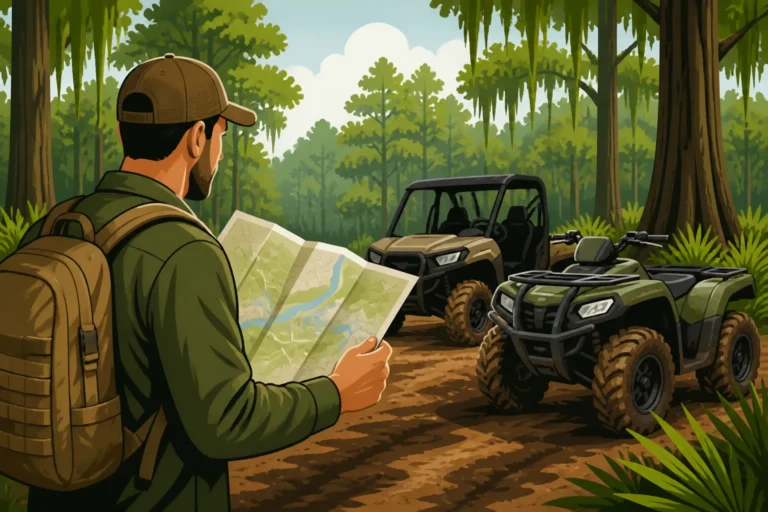
Start by choosing a specific riding area rather than drawing a long route across a large region and hoping every segment is open. Identify the land manager for each section. Then check official access information, call the relevant office or property, and read signs when you arrive. These steps are especially useful in places with multiple forest districts or a patchwork of public and private ownership.
A mapping app such as onX Offroad can help you review roads and terrain while planning, but treat it as a planning aid—not as permission to ride. Compare what you see in the app with official maps, land-manager notices, and signs on the ground. If your route crosses into a different parcel or management area, check that portion separately. onX Offroad may help you spot a boundary or route change on screen, but it cannot determine whether a seasonal restriction has just taken effect.
Save a backup plan before leaving home. If a trailhead is closed, the road is too busy, or a route turns out to be private, you will have another lawful option instead of feeling tempted to ride around a barrier. For forest riding, [Checking Trail Conditions Before You Load the Trailer](Checking Trail Conditions Before You Load the Trailer) is a useful reminder to check conditions before committing to the drive.
Ride with visibility and courtesy in mind
Hunting-season riding calls for a little more care than a casual summer loop. Wear appropriate protective gear, use the machine’s required lighting, and keep a safe speed where sightlines are short. On a forest road, a bend, rise, or stand of trees can hide another vehicle or a person on foot. Give yourself enough room to stop without swerving off the road.
Make your group easy to manage. Agree on a lead rider, a sweep rider, and a regrouping point before starting. Keep enough distance to avoid dust and sudden braking, and make sure nobody is left behind at a junction. If someone wants to explore an unmarked spur, the answer should be to check its status first—not to follow it and sort out the rules later.
If you encounter hunters, slow down and give them space. Do not drive close to a hunting spot to ask questions, and do not assume a person on foot will hear your machine in time to move. If you cannot tell whether a route is being used or restricted, turn around or choose your backup route. Respectful riding protects people, reduces conflict, and helps preserve access for everyone.
Game Retrieval, Closures, and Common Mistakes
Keep retrieval rules separate from recreational riding
A common source of confusion is assuming that a rule allowing machine use for a specific hunting-related purpose means the same route is open for a recreational ride. It may not. Game-retrieval permissions can have particular conditions, such as limits on where a machine may travel or when it may be used. Check the applicable WMA rules and ask the area manager if the wording is unclear.
Do not use retrieval as a reason to cross a closed road, leave an authorized route, or enter land without permission. If you are hunting and expect to use a machine, learn the rules before the hunt rather than waiting until an animal is down. That is a stressful moment to discover that the route is closed or the intended use is not allowed.
Firearm and machine rules also need to be considered together. Do not carry or handle a firearm in a way that violates land rules or creates a hazard for riders and other visitors. Review [Mississippi WMA Weapon Restrictions](Mississippi WMA Weapon Restrictions) and any property-specific conditions before traveling. If the rule is uncertain, get clarification from the managing agency instead of relying on what another rider says.
Avoid assumptions that can end a ride
Several habits cause preventable problems during hunting season:
- Treating an open gate as permission to enter.
- Following a tire track onto an unmarked road or trail.
- Assuming a route is open because it appeared on an app.
- Riding on a WMA road without confirming that it is designated for motorized use.
- Treating game-retrieval access as recreational access.
- Ignoring seasonal notices, temporary closures, or posted signs.
- Crossing private land because it seems to connect two public routes.
If you are stopped or approached by a land manager, ranger, or other authorized official, stay calm and follow instructions. Be ready to explain where you entered and which route you planned to use. Carry identification and any permits or passes that apply to your ride. [Mississippi Proof of Ownership on the Trail](Mississippi Proof of Ownership on the Trail) covers another practical part of being prepared when riding.
A good hunting-season ride is not always the longest ride. It is the one where the group knows which land it is on, follows the route that is actually open, and turns around when the rules or conditions are uncertain. Check the right source, keep a backup destination, and leave room for hunters and other visitors to use the land safely. Those simple habits make it easier to enjoy Mississippi trails without creating problems for yourself or the next rider.
Disclaimer
This article is for general informational purposes only and does not constitute professional advice. Laws, prices and regulations vary by location and change over time. Consult a qualified professional for guidance on your specific situation.