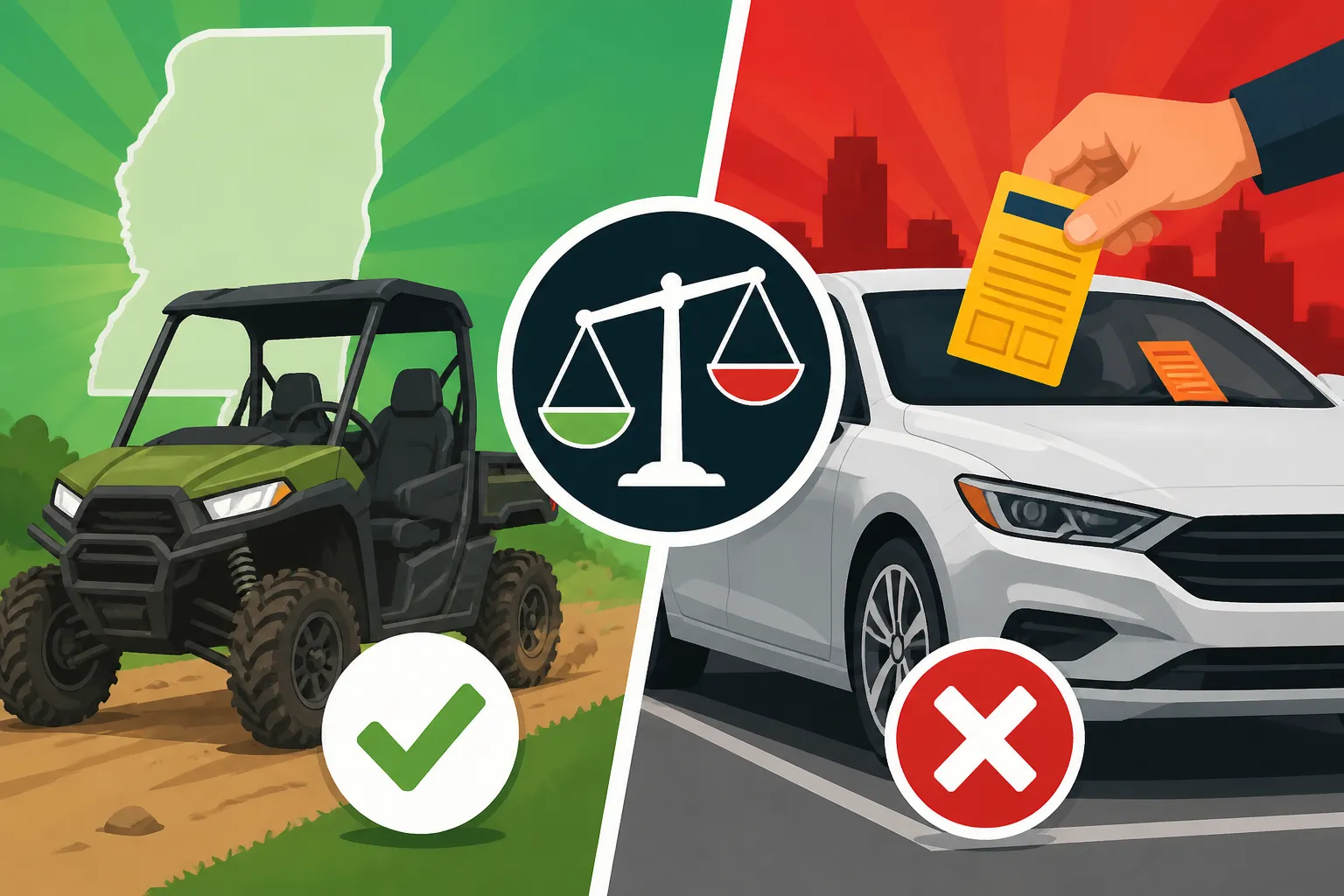
Why the Penalty Costs Less Than a Parking Ticket
It’s a head-scratcher for many ATV and UTV enthusiasts in Mississippi: you hear about the state’s strict ban on riding off-road vehicles on public roads, yet the penalty for getting caught often seems ridiculously low – sometimes even less than a parking ticket. This discrepancy can be incredibly frustrating and confusing, leading riders to question the seriousness of the law. This guide will dive deep into Mississippi's ATV laws, explain why the fine is what it is, and reveal the often-overlooked, far more severe consequences that can hit you harder than a simple ticket.
The Curious Case of Mississippi's $50 ATV Road Riding Fine
Let’s be honest, getting a ticket for anything is never fun, but when you look at the $50 fine for illegally riding an ATV or UTV on a public road in Mississippi, it can feel like a slap on the wrist. Many riders, especially those new to the state or just getting into the sport, might scratch their heads, wondering why such a strict prohibition carries such a seemingly minor financial penalty. Is the state really serious about keeping these machines off the asphalt if the cost is so low?
The simple truth behind [Why Mississippi's Road Riding Fine Stops at $50] lies in the brevity and historical context of Mississippi's off-road vehicle legislation. Unlike many states with extensive chapters dedicated to ATVs, UTVs, and other recreational machines, [Mississippi's ATV Law Is Only Two Sections Long]. These sections are fairly blunt, making it clear that ATVs and other non-highway vehicles are generally not allowed on public roads. However, when it comes to the enforcement mechanism, the penalty outlined is not particularly steep. It's almost as if the initial legislation focused more on the outright ban than on creating a punitive fine structure to deter violations. This often leads to a false sense of security for riders, who might assume the low fine means the act itself isn't a big deal.
This minimal fine, however, can be incredibly misleading. While the state statute for the infraction itself might only carry a $50 penalty, this doesn't account for court costs, administrative fees, or the potential for additional charges, which can quickly inflate the actual cost. Think of it like this: a basic speeding ticket might be $75, but once you add in various fees, it can easily double or triple. The same principle applies here, even if the base fine is small. So, while the number on the initial citation might seem trivial, the final bill from the justice court can be a real surprise, often making that "cheap" ticket much more expensive than anticipated.
What Mississippi Law Actually Says About ATVs on Public Roads
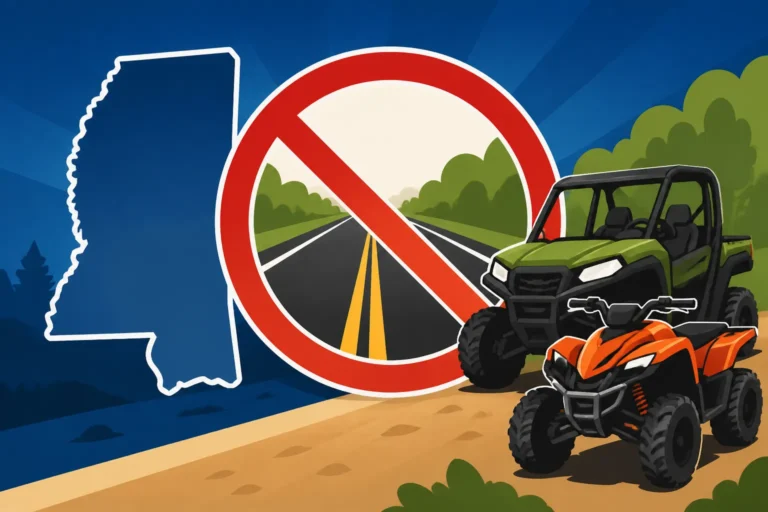
It's crucial to understand that despite the low fine, [Mississippi Bans ATVs on Public Roads] in no uncertain terms. This isn't a gray area where you might find loopholes; the law is quite direct. The relevant statute, [Mississippi Code Section 63-31-3], clearly defines what constitutes an "all-terrain vehicle" or "off-road vehicle" and then explicitly states that these machines are not to be operated on public roads, streets, or highways. This includes everything from the smallest youth quad to the largest side-by-side.
When the law talks about "public roads," it means exactly that: any road maintained by the state, county, or municipality. This includes paved highways, gravel county roads, and city streets. It doesn't matter if it's a quiet country lane with no traffic or a bustling main thoroughfare; the ban applies universally. There's often confusion among riders who think a quick jaunt across a road or a short trip down a less-traveled path is acceptable. Unfortunately, the law makes no such distinctions. Your machine, whether it’s a pure sport quad or a utility UTV equipped for tough jobs with parts from a company like SuperATV, is considered an off-road vehicle and is therefore prohibited from these public ways.
Furthermore, Mississippi's off-road vehicle laws are notably rigid in their lack of exceptions. Unlike some other states that might permit ATVs on certain low-volume roads, for agricultural purposes, or to cross a highway, [Mississippi Has No Farm Road Exception] at the state level. This can be particularly frustrating for farmers or rural residents who might use their machines for work and need to traverse a short distance on a public road to get from one field to another. While some local municipalities might have specific ordinances regarding golf carts or low-speed vehicles, these almost never extend to ATVs and UTVs. This means that if a deputy sees you on a county road, even if you’re just trying to get to another section of your property, you could still face that citation. It really boils down to this: if it's a public road, your ATV shouldn't be on it.
Beyond the Ticket: The Real Costs and Consequences
The $50 fine might seem trivial, but focusing solely on that number is a dangerous mistake that can lead to far more severe, and costly, consequences. The actual dollar amount of the penalty itself is often the least of your worries when you’re caught riding illegally on a public road in Mississippi.
First and foremost, there's the very real risk of your machine being impounded. Imagine this scenario: you're cruising down a county road, perhaps just trying to connect two trails, when [What a Mississippi Deputy Can Ask to See] includes your paperwork and finds you're illegally on the road. A citation is one thing, but if the deputy decides your machine poses a hazard or that you're a repeat offender, they can call for it to be towed. [When an ATV Gets Impounded After a Stop], you're looking at towing fees, daily storage fees at the impound lot, and possibly administrative fees from the law enforcement agency. These costs can quickly skyrocket, easily making that $50 fine look like pocket change. We're talking hundreds, possibly even over a thousand dollars, just to get your machine back. And that’s before you even pay the court fine.
Then there's the truly terrifying prospect of an accident. While [Mississippi Has No Insurance Mandate] for ATVs, riding an uninsured machine on a public road is a recipe for financial disaster. If you cause an accident involving another vehicle, a pedestrian, or even public property (like a mailbox or a road sign), you are personally liable for all damages. This could mean tens of thousands of dollars in property damage, medical bills, lost wages for injured parties, and potential lawsuits. Even if you have comprehensive ATV insurance for off-road riding, many policies explicitly exclude coverage for incidents that occur while illegally operating the machine on a public road. A simple fender bender on the asphalt can quickly turn into a life-altering financial burden, far eclipsing any paltry $50 fine.
Finally, consider the legal implications beyond just a simple ticket. If you are involved in an accident, or if a deputy suspects impaired driving, you could face much more serious charges. [Mississippi DUI Law and Off-Road Machines] applies to ATVs and UTVs just as it does to cars. Operating under the influence can lead to hefty fines, loss of your driver's license (yes, even if you were on an ATV!), jail time, and a criminal record. Additionally, repeated offenses for illegal road riding could lead to more severe penalties from the court, including higher fines, community service, or even confiscation of your machine in extreme cases. The perceived leniency of the initial $50 fine should never overshadow the very real, very expensive, and very stressful downstream consequences that can completely derail your riding fun and your financial stability.
Making Sense of the Disparity: Comparing Fines in the Magnolia State
It’s truly perplexing for many riders to see the flat ban on ATVs on public roads juxtaposed with such a minimal initial fine. To put it in perspective, let’s compare the basic [Mississippi Penalties for an Illegal Road Ride] to some other common infractions you might encounter in the state.
| Offense | Typical Base Fine Range (Mississippi) | Potential Additional Costs/Consequences |
|---|---|---|
| Illegal ATV/UTV on Public Road | $50 | Towing, impound fees, liability for accidents, court costs, increased insurance premiums (if applicable), DUI charges if impaired |
| Parking in a No Parking Zone | $25 – $75 | Towing, impound fees (less common for cars than ATVs) |
| Speeding (minor infraction) | $75 – $150 | Court costs, points on license, increased car insurance premiums |
| Running a Stop Sign/Red Light | $100 – $200 | Court costs, points on license, increased car insurance premiums, accident liability |
| Littering | $100 – $250 | Court costs, community service |
| Driving Without Proof of Insurance (Car) | $300 – $1,000+ | Impoundment, license suspension, SR-22 requirements |
As you can see from the table, the base fine for illegally operating an ATV on a public road is often on par with, or even less than, a standard parking ticket, and significantly less than many other minor traffic infractions for street-legal vehicles. This disparity can certainly send mixed signals to riders. It makes it seem like the state isn't particularly concerned with the act itself, merely going through the motions with a symbolic penalty.
However, this table starkly highlights why it's a mistake to focus solely on that base fine. The "potential additional costs/consequences" column tells the real story. For an ATV rider on a public road, the risk of impoundment is high, and the financial liability for an accident is catastrophic, especially given the lack of a mandatory insurance requirement. A car driver caught speeding might get a higher fine and points on their license, but their vehicle typically won't be immediately impounded for a first offense, and their mandatory liability insurance will cover damages in an accident. An ATV rider, however, faces immediate and substantial secondary costs that often dwarf the initial citation amount.
Ultimately, the message this sends to riders is not that it's "okay" to ride on the road because the fine is low. Instead, it's a stark reminder that the state's legislative framework for ATVs on roads is simple and direct, but the real-world enforcement and risk assessment are far more complex and severe. The low initial fine is a red herring. The underlying risk of property damage, personal injury, impoundment, and legal entanglement is immense, making that small fine utterly insignificant in the grand scheme of what could happen. Don't let the small number on a potential ticket fool you into thinking the consequences aren't serious.
Disclaimer
This article is for general informational purposes only and does not constitute professional advice. Laws, prices and regulations vary by location and change over time. Consult a qualified professional for guidance on your specific situation.