Mississippi ATV Road Rules Under 63-31-3
It's a common dream for many ATV and UTV owners in Mississippi: the freedom to ride your machine from your driveway down to the local store, or to connect two favorite trails with a quick hop on a county road. However, the reality in the Magnolia State often clashes with this desire, leaving many riders confused and frustrated by strict regulations. This comprehensive guide will meticulously break down Mississippi's ATV road rules, with a specific focus on what state law 63-31-3 actually means for you and your off-road machine.
The Core of Mississippi's ATV Road Ban: Understanding Code Section 63-31-3
Let's face it, Mississippi has a reputation for being a haven for outdoor enthusiasts, and ATVs and UTVs are a huge part of that culture. So, it can be incredibly disheartening to discover that the state law regarding these machines on public roads is surprisingly strict and, to many, quite limiting. The foundation of this limitation rests squarely on Mississippi Code Section 63-31-3.
What the Law Actually Says (and Doesn't)
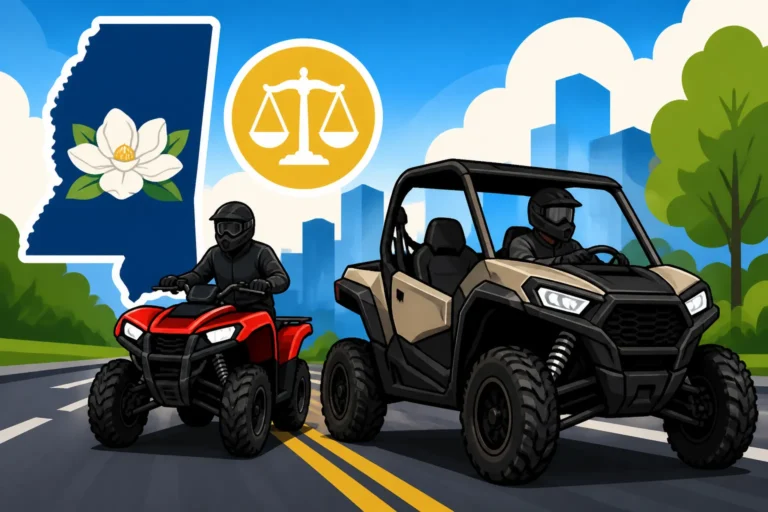
Mississippi Code Section 63-31-3, which you might hear referred to simply as "the ATV law" or "the off-road vehicle statute," is remarkably direct and, unfortunately for many riders, quite unforgiving. In essence, it unequivocally states that all-terrain vehicles and off-road vehicles are prohibited from operating on any public street, road, or highway in the state of Mississippi. There's no gray area here, no implied exceptions, and no subtle phrasing to dissect. The ban is clear and absolute at the state level.
This means that if you're riding your quad or side-by-side on anything that the state defines as a public road – be it a bustling highway, a quiet paved county road, or even a maintained gravel road – you are in violation of state law. Many riders assume there are unwritten rules or common-sense exceptions, but the statute itself offers none. It doesn't differentiate between crossing a road, riding for a short distance, or cruising for miles; the prohibition applies uniformly. This can be a tough pill to swallow, especially when you see riders in other states enjoying more freedom on their machines. The simplicity of [Mississippi Law Flatly Bars ATVs From Public Roads] often catches people off guard.
Why This Law Exists: Safety and Infrastructure Concerns
While the ban might feel restrictive, it's rooted in specific concerns that state legislators have had over the years. Primarily, these concerns revolve around public safety and the integrity of road infrastructure. ATVs and UTVs are designed for off-road environments. They typically lack many of the safety features mandated for on-road vehicles, such as turn signals, rearview mirrors, DOT-approved tires, and robust suspension systems designed for sustained high-speed pavement use. When these machines interact with cars and trucks, the risk of severe accidents increases dramatically due to speed differentials and the lack of protective enclosures for ATV riders.
Furthermore, the aggressive tread patterns of many off-road tires, while excellent for traction on dirt and mud, can cause accelerated wear and tear on paved road surfaces. The weight distribution and suspension of ATVs and UTVs are also not optimized for road handling, making them more prone to rollovers or instability at road speeds, especially in emergency maneuvers. It’s about more than just a quick ride; it’s about the broader implications for everyone sharing the road and the long-term maintenance of the public highway system. These considerations led to the clear, unambiguous wording you find in [Mississippi Code Section 63-31-3].
Distinguishing ATVs, UTVs, and Other Off-Road Vehicles in Mississippi Law
Understanding the state's stance on road use first requires knowing how Mississippi actually defines the machines we're talking about. The terms "ATV," "UTV," "side-by-side," and "off-road vehicle" are often used interchangeably in casual conversation, but the law draws important distinctions.
Mississippi ATV and ROV Legal Definitions
The state of Mississippi specifically defines "All-Terrain Vehicles" (ATVs) and "Recreational Off-Highway Vehicles" (ROVs), which is the legal term for what most of us call UTVs or side-by-sides. These definitions are crucial because they dictate which vehicles fall under the umbrella of Code Section 63-31-3's road ban. Generally, an ATV is described as a motorized, off-highway vehicle designed to travel on four or more low-pressure tires, having a seat designed to be straddled by the operator, and handlebars for steering control. These are typically single-rider or two-rider machines where you sit astride the engine.
ROVs, or UTVs, are distinct. They are often defined as motorized off-highway vehicles designed to travel on four or more tires, with a steering wheel for steering control, foot pedals for acceleration and braking, and nonstraddle seating for the operator and passengers. This clearly encompasses the popular side-by-side machines that resemble small cars. Both types of vehicles, despite their differences in seating and controls, are explicitly categorized as off-highway vehicles and are subject to the same road use restrictions under state law. It's important to know [What the Law Counts as an Off-Road Vehicle] to avoid any misconceptions.
The Difference Between Off-Road Vehicles and Street-Legal Carts
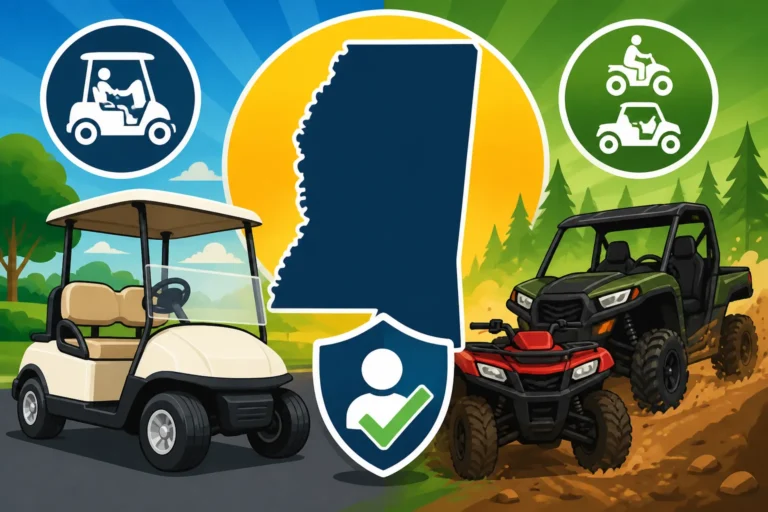
Here's where a lot of confusion comes into play. Many riders see golf carts and Low-Speed Vehicles (LSVs) cruising on neighborhood streets and assume their ATV or UTV should also be allowed. However, Mississippi law treats these categories very differently. Golf carts, while not inherently street-legal statewide, are often granted road access through specific local ordinances. These ordinances usually come with strict conditions regarding speed, specific road types (typically those with speed limits under 30 or 35 mph), and required safety equipment.
Low-Speed Vehicles (LSVs), on the other hand, are a separate class entirely. They are purpose-built for street use, have a top speed typically between 20 and 25 mph, and come equipped from the factory with DOT-approved tires, seat belts, headlights, taillights, turn signals, mirrors, and a VIN that allows them to be registered just like a car. Because LSVs meet specific federal and state safety standards, they can be legally registered and driven on public roads (usually those posted 35 mph or less) without needing special local permission, though local ordinances can still restrict them. Your ATV or UTV, even with aftermarket modifications, does not inherently meet the criteria for an LSV and cannot be registered as such in Mississippi. For more on these distinctions, check out [Mississippi Golf Cart and LSV Ordinances].
The Reality of Riding on Public Roads: Consequences and Penalties
So, what happens if you decide to disregard the state law and take your ATV or UTV onto a Mississippi public road? It's not just a theoretical prohibition; there are real, immediate consequences that can quickly turn a casual ride into a costly headache.
What Happens When a Deputy Stops You Riding
If a law enforcement officer, be it a state trooper, county deputy, or city police officer, spots you operating your ATV or UTV on a public road in Mississippi, you're likely going to be stopped. The first step will typically be an investigation to determine if you are indeed in violation of Code Section 63-31-3. Depending on the officer's discretion, your riding history, and the specific circumstances (e.g., speed, reckless operation, whether you're causing a disturbance), you could face a warning, but it's much more common to receive a citation.
A citation means a fine, and potentially court costs. Beyond the immediate financial hit, the officer may also require you to cease operation immediately. This could mean you have to arrange for someone to trailer your machine home from the roadside, or in some cases, the vehicle could even be impounded. Dealing with an impound lot is a significant hassle, involving towing fees, storage fees, and administrative charges, all before you even pay your fine. It's an inconvenient and expensive lesson that underscores the seriousness of the state's ban. For a deeper dive into the legal repercussions, read [Mississippi Penalties for an Illegal Road Ride].
Why the Fine Might Seem Small (But the Impact Isn't)
It's true that the statutory fine for violating Mississippi's ATV road ban often appears relatively low compared to, say, a speeding ticket or other moving violations. Some riders might even shrug it off, thinking it's a small price to pay for a convenient shortcut. However, this perspective overlooks the broader, often more significant, impacts that a citation can have. First, a record of this violation goes into the legal system. While it typically won't affect your driving record like a car-related traffic ticket, it is still a legal infraction that could be considered in future interactions with law enforcement.
More importantly, repeated offenses can lead to escalating penalties, stricter enforcement, and even the impoundment of your machine for longer periods. Think about the costs beyond the fine: potential towing fees, daily storage charges at an impound lot, and the time lost dealing with court appearances and vehicle retrieval. Furthermore, if you're involved in an accident while illegally operating your ATV on a public road, your insurance coverage might be completely voided, leaving you personally liable for damages, injuries, and legal fees. Even if you have comprehensive coverage on your machine, it's typically for off-road use, and using it on a prohibited public road changes the game entirely.
Avoiding Trespass and Other Charges on Private Land
Given the strict road ban, many riders choose to stick to private property. However, it's absolutely critical to understand that even on private land, you cannot just ride anywhere you please. The law regarding trespass in Mississippi is clear: you must have explicit permission from the landowner to ride on their property. This permission should ideally be in writing, especially if you're riding regularly or on large tracts of land. Ignoring this can lead to charges of trespassing, which can carry fines and potentially other legal consequences.
Furthermore, if you are riding on private land that is connected to, or near, a public road, you must ensure that your entry and exit points are entirely on private property and that you do not utilize any part of the public right-of-way for access or egress. Riding along ditches or shoulders that are part of the public road system, even just to get to a private trail, is still a violation of the state's road ban. Always know exactly where property lines lie, and always err on the side of caution. Carrying written permission can save a lot of headaches if questions arise. For more on property rights, see [Mississippi Trespass Law for Riders].
Local Ordinances: The Only Glimmer of Hope for Street Access
While state law 63-31-3 is undeniably restrictive, it's not the absolute end of the story for potential ATV/UTV road access in Mississippi. There's a vital caveat: local municipalities have the power to create their own ordinances.
How Local Ordinances Can (Sometimes) Create Exceptions
This is the key point for anyone hoping to ride their ATV or UTV on public roads in Mississippi: only a local city or county ordinance can grant you that privilege. The state law sets a baseline prohibition, but it typically allows local jurisdictions to adopt more specific rules for their own roads. This means that while you can't rely on a statewide "farm use" exception, your local town or county might have passed a specific ordinance that permits the use of certain off-road vehicles on certain roads under specific conditions.
These ordinances are not universal; they are hyper-local. What's allowed in Hattiesburg might be strictly prohibited in Meridian, and vice-versa. The power to create these exceptions lies with the local board of aldermen, city council, or county board of supervisors. They are responding to the unique needs and desires of their communities. If you've heard whispers of ATVs being ridden legally on roads somewhere in Mississippi, it's almost certainly due to one of these specific local ordinances, not a loophole in state law.
The Catch: Highly Specific Rules and Limited Scope
Even when a local ordinance does exist, it's crucial to understand that these are rarely blanket permissions. In fact, they almost always come with a laundry list of restrictions. Common limitations include:
- Designated Streets Only: The ordinance might only apply to streets with a certain speed limit (e.g., 30 mph or less), or only to residential streets, explicitly excluding major thoroughfares or state highways passing through town.
- Specific Hours of Operation: Some ordinances might limit riding to daylight hours.
- Equipment Requirements: You might be required to have mirrors, turn signals, brake lights, a horn, and even a slow-moving vehicle sign, even if your ATV didn't come with them from the factory. Companies like SuperATV offer a huge range of aftermarket accessories, from mirrors to signal kits, that could help meet these requirements, but remember, installing them doesn't automatically make your machine street-legal without a valid local ordinance.
- Vehicle Type Restrictions: Many ordinances that allow "carts" or "recreational vehicles" are actually written with golf carts or LSVs in mind, and explicitly exclude traditional ATVs or even larger side-by-sides. [Hattiesburg's Cart Ordinance in Mississippi] is a good example of how specific these can be.
- Permit Requirements: You might need to obtain a special local permit, often involving a fee and an inspection of your machine.
The key takeaway is that you cannot assume. Just because your neighbor says "it's fine" or you saw someone else do it, doesn't mean it's legal. These ordinances are often very narrowly tailored, and deviating from their specific rules can quickly put you back in violation of the law.
Finding and Understanding Your Local Rules
So, how do you find out if your specific city or county has an ordinance that might allow for limited ATV/UTV road use? The absolute best approach is to contact your local government directly. Don't rely on internet forums or anecdotal evidence. Here's how:
- City Residents: Call or visit your city clerk's office or the municipal police department. Ask specifically about ordinances related to "off-road vehicles," "ATVs," "UTVs," "side-by-sides," or "recreational vehicles" on public streets. Be prepared for them to say no, or to point you to a golf cart ordinance that doesn't cover your machine.
- County Residents (Unincorporated Areas): Contact your county administrator's office or the county sheriff's department. County ordinances are less common for ATVs/UTVs than city ordinances, but it's always worth checking.
- Read the Actual Ordinance: If they confirm an ordinance exists, request a copy of the actual text. Don't just take a verbal summary. Read it thoroughly yourself to understand every single requirement and restriction.
Ignoring this step is one of the biggest mistakes riders make. Ignorance of the law is not a valid defense if you're cited. Taking the time to do your due diligence and understand [Mississippi Ordinance Lookups Before You Ride] can save you significant trouble and expense down the road.
"Exceptions" That Don't Exist in Mississippi State Law
One of the most persistent sources of confusion and misinformation regarding ATV and UTV road use in Mississippi comes from common assumptions about "exceptions" that simply do not exist in state law. It's critical to debunk these myths to avoid legal trouble.
The Myth of the "Farm Use" or "Timber Use" Exemption
This is arguably the most widespread misconception among Mississippi ATV and UTV owners. Many riders believe that if they are using their machine for legitimate agricultural purposes, such as checking fences, hauling feed, or tending to livestock, or for timber operations, that it automatically grants them the right to ride on public roads. Unfortunately, Mississippi state law 63-31-3 makes no such farm or timber use exception for ATVs and UTVs on public roads.
While it's true that in some other states, certain types of farm equipment or vehicles used exclusively for agricultural purposes may have limited road access, that is simply not the case under current Mississippi statutes for off-road vehicles. If you're riding your utility quad from one field to another, even if those fields are on your own property, and you cross or drive on a public road to do so, you are in violation of state law. The function or purpose of your ride does not supersede the prohibition on public thoroughfares. It's a hard truth, but [Mississippi Has No Farm Road Exception] is a reality you must face.
Crossing Roads and Short Distances: Still Illegal
Another common assumption is that "just crossing" a road, or riding for "just a short distance" on the shoulder to get to another trail or private property, is somehow permissible. The state law, however, does not differentiate. The act of operating an ATV or UTV on a public road, even for a few feet, is considered a violation. There's no minimum distance or time limit specified in the statute that would make such brief incursions legal.
Law enforcement officers, while they may exercise discretion in some circumstances (e.g., if you're genuinely just pulling across a very low-traffic road with no alternative), are fully within their rights to issue a citation for any public road operation. Relying on an officer's potential leniency is a gamble that could easily backfire. To be entirely compliant with state law, any movement that involves a public road, no matter how brief, should be avoided unless a very specific and explicit local ordinance permits it.
Unpaved Roads and Dirt Roads Aren't Exempt Either
Some riders mistakenly believe that the ban only applies to paved roads or state highways, and that gravel roads, dirt roads, or unimproved county roads are fair game. This is another critical misunderstanding. When the law refers to "any public street, road, or highway," it generally encompasses any public right-of-way that is maintained by the state, county, or municipality for public travel, regardless of its surface material.
So, that beautiful gravel road leading through the woods, or the dirt road connecting two rural communities, is still considered a public road if it's maintained by a government entity. Your ATV or UTV is just as illegal on those surfaces as it would be on a bustling interstate. The type of terrain your machine is designed for does not grant it legal access to public thoroughfares that are unpaved. The only exceptions for riding off-road vehicles on specific unpaved paths would be within designated trail systems, such as those found in national forests (like [Mississippi WMA Designated Roads Only]), or on private land with permission.
Equipment, Licensing, and Safety on Public Land (When Permitted)
Even if you find a rare local ordinance allowing limited road use, or if you're riding on designated public trails, there are still crucial rules regarding licensing, safety equipment, and the inherent limitations of ATV/UTV design.
Driver's License or Safety Card Requirements
While a standard driver's license doesn't grant you permission to ride an ATV on a public road in Mississippi, it is often a requirement for operating an ATV or UTV on any public land, including designated trail systems or areas where local ordinances permit limited road access. For riders under a certain age (typically 16), a valid ATV safety certificate, obtained through an approved safety course, is usually required in lieu of a driver's license when operating on public property.
This means even when you're doing everything right and riding where you're allowed, you still need to be able to prove your competency or authorization to operate the machine. It's not just about the vehicle; it's about the operator. Always carry your driver's license or safety certificate with you when you ride on any public land or in areas with local permissions. For details on who needs what, see [Mississippi Requires a License or a Safety Card].
Helmet Laws for Young Riders
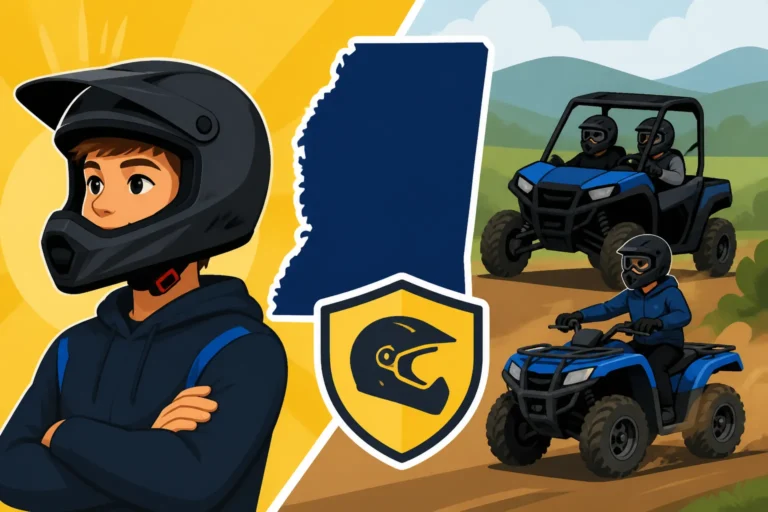
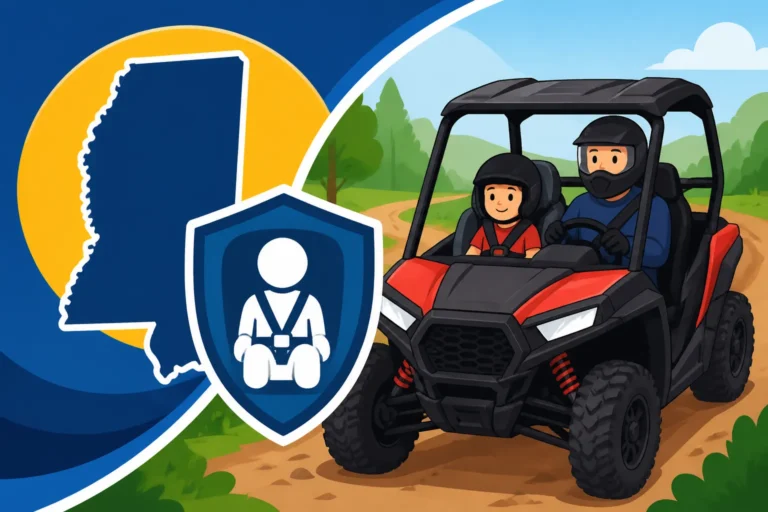
Mississippi has specific laws regarding helmet use for younger ATV and UTV riders, and these laws apply regardless of where you are riding – private property, designated trails, or even under a rare local ordinance. Specifically, all riders and passengers under the age of 16 are required to wear a DOT-approved helmet when operating or riding as a passenger on an ATV or UTV. This is a critical safety measure designed to protect children and young teens from serious head injuries in the event of an accident.
Parents and guardians are responsible for ensuring that young riders comply with this law. Failure to do so can result in citations and, more importantly, put a child at unnecessary risk. Even if your 15-year-old is just cruising around your own property, they still need to be wearing a helmet. This is non-negotiable and a fundamental safety standard in the state. Don't compromise on this one. For specifics, consult [Mississippi ATV Helmet Law Age].
Why Standard ATV Equipment Falls Short for Road Use
The fundamental design of an ATV or UTV is optimized for off-road performance, not for sharing asphalt with cars and trucks. This means standard off-road machines inherently lack the safety and signaling equipment that is legally required for highway vehicles. Here's why they fall short:
- No DOT-Approved Tires: ATV tires are designed for traction in dirt, mud, and rocks, not for sustained speeds on pavement. They often have aggressive treads and soft compounds that wear quickly and can handle poorly on hard surfaces, especially in wet conditions.
- Lack of Turn Signals, Mirrors, and Horn: Most ATVs come with basic headlights and taillights, but they generally lack turn signals, rearview mirrors, and a proper horn – all essential for safe and legal operation on public roads. While aftermarket kits exist to add these components, such as those from SuperATV, simply installing them does not magically make your machine street-legal in Mississippi.
- Limited Suspension and Braking: The suspension systems on ATVs and UTVs are typically set up for rough terrain and lower speeds. They may not handle potholes, quick stops, or evasive maneuvers on pavement as effectively as a street-legal vehicle, leading to instability or longer stopping distances.
- No Enclosed Occupant Protection: Unlike cars or trucks, ATVs offer minimal protection in a collision. UTVs offer some roll-over protection, but they are still far less robust than a standard vehicle.
Even if you install every available aftermarket street-legal conversion kit – adding turn signals, mirrors, a horn, and even a windshield – these modifications do not override Mississippi's state law prohibition on ATVs and UTVs on public roads. They might make your machine safer for off-road use or meet requirements in other states where road legality is permitted, but they do not confer legality on Mississippi's public roads under current state statute.
Future Outlook and Advocacy for ATV Road Access
Given the current strict regulations, many riders understandably feel frustrated and wonder if things will ever change. While immediate change isn't on the horizon, understanding past efforts and how to advocate can provide a path forward.
Past Legislative Efforts and Why They Failed
It's not for lack of trying that Mississippi's ATV road laws remain so strict. Over the years, there have been various attempts by state legislators to introduce bills that would grant more road access to ATVs and UTVs, particularly for specific uses like agriculture or connecting trails. These bills often aim to mirror laws in neighboring states, which tend to be more lenient.
However, many of these proposed bills encounter significant hurdles and often die in committee. The reasons for their failure are varied but often include concerns from law enforcement agencies about public safety, resistance from highway departments concerned about road wear and maintenance costs, and sometimes a lack of strong, unified political will. Legislators weigh the economic benefits for rural communities and the desires of the riding community against potential safety risks and infrastructure impacts. It's a complex balancing act, as seen in the discussions surrounding [Mississippi's Failed 2025 Road Access Bill] and other previous attempts.
How Riders Can Advocate for Change
If you're passionate about seeing more flexible ATV and UTV road laws in Mississippi, sitting idly by won't bring about change. Advocacy is key, and here's how riders can effectively participate:
- Join or Form an ATV/UTV Club: Organized groups have a much louder voice than individual riders. Local clubs can pool resources, coordinate efforts, and present a united front to lawmakers. They also serve as a hub for sharing accurate information and planning group rides.
- Contact Your Legislators: Reach out to your state representative and state senator. Share your personal stories about why limited road access would be beneficial – whether for accessing hunting land, agricultural purposes, or connecting trails. Be respectful, articulate, and specific about the changes you'd like to see and why they matter to you and your community.
- Support Pro-Riding Organizations: Look for state or national organizations that advocate for off-road vehicle access. Their lobbying efforts and research can be instrumental in influencing policy.
- Educate Yourself and Others: Understand the current laws thoroughly. Correct misinformation when you hear it. A well-informed riding community is a more effective one. Advocate for safety and responsible riding, as that builds trust with policymakers and the general public.
- Participate in Public Hearings: When legislative bills are introduced, pay attention to opportunities for public comment or hearings. Your presence and testimony can make a difference.
What Other States Do Differently
Looking at how neighboring states handle ATV and UTV road access can provide valuable context and highlight potential models for Mississippi. Many states offer a variety of exceptions that Mississippi currently lacks:
- Agricultural Exemptions: States like Alabama and Louisiana often allow ATVs and UTVs to operate on public roads for agricultural purposes, usually with specific equipment requirements (e.g., slow-moving vehicle signs) and during daylight hours.
- Road Crossing Privileges: Some states explicitly permit ATVs to cross public roads at intersections, or to ride short distances on shoulders to connect trails.
- Designated Road Systems: A few states have created specific "OHV-friendly" road systems, often in rural areas, where appropriately equipped ATVs and UTVs can be legally operated.
- UTV-Specific Laws: Some states differentiate more clearly between ATVs and UTVs, offering UTVs more road access due to their perceived greater stability and capacity for safety modifications.
These examples show that a total ban isn't the only approach. While Mississippi's current law is strict, comparing it to other states reveals the range of possibilities that could exist if future legislative efforts gain traction.
| Vehicle Type | State Road Legal (Generally) | Requires Local Ordinance for Road Use | Primary Use Case | Common MS Road Penalties |
|---|---|---|---|---|
| ATV | No | Yes (Highly Specific & Rare) | Off-road recreation/utility | Fine, potential impoundment |
| UTV (Side-by-Side) | No | Yes (Highly Specific & Rare) | Off-road recreation/utility | Fine, potential impoundment |
| Golf Cart | No | Yes (More Common) | Short-distance local travel | Citation if no ordinance |
| Low-Speed Vehicle | Yes (With Registration) | N/A (Already Street Legal) | Neighborhood travel, commuting | N/A (if registered) |
Disclaimer
This article is for general informational purposes only and does not constitute professional advice. Laws, prices and regulations vary by location and change over time. Consult a qualified professional for guidance on your specific situation.