The Gun Season Setback on Management Area Roads
During gun season, an ATV trip on a Mississippi Wildlife Management Area can bring road-access rules and firearm-safety rules into the same decision. The setback is easy to misunderstand: it does not make a road a hunting lane or authorize shooting near traffic. Here’s how to think about the 100-foot rule, where it applies, and what to check before you ride or hunt.
What the Gun Season Setback Means
On Mississippi Wildlife Management Areas, a rule commonly summarized as keeping a loaded rifle at least 100 feet from a road is a safety restriction tied to management-area use during gun season. It is not a general permission to carry or discharge a firearm wherever you like, and it should not be treated as a substitute for the rules governing a particular WMA.
The practical point is that a hunter should not handle or transport a loaded rifle close to a management-area road. Plan to unload it before approaching the road, vehicle, or another place where the required separation cannot be maintained. Treat the distance as a minimum safety boundary, not a target to cut close.
That distinction matters because “on a road” can mean several things in everyday conversation: a public highway, a county road, a road inside a WMA, or a trail that happens to be wide and flat. The setback discussed here is associated with management-area roads and hunting regulations. It does not automatically apply to every road in Mississippi in the same way, nor does it establish that every road on public land is open to ATV travel.
The setback also does not override the basic prohibition against shooting from or across a public road. Even if a hunter is more than 100 feet away, that distance alone does not make firing toward, across, or from a road lawful. Nor should anyone infer that a firearm can be loaded on an ATV simply because the machine is stopped. Where and how a firearm may be carried depends on the applicable hunting and area rules.
| Situation | Practical takeaway |
|---|---|
| Riding near a WMA road during gun season | Keep the firearm unloaded while approaching or traveling near the road, and confirm the current WMA rule. |
| Hunting away from a road | Follow the season, weapon, license, and area-specific rules; the setback does not replace them. |
| Crossing or traveling on a road | Do not shoot from or across it. Use a safe, lawful transport method for the firearm. |
| Riding a road inside a WMA | First confirm the road is designated and open to the machine. |
| Unsure how distance is measured | Ask the WMA office or managing agency before the hunt; do not guess at the boundary. |
The phrase “100 feet from the road” can sound straightforward, but a regulation may define the road, the relevant activity, or the point from which distance is measured more precisely than a short summary does. Do not rely on a rough estimate from an ATV seat, a map, or a fence line. If the exact measurement affects your plan, check the current regulations for that WMA.
For the broader limits on riding and hunting on management areas, see Mississippi WMA Rules for Riders and Mississippi WMA Designated Roads Only. These are separate questions: a road can be subject to a hunting setback while also being closed to ATV traffic.
Why a Road Setback Is Not Permission to Ride or Shoot
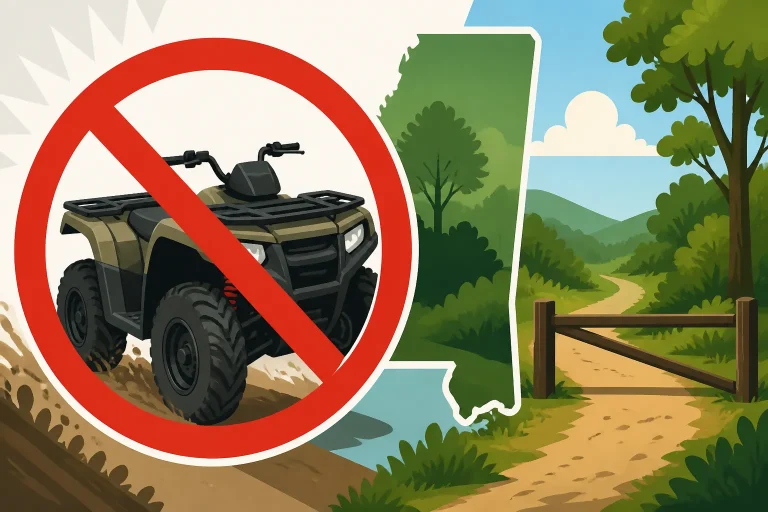
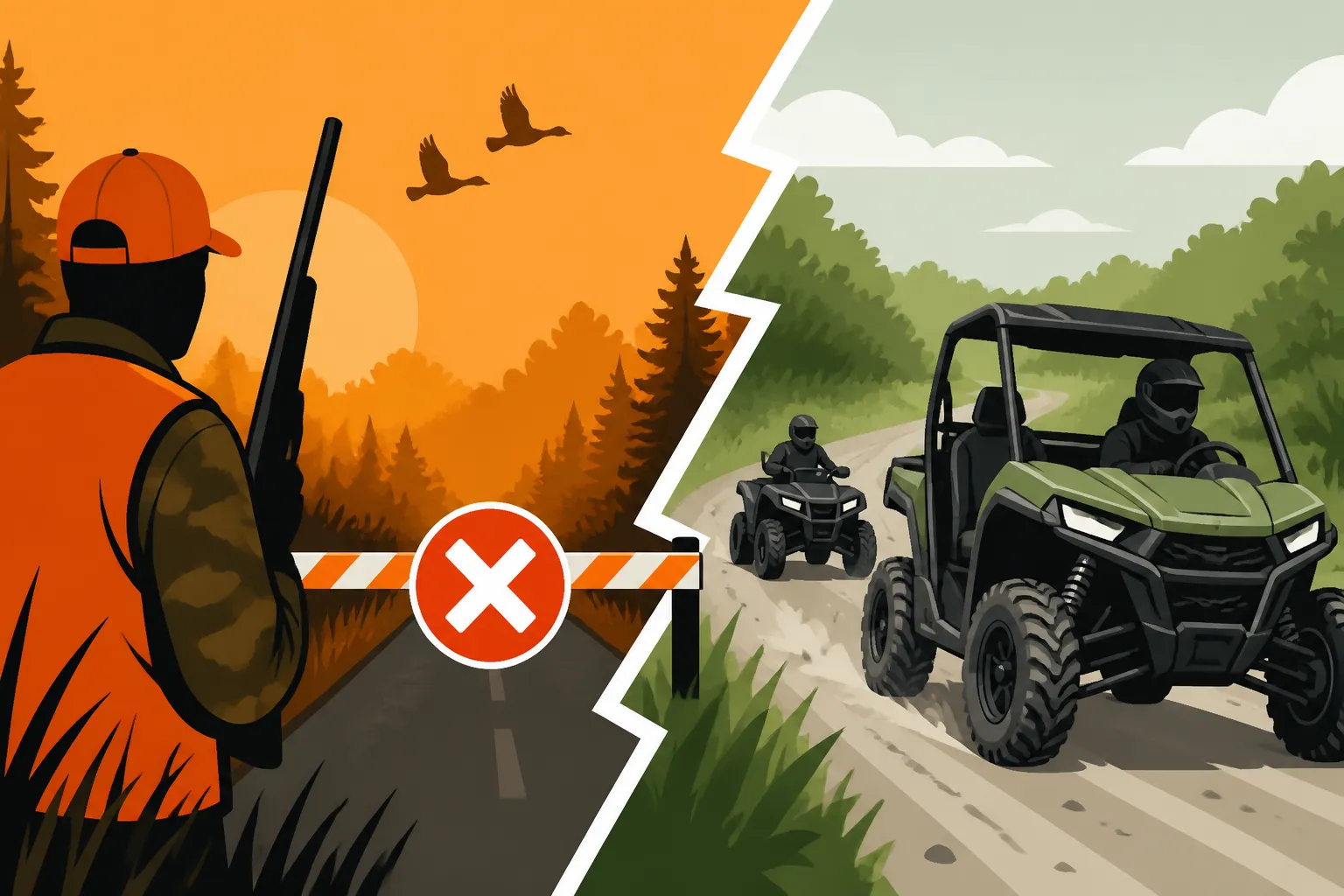
A setback concerns firearm safety near a road. It does not decide whether an ATV or side-by-side may use that road. Wildlife management areas can limit vehicle travel to designated roads, close routes seasonally, or restrict access behind a gate. A road that appears on a map may still be closed, and a worn track does not necessarily count as an authorized route.
Before unloading the machine, identify the official road and check for signs, gates, berms, or posted closures. Do not ride around a barrier because another rider has done so or because the route looks passable. Mississippi WMA Riding on Designated Roads explains why staying on authorized routes matters.
The reverse is true, too: permission to ride a designated road does not mean a firearm may be loaded or used there. Keep the driving decision and the firearm decision separate. Ask two questions before moving:
- Is this road open to ATV or UTV travel today?
- Can the firearm be transported in compliance with the current hunting and WMA rules?
If either answer is unclear, stop and check with the managing office. Avoid resolving uncertainty by riding farther down the road or handling a loaded weapon beside it.
The same separation applies to weapon types and activities. Rules for a rifle during gun season may not be identical to rules for another firearm, a different season, or a particular management area. Mississippi WMA Weapon Restrictions is a useful starting point, but the current regulations for the area you plan to visit should control. Do not assume a rule from one WMA applies everywhere.
It is also important not to confuse a road setback with a general firearm setback from homes, property lines, or other people. Those may involve different rules and different distances. A road-specific rule does not answer where you can hunt relative to a residence, boundary, trailhead, camp, or another hunter.
Plan the ATV Trip and Firearm Transport Separately
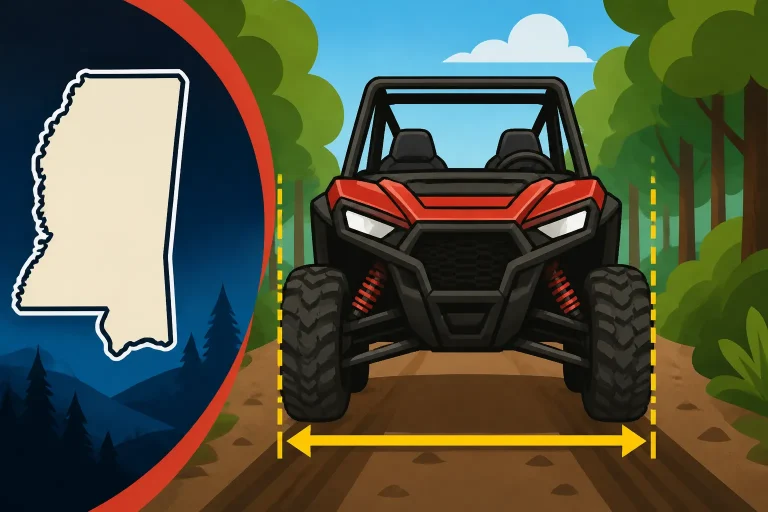
A safe plan begins before the machine is unloaded from the trailer. Check the WMA’s current hunting regulations, access map, vehicle restrictions, season dates, and road-closure notices. Confirm that the road you intend to use is designated for vehicle travel and that the machine meets any applicable trail or road limits. A hunting permit or license does not itself make a closed road open.
When transporting a firearm, follow the applicable rules for whether it must be unloaded and how it must be secured. A practical safety approach is to keep it unloaded whenever the machine is moving, especially near roads, other hunters, parking areas, or camps. Secure it so it cannot fall, shift, or become entangled with cargo. Do not place a loaded firearm where a passenger or driver could contact the trigger or where a bump could dislodge it.
A rifle carried on an ATV should not obstruct the driver’s view, interfere with steering or braking, or extend into a place where it could strike a person. Keep ammunition separate until you are at a lawful hunting location and have confirmed that loading is allowed. These are sound handling precautions, but they do not replace any specific WMA transport requirement.
If the ride requires crossing a road, stop well before the crossing. Unload and secure the firearm as required, check for traffic and other hunters, and cross only where permitted. Never fire from the machine, from a road, or across a road. A road crossing is a transportation task, not a chance to take a shot.
Hunters using a machine to retrieve game should check the rules before the hunt, not after an animal is down. Retrieval permissions can be limited by area, season, road designation, or the type of machine. See Using a Quad to Retrieve a Downed Deer and Mississippi WMA Game Retrieval Rules for related considerations. Do not assume that because a road is open for travel, every off-road route or retrieval method is allowed.
A simple pre-ride checklist can prevent the most common mistakes:
- Identify the exact WMA and read its current regulations.
- Confirm the hunting season, legal weapon, license requirements, and any area-specific restrictions.
- Check which roads are designated and whether they are open on the day of your trip.
- Find the current firearm setback wording and confirm how it applies to the road you will use.
- Transport the firearm unloaded and secured whenever required, and use that approach as a safety baseline.
- Plan crossings, parking, and retrieval routes before entering the area.
- If a sign or regulation conflicts with an online map or older information, follow the posted restriction and contact the managing office for clarification.
The right answer can depend on the specific WMA and the current season. A general summary is useful for planning, but it should not be your final authority when the exact road, firearm, or activity is in question. Mississippi WMA Road Closure Signs can help explain why posted closures matter, while [Questions Worth Asking a Southern Forest Office] offers a practical model for getting an answer from the land manager.
Common Misreadings of the 100-Foot Rule
“If I am 100 feet away, I can shoot across the road.” No. The setback does not create permission to shoot from or across a road. It is a minimum separation rule, not a firing authorization.
“A road means any trail I can ride.” Not necessarily. A management-area road, a designated ATV route, a public road, and an informal trail may be treated differently. Confirm the road’s status and the rule’s definition instead of relying on appearance.
“If the firearm is unloaded, the distance does not matter.” Do not assume that. The rule’s wording and its application to transport, possession, or hunting may matter. Keep the firearm unloaded near roads as a safety practice, but check the exact regulation rather than concluding that unloading creates an exemption.
“A 100-foot setback applies to all public land and every season.” A short summary cannot establish that. The rule discussed here concerns management-area use and gun-season firearm safety. Other land, seasons, weapons, or activities may have different restrictions.
“The ATV permit or hunting license covers both.” Riding authorization and hunting authorization are distinct. A license does not open a closed road, and permission to ride does not determine how a firearm must be carried. Review both sets of requirements before heading out.
“I can estimate the distance from the machine.” A visual estimate is unreliable, especially on uneven ground or in thick cover. If the boundary is unclear, move farther away, keep the firearm unloaded, and ask the managing agency how to interpret the rule.
The safest approach is conservative: keep the firearm unloaded near management-area roads, never shoot from or across a road, ride only where vehicle travel is allowed, and confirm the current rules for the exact WMA. The setback is one part of a larger safety and access plan, not a shortcut around the rest of the regulations.
Disclaimer
This article is for general informational purposes only and does not constitute professional advice. Laws, prices and regulations vary by location and change over time. Consult a qualified professional for guidance on your specific situation.