Mississippi State Park Passenger Rules
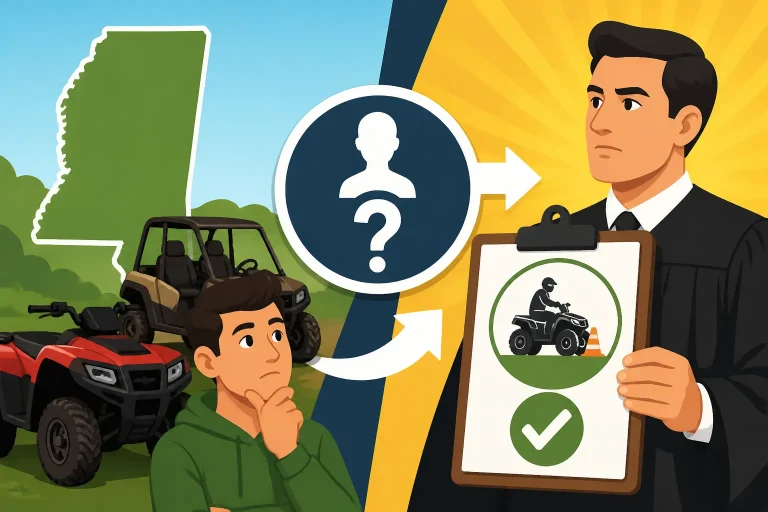
Mississippi state parks do not treat every ATV or UTV as a passenger vehicle. The practical rule is to carry only as many people as the machine was built to seat, using its original passenger seating—not a rack, fender, or lap. Park-specific access and safety requirements can also apply, so confirm them before you load up.
The passenger rule: use only factory seating
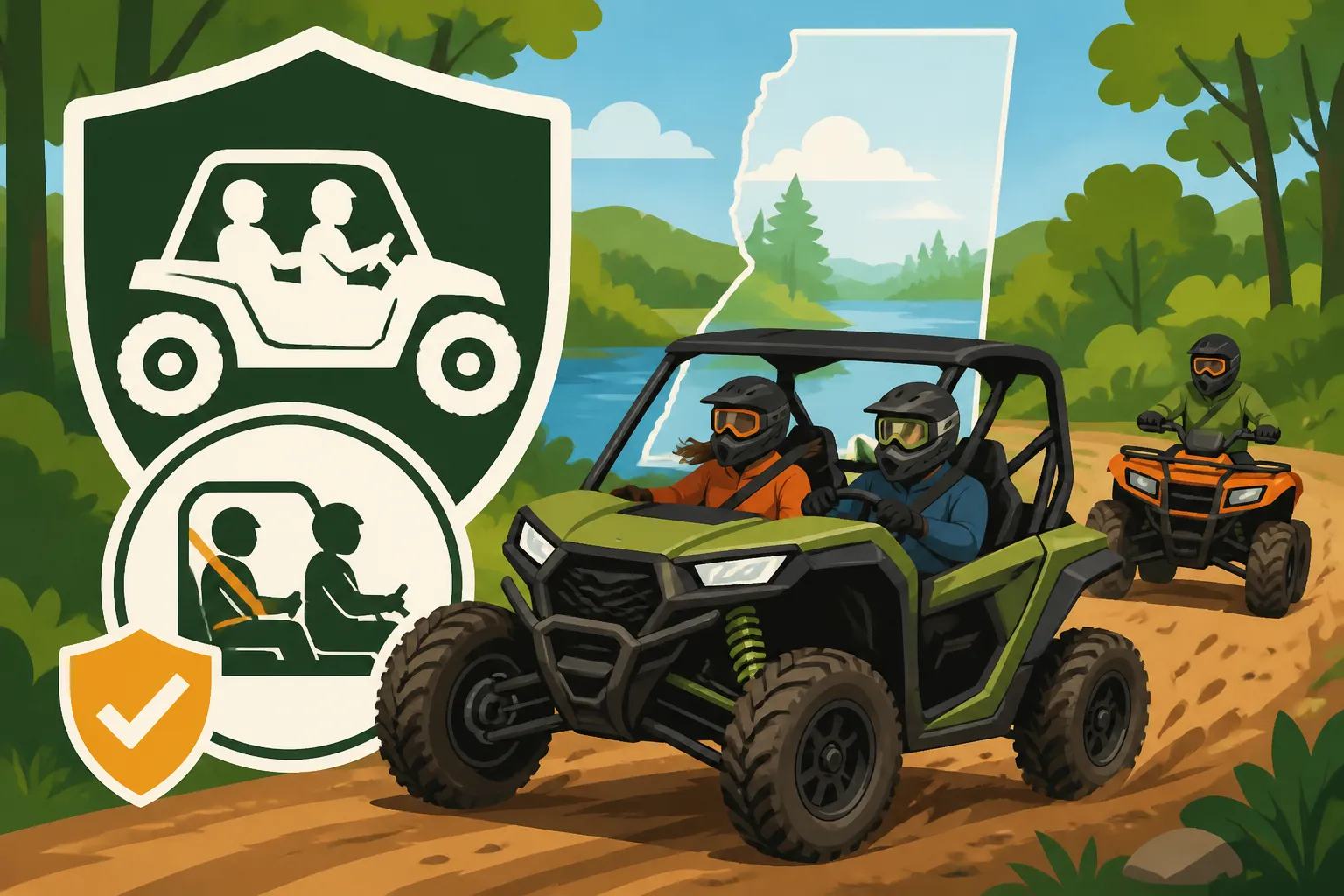
For a ride at a Mississippi state park that permits your machine, plan on one rider per manufacturer-designated seat. A passenger should have a proper seat intended for an occupant, with a safe way to hold on and keep their feet supported. Do not count a cargo rack, rear platform, fender, or improvised pad as a passenger seat.
The distinction matters because an ATV or UTV may have space that looks usable without being designed to carry a person. A rack is for cargo, and a passenger perched behind the seat can be thrown off during a turn, stop, or bump. Adding a cushion or grab handle does not change the machine’s intended seating capacity.
A useful rule of thumb is to follow the seating capacity shown by the manufacturer and the park’s own instructions. If the manual identifies a machine as a one-person ATV, carry one person. If a UTV is built with two, four, or another stated number of seats, do not exceed that capacity. The physical space available is not permission to add another rider.
| Machine or position | Practical passenger approach |
|---|---|
| Single-seat ATV | One rider; do not carry a passenger on the rack or fender |
| ATV designed with a passenger seat | Carry only the number of people the manufacturer specifies, using the intended seats |
| UTV with factory-installed seating | Stay within the stated seating capacity and use the designated seats |
| Cargo bed or rear rack | Cargo only, not a passenger position |
| Homemade or modified seating | Do not assume it qualifies; check with the park before riding |
Mississippi State Parks’ passenger guidance is summarized in State Parks Allow Passengers Only on Factory Seats. That is a useful baseline, but it does not replace the rules for the specific park, trail, or event you plan to use. Park staff may apply additional restrictions, and a park may not allow off-highway machines in the area you have in mind.
If your machine has been modified, check before bringing a passenger. A widened seat, added backrest, or aftermarket grab bar may improve comfort, but it does not automatically make the machine an approved two-person vehicle. The operator’s manual is the starting point; the park office can tell you whether the machine and its seating meet that location’s rules.
Why the machine’s design matters
ATVs and UTVs handle differently from cars. On an ATV, the rider shifts body weight to help control the machine. A passenger who is not seated as intended, or who leans the wrong way, can interfere with that movement. An extra person also changes weight distribution and may affect braking, steering, and stability.
A UTV has a different layout, but the same basic limit applies: seats are for occupants, and the cargo area is not an extra row. Passengers should use their own designated seats and any safety equipment supplied for those positions. If the machine has seat belts, use them as directed by the manufacturer and the park. Never place a passenger on the driver’s lap or ask someone to stand or kneel while the vehicle is moving.
A machine’s maximum seating capacity is not a suggestion to squeeze in one more person. It is the upper limit of the design. If a family group is larger than the number of safe seats, arrange another machine or make separate trips where park rules allow. Do not solve the problem by putting a child or adult on a rack.
Confirm that the park allows your machine and route
Passenger rules only matter after you have confirmed that the park allows the machine to ride there. A state park is not automatically an ATV trail system, and a road or campground inside a park is not automatically open to off-road riding. Access may be limited to specific trails, designated areas, approved events, or particular types of machines.
Start with the park’s own information rather than relying on a map pin, a social-media post, or a friend’s memory. Check Which Mississippi State Parks Allow Machines and [Mississippi State Park ATV Rules] for the broader access questions, then contact the specific park if anything is unclear. Ask whether your type of ATV or UTV is allowed, where it may be operated, whether passengers are permitted on that route, and whether there are machine-size or equipment restrictions.
A short call can prevent a wasted drive and a difficult discussion at the gate. Have the machine’s make, model, year, width, and seating capacity available. If the machine has aftermarket seating, a modified roll cage, or other changes, mention those details instead of assuming they will not matter.
Before heading out, clarify:
- Whether the park permits ATVs, UTVs, or both.
- Which trail or area is open to the machine.
- Whether a passenger is allowed on that machine and route.
- Whether the park limits machine width, sound, or other equipment.
- What identification, waiver, or safety documentation riders must bring.
- Whether the trail is open on the day you plan to visit.
- Whether rain, maintenance, or a special event has changed access.
Do not treat a park’s general permission to bring a machine as approval for every road, trail, or passenger arrangement. A location may allow a UTV on one route but prohibit it on another, or may have an access rule that depends on machine type. Follow signs and staff directions at the park, even if a route appeared open online.
The same caution applies to a private riding area. Private parks set their own entry and passenger conditions, which may differ from state park rules. A rule at one venue does not carry over to another. If you are comparing options, check Mississippi Private Park Age Minimums rather than assuming that an age or passenger policy is uniform across all riding locations.
Questions to ask the park office
A vague question such as “Can I bring my side-by-side?” may not get you all the information you need. Be specific. For example: “I have a four-seat UTV. Are passengers allowed on the designated route, and do all occupants need to sign a waiver?” If you are bringing a child, ask what age-related rules apply and what documents or safety equipment are required.
If a park employee gives you instructions by phone, note the date and the person or office you spoke with. That is not a substitute for posted rules, but it helps you remember what was confirmed. Recheck before traveling if the visit is weeks away, especially when weather or maintenance could affect trail access.
Keep passengers properly seated and equipped
A passenger’s safety depends on more than having a seat. Before starting, make sure every rider understands how to sit, hold on, and respond to the operator. This is especially important for children and for passengers who have never ridden an ATV or UTV.
For an ATV with a designated passenger seat, the passenger should sit in the intended position, hold the provided handholds, and keep both feet on the designated footrests. They should not lean out, reach toward the ground, or shift suddenly while the machine is moving. The passenger needs to follow the operator’s movements as appropriate for the vehicle and should speak up if they feel unstable or uncomfortable.
In a UTV, each passenger should use the seat assigned to them and follow the machine’s instructions for seat belts and other restraints. Keep hands and arms inside the vehicle where required, and do not allow anyone to ride in the cargo bed. A passenger who is too small to fit safely in the seat or use the restraint as designed should not be carried in that position.
Before moving, the operator should check that:
- Every occupant has a proper, designated seat.
- The number of people does not exceed the machine’s stated capacity.
- Passengers know where to place their feet and hands.
- Seat belts or other restraints are being used as intended.
- Helmets and any other required protective gear are fitted correctly.
- No cargo or loose gear can shift into a passenger’s space.
- Children are old enough and physically able to ride safely in that seat.
Mississippi state park requirements may include helmets for riders, and parks can set safety conditions beyond what a rider expects from ordinary road travel. Check [Mississippi State Park Helmet Requirements] and Mississippi State Park Age Proof before arrival. Do not assume a child’s helmet, size, age, or experience makes them eligible to ride as a passenger. Ask the park which requirements apply to the particular rider and machine.
A helmet needs to fit securely and be suitable for the activity. If you are buying one online, including through Amazon, verify that it meets the standard the park accepts, fits the rider properly, and can be fastened securely. A loose or poorly fitted helmet is not a practical substitute for the equipment rules.
Passengers should also dress for the ride. Closed-toe footwear, long pants, gloves, and eye protection can reduce exposure to debris and brush. These items do not make an unsafe passenger position acceptable, but they help prepare riders for conditions on an off-road route. Bring gear that fits the smallest rider in the group rather than assuming an adult-sized helmet or gloves will work.
Children need a separate check
Do not assume that a child may ride simply because they fit in a passenger seat. A child needs to be able to sit upright, hold on, keep their feet supported, and follow instructions throughout the ride. If they cannot do those things, the machine is not a safe passenger option for them.
Age, helmet, safety-course, supervision, and waiver rules can vary by location and activity. Confirm the park’s current requirements before your visit; a rule that applies to a young operator may not be identical to a rule for a child passenger. The park office can also clarify whether a parent or guardian needs to complete paperwork for a minor. Review Mississippi State Park Waiver Requirements and ask what documents are needed for each child.
For a child who is nervous, tired, or unfamiliar with the machine, a short ride is not automatically safe. An operator must be able to focus on controlling the vehicle, not repeatedly turn around to manage a passenger. If a child cannot remain seated and follow directions, choose a different activity.
Prepare for the gate, waiver, and ride
A little preparation makes it easier to resolve passenger questions before they become a problem at the entrance. Do not wait until a group is at the gate to find out that a child needs a different document, a machine is too wide for a trail, or the route is closed.
Use this sequence before traveling:
- Identify the machine. Check the manual or manufacturer’s label for the seating capacity and any restrictions. Record the model and dimensions if the park asks.
- Confirm access. Contact the park and ask whether that machine type may ride in the intended area.
- Confirm passengers. Explain how many people will ride, whether any are children, and whether the vehicle has standard or modified seating.
- Check current conditions. Ask about closures, weather-related changes, construction, or event restrictions.
- Review entry requirements. Find out what identification, waiver forms, age proof, helmets, safety certificates, or other documents riders need.
- Inspect the machine. Check tires, brakes, steering, lights where relevant, restraints, and the passenger seating before loading it.
- Brief the group. Explain where each person sits, what equipment to wear, and how to communicate with the operator.
- Follow the park’s signs and staff. Stay on routes open to your machine and stop if a direction or closure is unclear.
For waivers, do not assume that one adult signature covers every occupant. The park may require separate information or signatures, especially for minors. Find out whether forms must be completed at the park or can be handled ahead of time. The process is covered further in Mississippi State Park Waiver Requirements.
Carry proof of identity and any documents the park says are necessary. Mississippi State Park Age Proof can help you anticipate age-related questions, while Mississippi State Park Incident Reporting is useful to review so you know how the park expects an incident to be reported. These requirements are separate from passenger capacity, but they can determine whether the group is ready to ride.
A final check is worthwhile even if you have visited before. Rules can differ between parks, and access can change with trail conditions or park operations. Keep the park’s contact information handy and confirm details close to the visit, particularly if you are traveling a long distance or bringing multiple machines.
Common passenger mistakes to avoid
Most preventable passenger problems come from treating an ATV or UTV like a small car, or from assuming that a familiar riding area has the same rules as a state park. A few habits help keep the group within both the machine’s design and the park’s requirements.
Putting a passenger on the rack. A rack may seem stable while the machine is parked, but it is not a passenger seat. It offers no proper seating position and can leave a rider exposed to falls, branches, or contact with moving parts. Keep people off racks and cargo beds.
Exceeding the stated seating capacity. A second person does not become a passenger the machine can safely carry just because both people fit physically. Use the manufacturer’s capacity, not guesswork.
Assuming every UTV seat is interchangeable. Follow the manual and the park’s requirements for the specific vehicle. Do not carry occupants in a cargo area or in a position not designed for passengers.
Relying on an aftermarket addition as approval. Added cushions, rails, or handles do not necessarily alter a machine’s certified or intended capacity. Ask the park before relying on a modification.
Assuming children follow the same rules everywhere. Age and documentation requirements may depend on the park and activity. Confirm what applies to both young passengers and young operators.
Confusing a state park with a public road. Permission to ride inside a designated park area does not authorize riding on public streets or roads outside it. Separate road restrictions apply. See Mississippi ATV Road Rules Under 63-31-3 for the distinction.
Relying on old information. A trail that was open on a previous visit may be closed or subject to new conditions. Check with the park before departing rather than relying only on a past trip or third-party post.
If staff tell you that a passenger arrangement is not allowed, do not argue that another park accepted it or that a similar machine carries passengers elsewhere. Ask what the park allows and whether there is a safe alternative. If no approved passenger seat is available, leave the passenger off the machine.
Frequently Asked Questions
Can a passenger ride on the back of a Mississippi ATV?
Only if the ATV is designed and approved for a passenger in that position and the park permits it. A cargo rack, fender, or added cushion is not a substitute for a factory-designated passenger seat.
Can someone ride in the cargo bed of a UTV?
Do not use the cargo bed as a passenger area. Carry occupants only in designated seats and stay within the machine’s stated seating capacity.
Are passenger rules the same at every Mississippi state park?
Do not assume they are. The factory-seat rule is a sound baseline, but machine access, routes, waivers, and other requirements can differ. Confirm with the specific park before you travel.
Can a child ride as a passenger?
A child should ride only if they can sit and remain secure in a designated seat and meet the park’s requirements. Ask the park about age, helmet, supervision, and documentation rules before the visit.
Does permission to ride in a state park allow riding on nearby roads?
No. Park access does not grant permission to ride on public roads outside the approved park area. Check the rules for each place you plan to travel.
Disclaimer
This article is for general informational purposes only and does not constitute professional advice. Laws, prices and regulations vary by location and change over time. Consult a qualified professional for guidance on your specific situation.