Mississippi Riding Near Gulfport
Gulfport has plenty of places to haul a quad, but that does not mean there is an open riding area just around the corner. Most worthwhile options are inland, and access can depend on trail rules, weather, machine width, and seasonal closures. This guide explains how to compare public forest trails and private parks, plan a Gulf Coast ride, and avoid arriving with the wrong machine or outdated information.
Where to Ride an ATV Near Gulfport
Gulfport is a useful starting point for exploring Mississippi’s coastal and inland riding areas, but riders should not assume that beaches, roadside ditches, timber roads, or open-looking tracks are legal places to ride. The practical choices are designated riding areas: public trails where off-highway vehicle use is allowed and private parks that set their own rules.
For a wider overview of legal places to ride around the state, start with [Mississippi ATV Trails: Where to Ride]. If you are specifically weighing inland forest access against closer coastal options, [Mississippi Coast and De Soto National Forest Riding] is a useful related topic.
De Soto National Forest and Bethel OHV Trail
De Soto National Forest is one of the main public-land areas to investigate from the Gulfport region. The Bethel OHV Trail system is a named riding destination in the forest, but it is not a free-for-all across every forest road or clearing. Riding is limited to routes and areas designated for that use, and conditions or closures can change.
Before setting out, confirm which trail sections are open, what kinds of vehicles are permitted, and whether you need a pass or other documentation. A route that appears on a phone map is not necessarily an authorized OHV trail. Forest roads may be closed to motorized recreation, and a gate, berm, posted sign, or closure notice should be treated as a clear instruction—not a challenge to find a way around it.
The Bethel system is especially important to research if you ride a wider side-by-side. Trail systems can set vehicle-size limits that rule out some machines, even when those machines are otherwise appropriate for off-road use. Read [Bethel OHV Trails in Mississippi] and [Mississippi Trails With Width Limits] before loading up. Then compare your machine’s actual width with the limit in the current trail information.
Private parks within a Gulf Coast drive
A private riding park can be a better fit if you want a defined entrance, managed riding area, or facilities that are not available at a remote forest trailhead. Red Creek Off-Road is one option riders in the broader Gulf Coast region may investigate. It is a private recreation destination rather than an extension of public forest land, so its admission process, operating days, machine rules, and amenities are governed by the park.
Do not rely on an old social media post or a friend’s memory for a visit plan. Check directly with the operator before leaving Gulfport, especially if you are making a full day of it or bringing a group. Ask whether the park is open, what types and sizes of machines it accepts, what safety equipment is required, whether reservations are needed, and what happens if weather affects operations. See [Red Creek Off-Road in Mississippi] for more on this option.
Private parks and public trails solve different problems. A private park may offer a more contained riding experience, while a forest trail can feel quieter and more remote but requires careful attention to maps, access rules, and conditions. Neither choice is automatically better for every rider. The right match depends on your machine, experience, group, and tolerance for changing plans.
| Riding option | Best suited to | Check before leaving Gulfport |
|---|---|---|
| Bethel OHV Trail in De Soto National Forest | Riders seeking designated public forest trails | Open routes, pass requirements, machine width, closures, and trail conditions |
| Red Creek Off-Road | Riders looking for a managed private riding area | Operating status, admission process, accepted machines, safety rules, and facilities |
| Other forest roads or tracks | Only when specifically authorized for motorized riding | Land manager rules, posted closures, and whether the route is designated for OHV use |
Match the Riding Area to Your Machine
A frustrating trail day often starts before the engine is turned on: a machine is too wide for the route, a rider has misunderstood a pass requirement, or a group arrives without checking whether every vehicle is allowed. A little preparation can prevent a long drive from ending at a trailhead sign.
Check width and vehicle eligibility
Width is a practical issue, not just a measurement on a specification sheet. A trail can be open to some ATVs and still exclude a wider side-by-side. If you ride a UTV, use the manufacturer’s published width as a starting point, then check the riding area’s specific measurement method and current limits. Accessories, wheel offsets, or other changes may affect the machine’s actual width.
Do not assume that a trail listed as “OHV” accepts every off-highway vehicle. Some routes are designed for narrower machines, and some parks distinguish between ATVs, dirt bikes, and UTVs. If the rules are unclear, ask the forest office or park operator directly and describe your exact machine. Make, model, and width are more useful than simply saying “I have a side-by-side.”
For Bethel, check the trail-specific limit rather than relying on what you have heard about another Mississippi trail. The guide [Bethel's Width Limit in Mississippi] is relevant when you are evaluating fit. Also inspect the machine’s width at its widest point, including tires or installed accessories, rather than guessing from the brochure.
Understand passes, permits, and rider requirements
Public forest riding may require an OHV pass, and a pass should not be mistaken for permission to ride anywhere in the forest. It applies under the terms set for the relevant trails or area. Confirm whether the pass is tied to a person, a machine, or another condition, and whether it needs to be displayed or carried. The details can differ from a private park’s admission or waiver process.
Check rider requirements as carefully as machine requirements. A group with young riders should confirm age rules, supervision requirements, helmet standards, and any safety-course documentation that applies to the particular riding area. A parent’s assumption that a child can ride because they are allowed on private land may not satisfy rules for public recreation land.
Keep proof of ownership and any required trail documents accessible, and make sure each person in the group understands the rules before riding. [Mississippi National Forest OHV Passes] explains the public-forest pass topic in more detail. For private parks, call the operator about its own waiver and age requirements rather than assuming public-land rules apply.
Plan Around Weather, Trail Conditions, and Navigation
The Gulf Coast’s heat, humidity, and heavy rain can change the feel of a ride quickly. A trail that was firm during a dry spell may become muddy, rutted, or temporarily closed after a storm. Good planning means checking conditions close to departure and having a backup plan that does not depend on pushing through a closure.
Check conditions before you tow
Before leaving Gulfport, check the latest information from the land manager or park operator. Ask specifically about recent rain, standing water, active closures, and whether the route is suitable for your machine. A general forecast for the coast may not reflect conditions inland, so look at the forecast for the riding area itself.
After rain, expect more than slippery tires. Water can conceal ruts, wash out small sections, soften shoulders, and make recovery difficult. A heavy UTV can dig into wet ground quickly, while a smaller ATV can be difficult to extract without help. If a route is closed or conditions are poor, changing the plan is safer than trying to force a ride.
The guidance in [Mississippi Trail Conditions After Rain] can help you think through weather-related trail changes, while [Bethel's Wet Weather Closures in Mississippi] focuses on why a specific public trail may close. Call or check official notices before loading the trailer, rather than treating a closure as something you can sort out after arrival.
Build a navigation plan with a backup
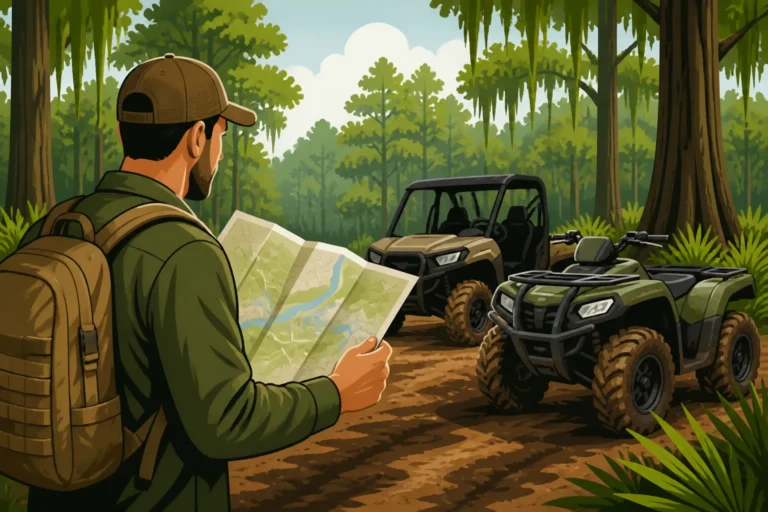
Save the route and relevant maps before you lose cell service. Mobile coverage can be unreliable in forested areas, and a navigation app may not have a usable connection when you need to confirm a turn. Carry a charged phone, a vehicle charger or power bank, and an offline map or paper backup. Tell someone who is not riding with you where you plan to go and when you expect to return.
onX Offroad can help riders review mapped routes and plan a trip, especially when comparing a trail area with nearby roads and landmarks. Use it as a planning aid, not as the final authority on whether a route is open or legal. Confirm the route with official forest or park information, and obey signs on the ground even if a digital map appears to show a through-route.
Before the group moves out, agree on a meeting point in case riders become separated. Make sure each rider knows the trailhead location, the planned route, and how to return to the staging area. In a remote area, a simple plan—such as stopping at the last signed intersection rather than continuing alone—can prevent a minor separation from becoming a stressful search.
Prepare for a Full Day Away from the Coast
A ride near Gulfport may involve a drive inland, trail time, and a return trip after a tiring day in the heat. Treat the outing as a full-day plan, not just an hour on the machine. Your trailer, clothing, tools, and return arrangements all affect how smoothly the day goes.
Pack for heat, mud, and basic repairs
Bring more water than you think the group will need, and plan regular breaks in shade where available. Heat and humidity can make riders feel worn out before they realize how much fluid they have lost. Avoid waiting until someone feels faint, confused, or unusually weak before stopping. A rider who is overheated is not in a good position to continue safely.
Pack a basic repair kit suited to the machines in your group. That might include tire-repair supplies, a compact air source, gloves, a small tool kit, a tow strap, and any machine-specific items you know are prone to loosening or failure. A winch can be useful for recovery, but it is not permission to ride into deep water or soft ground without assessing the risk. Keep recovery equipment rated for the machine and use it with care.
For a muddy ride, bring spare clothes, a towel, drinking water for cleanup, and a way to keep wet gear separate from the truck cab. Secure coolers and loose cargo so they cannot shift on rough ground. If you expect to cross water, stay within the machine’s capability and avoid unknown depth or current. A route that looks shallow from the bank can hide soft, uneven ground.
Check the trailer and the loading area
A trailer issue can derail a trip before you reach the trail. Check the hitch connection, safety chains, lights, tires, and load straps before leaving home. Confirm that the combined weight of your machine and gear is appropriate for the trailer and tow vehicle. Secure each machine at stable tie-down points and recheck the straps after a short drive.
At the riding area, use designated staging and parking spaces. Avoid blocking gates, roadways, or access for emergency vehicles. If the trailhead is crowded, do not unload in a spot that forces other riders to maneuver around your trailer. A little courtesy at the staging area makes the start of the ride safer for everyone.
Before heading home, check the machine for mud or debris that could obscure lights or interfere with loading. Look for loose parts, leaks, or damage while the machine is still easy to inspect. If you have ridden through water or deep mud, plan appropriate cleaning and maintenance afterward rather than assuming a quick rinse is enough.
Choose a Ride That Fits Your Group
The best riding area is not always the one with the most miles or the most challenging terrain. A beginner, a family group, and a crew of experienced UTV riders may need very different conditions. Choose based on the least experienced rider and the least capable machine in the group, not just the strongest rider’s appetite for a challenge.
Beginners and family groups
For a first outing, prioritize clear access rules, straightforward navigation, and a route that allows the group to stop without pressure. A private park may be helpful if its current facilities and rules fit your needs. On public land, learn the route and requirements beforehand, and do not count on another rider at the trailhead to explain the system.
Set simple expectations for children and newer riders: stay within sight or agreed communication range, stop at designated decision points, and do not follow a faster rider onto an unfamiliar route. Check age and helmet rules for the specific site. Bring properly fitting protective gear, and make sure the machine is appropriate for the rider’s size and experience.
A family ride should include a realistic turnaround point. If the group is tired, hot, or behind schedule, ending early is a sensible choice. Plan the day so that there is no pressure to squeeze in one last loop as daylight fades or weather moves in.
Experienced riders and larger machines
Experienced riders often value longer routes, mud, or more technical terrain, but experience does not cancel access rules. If your group includes wide UTVs, heavily modified machines, or a mix of vehicle types, confirm compatibility before the trip. A route suitable for a narrow ATV may not work for a side-by-side, and a technical section that one rider can manage may leave another machine stuck.
Agree on the group’s pace and recovery plan before unloading. Decide who carries first-aid supplies, who has navigation, and how the group will communicate if someone has a mechanical issue. Avoid splitting up without a clear meeting point and a reliable way to reconnect.
Use onX Offroad or another mapping tool to help organize the route, but cross-check with current official information. If a map and a posted closure disagree, follow the closure. If there is uncertainty about access, ask the relevant land manager before riding. That small extra step is much easier than dealing with a citation, a recovery problem, or a frustrated group after reaching a closed gate.
A Practical Pre-Trip Checklist for Gulfport Riders
A dependable ride begins with a few checks that are easy to skip when everyone is eager to get on the road. Use this checklist the day before and again before departure.
- Choose a designated riding area. Confirm that the route or park is open to your type of machine. Do not treat unmarked forest roads or private land as public riding areas.
- Verify conditions. Check for rain-related closures, muddy sections, operating changes, or other notices from the land manager or park operator.
- Confirm machine fit. Measure or verify your ATV or UTV’s width and compare it with the current rules for the exact trail or park.
- Check documents and requirements. Review pass, waiver, age, helmet, and safety-course rules for every rider in your group.
- Plan for navigation gaps. Save useful maps offline, carry a backup, and share your planned route with someone at home.
- Pack for the weather and terrain. Bring water, protective gear, basic repair supplies, and a change of clothes suited to the day’s conditions.
- Inspect the trailer and vehicle. Secure the load, check lights and tires, and make sure the tow setup is ready for the drive home.
- Set a turnaround plan. Agree on where the group will stop, how you will handle a separated rider, and when you will head back.
A little flexibility is part of riding in the Gulf Coast region. If the trail is closed, the weather has made it unsafe, or your machine does not meet the access rules, do not try to improvise an unauthorized route. Reschedule, choose a confirmed alternative, or make the trip a scouting visit instead. A good day is one where everyone gets home with their machine, their gear, and a reason to ride again.
Disclaimer
This article is for general informational purposes only and does not constitute professional advice. Laws, prices and regulations vary by location and change over time. Consult a qualified professional for guidance on your specific situation.