Mississippi Penalties for Illegal Road Riding
It’s a common scenario across Mississippi: you’ve got your ATV or UTV, the sun is shining, and you just need to get from your hunting camp to that prime fishing spot, or maybe just across the county road to a neighbor’s property. It seems like such a short distance, a quick hop, nothing to worry about, right? But unfortunately, that seemingly innocent decision to take your off-road machine onto a public road in Mississippi can quickly turn into a headache, leading to fines, court appearances, and a whole lot of frustration. This guide is here to shed light on the very real penalties you face for illegal road riding and help you understand the state's stance on these powerful machines.
The Hard Truth: Why Mississippi Bans ATVs from Public Roads
Look, I get it. You might see folks riding side-by-sides down country roads in other states, or even hear anecdotal stories of someone "getting away with it" here in Mississippi. But the reality is, state law is pretty clear on this, and deputies and local law enforcement officers are tasked with enforcing it. The state views ATVs and UTVs as off-road vehicles, pure and simple, and has specific reasons for keeping them off asphalt.
The Letter of the Law: Mississippi Code Section 63-31-3
Mississippi’s Off-Road Vehicle statute, specifically [Mississippi Code Section 63-31-3], lays it all out. It states that an all-terrain vehicle (ATV) or off-road vehicle (ORV) cannot be operated on any public road or highway of this state. There are no two ways about it; the language is direct and leaves very little room for interpretation. This isn't some obscure, rarely enforced rule; it's a fundamental aspect of how the state categorizes and regulates these machines. It means that whether you're on a four-lane highway or a dusty gravel county road in the middle of nowhere, if it's considered a "public road," your ATV or UTV shouldn't be on it.
Many riders, especially those new to the state or those coming from areas with more lenient laws, often express surprise or even disbelief at how strict this rule is. They might argue that their machine is perfectly capable of handling road speeds, or that it has lights and signals, making it just as safe as a golf cart. However, the law isn't based on a machine's capabilities but on its official classification and the intent behind its design. These machines are built for dirt, mud, and trails, not for sharing lanes with cars and trucks traveling at highway speeds.
What "Public Road" Really Means
When the law talks about "public roads," it's not just referring to busy interstates or state highways. It's much broader than that. A public road in Mississippi encompasses almost any thoroughfare maintained by the state, county, or municipality that is open for public vehicular travel. This includes those quiet, two-lane county roads, the paved streets within a city or town, and even unpaved, gravel roads that are part of the public road system. The distinction between a "public road" and private land or a designated off-road trail is crucial for riders to understand.
This can be a tough pill to swallow for riders who own property or hunting leases that are separated by a short stretch of public road. You might have acres of private land on either side, and that small section of public asphalt feels like an arbitrary barrier. However, from a legal standpoint, that's precisely what it is. An enforcement officer isn't going to distinguish between your half-mile jaunt to a fishing hole and someone joyriding on a main street; the act of operating the ATV on the public road is what triggers the violation. Always assume if there's a road sign, a yellow line, or it's maintained by a government entity, it's off-limits.
No Exceptions: Farm Roads, Levees, and the Like
One of the most common misconceptions among Mississippi riders is the idea of a "farm road exception" or being allowed to ride on certain service roads, like those along levees. Unfortunately, [Mississippi Has No Farm Road Exception] for ATVs and UTVs. While some states do carve out specific allowances for agricultural use, Mississippi's statute doesn't. If the road is public, it's prohibited, regardless of whether you're using your machine for legitimate farming tasks, hauling timber, or managing a hunting property.
Similarly, riding on levees, even if they're not heavily trafficked, is generally prohibited. These aren't public roads in the traditional sense, but they are often regulated by levee boards or other authorities, and unauthorized vehicle access can lead to significant penalties, especially if damage occurs. The intent of these rules is to protect infrastructure and ensure safety. It's paramount for riders to verify the legality of any specific path or area before assuming it's okay, especially if it's not explicitly designated as an OHV trail or part of your private property. Many riders are surprised to learn that [Mississippi Levee Riding Is Prohibited].
What Happens When You're Caught: Penalties for Illegal Road Riding
So, you took that chance, crossed that road, and a flashing blue light appears in your rearview mirror. What now? The consequences for illegally riding an ATV or UTV on a public road in Mississippi can range from a warning to significant fines, court costs, and even the impoundment of your machine. It’s important to understand that these aren't minor infractions; they are taken seriously by law enforcement.
Understanding the Fines and Court Costs
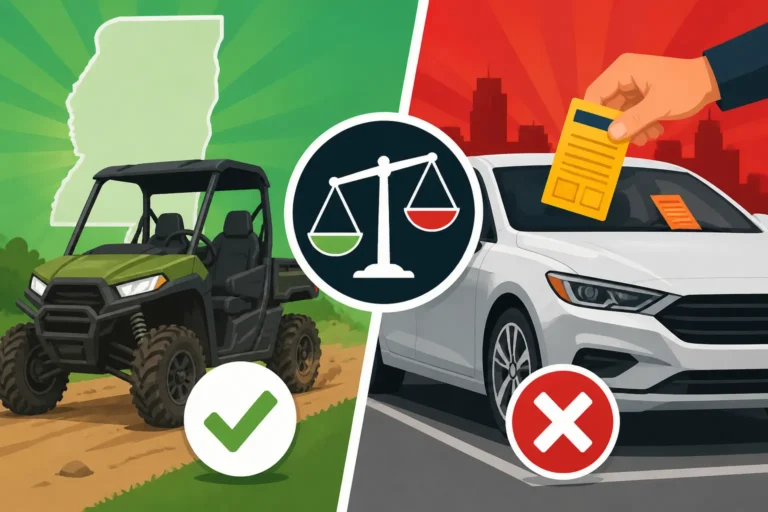
The actual fine for illegally riding an ATV on a public road in Mississippi is often less than what some people expect, typically around $50. However, this base fine is rarely the end of the story. Like most traffic violations, this fine is usually accompanied by court costs, which can significantly increase the total amount you have to pay. These court costs vary by jurisdiction but can easily double or even triple the initial fine, turning that $50 ticket into something closer to $150 or more. [Mississippi Fines for Road Riding] might seem low, but the total impact is often higher.
Imagine you're stopped in a small town or a rural county. The local justice court processes these citations, and their fees are added on top of the state-mandated fine. This means that a casual ride across a street could end up costing you a substantial chunk of change that you certainly didn't budget for. And let's not forget the time commitment: receiving a citation usually means a mandatory court appearance or at least the hassle of figuring out how to pay the fine and costs, which takes away from your valuable time on the trails or with family.
The Discretion of the Deputy: Warnings vs. Citations
While the law is clear, how it's enforced can sometimes vary depending on the officer, the specific circumstances, and the jurisdiction. A deputy might exercise discretion, especially if you're polite, cooperative, and it's your first offense for a very short distance. In such cases, you might receive a verbal warning, or a written warning instead of a full-blown citation. This is not a guarantee, however, and you should never count on it.
However, discretion is a double-edged sword. If you're riding recklessly, appear to be under the influence, cause a disturbance, or are uncooperative, you can almost guarantee you'll receive a citation and face the full force of the law. Officers are primarily concerned with public safety, and if your actions are perceived as endangering others or showing disregard for the law, they will act accordingly. It's always best practice to pull over safely, be respectful, and understand that the officer is simply doing their job to enforce [Mississippi Law Flatly Bars ATVs From Public Roads].
Beyond the Ticket: Impoundment and Other Consequences
A citation and fine might be the most immediate consequences, but they aren't the only ones. In some cases, particularly for repeat offenders, serious safety violations, or if the machine is deemed a public nuisance, law enforcement has the authority to impound your ATV or UTV. This means your machine could be towed away and stored at an impound lot. Getting it back will involve paying not only the fines and court costs but also towing fees and daily storage fees, which can quickly add up to hundreds of dollars.
Beyond the direct financial costs, there are other potential headaches. If you're involved in an accident while illegally riding on a public road, your insurance company might deny coverage, leaving you personally liable for damages and injuries. Furthermore, operating an unregistered or uninsured vehicle on public roads can lead to additional charges. And let's not forget the potential for points on your driving record if the citation is handled as a traffic violation, which could impact your car insurance rates. For many riders, the hassle and expense of dealing with an impounded machine far outweigh the convenience of a quick road trip. When an ATV gets impounded after a stop, it's a major setback.
The Legal Nuances: Why Off-Road Machines Aren't Street Legal
It's easy to look at a modern side-by-side, especially one tricked out with turn signals, mirrors, and a horn, and think, "Why isn't this thing street legal?" The answer lies in how Mississippi legally defines and categorizes vehicles, and the specific requirements for operating on public roads. It's not just about what a machine can do, but what it's classified as.
Defining an ATV vs. Other Vehicles
In Mississippi law, an All-Terrain Vehicle (ATV) is specifically defined, and these definitions are distinct from other types of vehicles like cars, trucks, or even motorcycles. Generally, an ATV is a motorized vehicle designed for off-road use, having three or more wheels, a seat designed to be straddled by the operator, and handlebars for steering. Side-by-sides (or UTVs) often fall under the broader category of "Off-Road Vehicles" (ORVs) due to their seating and steering wheel, but they are still primarily designed for off-highway use. [Mississippi ATV and ROV Legal Definitions] clearly distinguish them.
The crucial difference here is the "designed for off-road use" part. This design intent is what separates them from street-legal vehicles. While many ATVs and UTVs are incredibly versatile, powerful, and even comfortable, they lack specific safety and emissions certifications required for on-road vehicles. They might not have the correct lighting, braking systems, or crash protection features mandated for street use. This foundational difference in design and intended use is why they can't simply be registered like a car, even if you bolt on some street-legal accessories from a company like SuperATV. While SuperATV offers fantastic aftermarket parts for off-road performance, these modifications generally don't magically make your machine street legal in Mississippi.
The License Plate Conundrum
One of the most immediate visual cues that an ATV isn't meant for the road is the lack of a license plate. Mississippi does not register ATVs in the same way it registers cars or motorcycles for road use. While you can get a voluntary title for an ATV in Mississippi, particularly for newer machines, this title serves primarily as proof of ownership, not as a permit for road travel. [Mississippi Does Not Register ATVs] for highway use, and therefore, no license plate is issued.
Without a state-issued license plate, your ATV cannot legally operate on public roads. A title is a crucial document for proving ownership, especially when buying or selling a machine, or if you need to report it stolen. But it absolutely does not grant you permission to ride on public streets. Many new ATV owners, seeing that they can title their machine, mistakenly believe this means they can now take it on the road. This is a dangerous misconception that can lead directly to penalties.
Failed Efforts for Road Access Legislation
It's not for lack of trying that Mississippi ATVs remain off public roads. Over the years, there have been various legislative efforts to introduce more comprehensive road access for off-road vehicles. These bills often aim to create specific conditions under which ATVs could use public roads, such as low-speed limits, daylight-only operation, or designated crossing points. However, many of these efforts have either failed to pass through the legislature or died in committee. [Mississippi's Failed 2025 Road Access Bill] is a recent example of this.
The reasons for these legislative hurdles are complex, often involving concerns from law enforcement, insurance companies, and public safety advocates. There's a strong emphasis on maintaining clear distinctions between vehicle types to ensure safety and liability. While some municipal and county governments have enacted local ordinances that allow golf carts or low-speed vehicles (LSVs) on certain streets, these typically do not extend to ATVs or UTVs due to their inherent design and power. These are different classes of vehicles with different regulations, and it's important not to confuse them.
Staying Legal: Avoiding Penalties and Riding Responsibly
Given the strict state laws, the best way to avoid penalties for illegal road riding is simple: don't do it. But beyond that, there are practical steps you can take to ensure your riding adventures are both thrilling and legal. Understanding your options and responsibilities is key to enjoying your machine without the added stress of legal trouble.
Ride on Private Land or Designated Trails
The most straightforward way to avoid penalties is to stick to where your ATV or UTV is legally intended to be: private property with permission, or designated off-road vehicle trails. Mississippi has a growing number of fantastic places to ride, from national forest trails to private mud parks. Places like Bethel OHV Trails offer miles of adventure, and private parks like Red Creek Off-Road provide a range of terrain for every type of rider. [Mississippi ATV Trails: Where to Ride] provides a great starting point for finding legal places to ride.
Always ensure you have explicit permission to ride on private land. Oral permission is a start, but written permission is always better, especially if you're riding on someone else's property regularly. For designated trails, always check their specific rules regarding machine types, width limits, hours of operation, and any required passes or fees. For example, [Bethel's 43 Miles Are Built for 50-Inch Machines], so if you have a wider side-by-side, it might not be permitted there. Planning ahead and knowing where you're going will save you a lot of grief and ensure you have a legal and enjoyable ride.
Knowing Local Ordinances for Golf Carts and LSVs (and Why They Don't Apply to ATVs)
Many Mississippi towns, particularly coastal communities or those with large retirement populations, have enacted local ordinances that permit golf carts and sometimes Low-Speed Vehicles (LSVs) on certain public streets. These ordinances are specific to those vehicle types and do NOT, in almost all cases, apply to ATVs or UTVs. It’s a critical distinction that riders often misunderstand. For example, [Hattiesburg Opened Its Streets to Golf Carts], but this doesn't extend to ATVs.
Before you even think about riding anything other than a street-legal car on a town street, you must verify the specific local ordinance. Many municipalities define exactly what kind of golf cart or LSV is allowed, what roads they can use (often only those with speed limits of 30 mph or less), and what equipment is required (lights, signals, seatbelts, etc.). Attempting to pass off your ATV or UTV as a "golf cart" in a town with such an ordinance is a quick way to get a ticket. These laws are written precisely, and the definitions are key. Your side-by-side, even with a SuperATV windshield and roof, is still an off-road vehicle in the eyes of the law, not a golf cart.
Carrying Necessary Documentation
Even when you're riding legally on private land or designated trails, it's a good habit to carry essential documentation. This includes proof of ownership (like a bill of sale or title), any required permits for trail systems (like a [Mississippi Forest Pass Cost] for national forests), and a valid driver's license if you're old enough to have one. For younger riders, carrying proof of an ATV safety course certificate is crucial, as some public lands and private parks require it.
While a deputy cannot pull you over for simply being on private land, if they have legitimate reason to believe you're trespassing or violating another law, they might approach you. Being able to quickly and clearly demonstrate ownership and legal right to be where you are can de-escalate situations and ensure a smooth interaction. While [Mississippi Issues No License Plate] for ATVs, having your ownership papers in order is the next best thing.
Protecting Yourself: Insurance and Safety Considerations
Riding an ATV or UTV comes with inherent risks, whether you're on a designated trail or, heaven forbid, illegally on a public road. While the focus here is on avoiding penalties for road riding, a holistic approach to safety and protection includes understanding insurance and general safety guidelines.
Why Insurance Matters Even Off-Road
Unlike cars, Mississippi does not mandate insurance for ATVs or UTVs. However, that absolutely does not mean you shouldn't have it. [Mississippi Has No Insurance Mandate] for off-road vehicles, but for your own protection and peace of mind, it's highly recommended. Accidents can happen anywhere – on private land, at a mud park, or on a national forest trail. If you're involved in an incident where someone is injured or property is damaged, without insurance, you could be personally liable for huge costs.
ATV insurance can cover a range of scenarios: damage to your own machine, liability for injuries to others or damage to their property, and even theft. Many homeowners' policies offer limited coverage for ATVs, but often only when the machine is on your property. A dedicated ATV policy provides much broader protection. Consider the investment you've made in your machine, perhaps including performance upgrades from SuperATV. Protecting that investment, and your financial well-being, with a good insurance policy is just plain smart.
Helmet Laws and Youth Riders on Public Land (When Applicable)
While Mississippi's primary road ban for ATVs is strict, there are specific safety laws that apply to certain riders, particularly youth, when operating on public lands or trails where ATVs are permitted. For instance, [Mississippi Helmet Law for Riders Under 16] requires anyone under the age of 16 to wear a helmet when operating an ATV. This rule is designed to protect young riders, who are at a higher risk of serious injury in the event of an accident.
Furthermore, many designated riding areas, including state parks and national forest trails, may have their own additional safety rules that go beyond state law, such as requiring all riders, regardless of age, to wear helmets. They might also have age restrictions for operating certain size machines or require a safety course certificate for younger riders. Always check the specific rules of any riding area before you go, and make sure all riders, especially children, are properly equipped and knowledgeable about safety.
Machine Modifications and Their Impact on Legality
Many riders love to customize their ATVs and UTVs, adding lights, lift kits, bigger tires, and performance parts. While these modifications can enhance the off-road experience, they generally do not change the legal classification of your machine for road use in Mississippi. Adding turn signals or a horn might make your machine seem more road-ready, but it doesn't make it legally road-ready under state law.
In fact, some modifications could inadvertently create new problems. For instance, altering exhaust systems to be louder might lead to noise complaints, especially in areas near residential zones, even if you're on private land. While aftermarket parts from brands like SuperATV can drastically improve your machine's performance and utility in off-road settings, they don't circumvent Mississippi's strict ban on ATVs on public roads. Always prioritize modifications that enhance safety and performance for off-road use, rather than those aimed at making a non-street-legal vehicle appear street legal.
Disclaimer
This article is for general informational purposes only and does not constitute professional advice. Laws, prices and regulations vary by location and change over time. Consult a qualified professional for guidance on your specific situation.