Mississippi Trail Etiquette Locals Expect
A good Mississippi ride can turn sour fast when dust clouds a neighbor’s camp, a machine cuts around a closed gate, or riders meet a logging truck on a narrow road. Trail etiquette is more than being polite: it helps protect access and keeps people, wildlife, and machines safer. Here’s how to ride considerately on public trails, private land, and muddy park routes.
Before You Ride, Know Who Manages the Land
Confirm that the route is open and legal
A line on a map is not automatically an ATV trail. In Mississippi, routes may cross National Forest land, wildlife management areas, private timberland, or other property with different rules. Some roads are open to certain uses while nearby trails are closed to motor vehicles. A familiar shortcut can also be closed seasonally or after weather damage.
Before you unload, check the current rules with the land manager or riding area. For National Forest riding, start with Mississippi National Forest Riding Explained and confirm the applicable trail information through the Forest Service. On a wildlife management area, don’t assume a road is open just because it appears on a map: [Mississippi WMA Designated Roads Only] is a useful reminder to stick to routes designated for riding.
Mapping apps can help with orientation, but they shouldn’t be treated as permission to ride. For example, onX Offroad may help you understand where a route appears to run, but check land status, closures, signs, and access rules with the managing agency or landowner. A map line can be outdated or show a road that is not open to ATVs.
Respect gates, signs, and landowner boundaries
A closed gate means stop, even if there are fresh tire tracks on the other side. Tracks only show that someone went through; they don’t prove that access is allowed. Don’t squeeze around a gate, lift a barrier, or follow an unmarked route into adjacent property. A few minutes saved can create damage, trespass problems, and a reason for an owner or manager to restrict future access.
On private land, get direct permission before riding. Don’t assume that permission to hunt, camp, fish, or use one section of a property includes permission to ride elsewhere. If you’re on a lease, check the agreement and ask the leaseholder or landowner what roads are open. What a Hunting Lease Says About ATV Use can help you think through why access terms matter.
A helpful habit is to record the boundary and access notes before the group sets off. onX Offroad can be a supplementary reference when planning, but don’t use it to override a posted closure or a landowner’s instructions. If your group disagrees about whether a route is allowed, choose the route you can confirm is open.
Share Trails Safely and Courteously
Yield on narrow routes and approach blind spots carefully
On narrow trails, slow down early enough to assess who has room to pass safely. A rider coming uphill may have less control and fewer options than someone on flatter ground, so be ready to yield where it is safe to do so. Don’t assume the other rider has seen you, especially around bends, dips, pine stands, and dusty stretches.
Leave enough room for the other machine to pass without forcing either rider into brush, soft shoulders, or a ditch. If you need to stop, pull fully off the travel path when the ground allows it. Avoid blocking an intersection or turning area while the group waits for someone to catch up. [Yielding on a Narrow National Forest Road] covers the same basic courtesy: slow down, communicate clearly, and make room without creating a new hazard.
Keep speeds low enough to stop within the distance you can see. Dust, glare, and uneven ground can hide a person, a fallen branch, or a machine stopped ahead. If visibility drops, reduce speed and increase following distance instead of riding close to the person in front.
Make room for hunters, hikers, horses, and work crews
Mississippi trails and forest roads can be shared with people who are not riding. During hunting seasons, a vehicle may be parked near a trail entrance, or a hunter may be walking well away from the road. Slow down, keep your voice and exhaust noise down, and give people plenty of space. Don’t ride toward someone to ask a question if there is a safe way to stop at a distance and speak calmly. See [Sharing a Forest Trail With Hunters] for more on being considerate around hunting activity.
When you encounter a logging truck or other work vehicle, stop somewhere visible and out of its path. Don’t try to pass if the driver may not have seen you, and don’t ride underneath raised equipment or around active loading areas. A truck may need more room to turn or stop than the trail appears to allow. [Meeting a Logging Crew on a Forest Road] is a good reminder that a work road is not a recreational trail first.
Keep noise, dust, and speed under control
A loud group can travel farther through a quiet forest than riders expect. Avoid unnecessary engine revving, especially near campsites, homes, trailheads, and places where people are stopped. Don’t idle in a group right beside another person’s campsite or gathering spot. If a route passes near a camp, slow down and move through without lingering. [Riding Quietly Past Southern Camps] offers a useful way to think about keeping shared areas peaceful.
Dust is another common source of friction. Leave a generous gap between machines, particularly on dry gravel roads, and ease off the throttle near walkers, parked vehicles, and camps. If you’re riding in a group, don’t let the lead rider set a pace that forces everyone else to stay in a dense dust cloud. A little patience keeps visibility better for the entire group.
Ride Responsibly in Mud and After Rain
Don’t turn a wet trail into a damaged trail
Mississippi’s clay, sand, and low-lying ground can change quickly after a storm. A route that was easy to ride yesterday may now have standing water, soft shoulders, or deep ruts. If the surface is being torn up, turn around rather than trying to power through. Spinning tires can widen a trail, damage drainage, and leave a mess for riders who arrive later.
Check the riding area’s weather and closure notices before loading the trailer. Some places close trails when conditions are wet; a closure is not an invitation to find a way around it. Mississippi Trail Conditions After Rain is especially relevant when planning a ride after heavy weather. If you can’t confirm that the route is open, pick another legal riding area or reschedule.
Avoid creating a new path around mud, puddles, or a downed obstacle. Going around the edge often widens the trail and may push riders onto fragile vegetation or private land. If the obstacle makes the route unsafe, turn back and report the issue to the manager rather than building your own bypass.
Use parks as they are intended to be used
Private mud parks may have specific check-in procedures, riding zones, age rules, noise requirements, and safety instructions. Read the posted rules before unloading, and ask staff if you’re unsure whether a route is open to your type of machine. A park’s general permission to ride does not necessarily mean every trail, pit, or obstacle is open to every rider.
Follow the park’s directions for speed, parking, staging, and passing. Don’t ride through a closed area just because another rider has left a track there. If the park uses wristbands, day tickets, waivers, or designated routes, make sure everyone in your group understands what’s required before the ride begins. Mississippi Private Mud Parks can help you plan for the differences between managed parks and public-land riding.
Bring a way to clean your machine without washing mud or fuel residue into a creek or drainage area. If a park has a wash station, use it as directed. Otherwise, ask staff where cleanup is permitted. Leave the area in good condition for the next group.
Make Good Etiquette Part of the Ride Plan
Prepare the group before starting
A quick conversation at the trailhead prevents a lot of avoidable problems. Agree on a pace, hand signals or other ways to communicate, a regrouping point, and what the group will do if someone has a mechanical issue. Make sure every rider knows that posted rules and closures take priority over the route you planned at home.
| Situation | Considerate response | Avoid |
|---|---|---|
| A gate or closure sign | Stop and choose a confirmed open route | Going around the barrier |
| Another rider on a narrow trail | Slow down and make room where safe | Forcing them onto a soft shoulder |
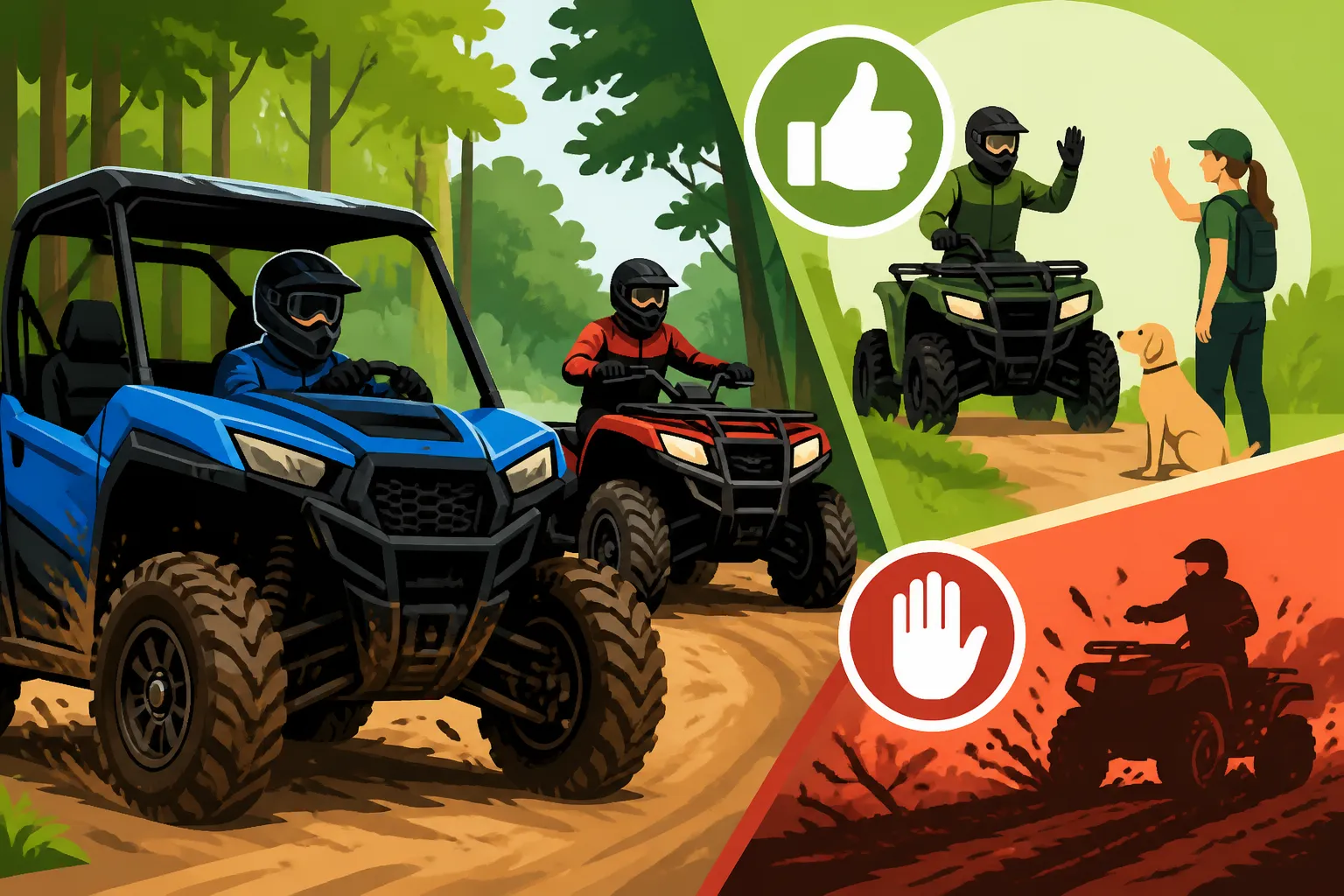
| A hunter, hiker, or camper nearby | Reduce speed, noise, and dust | Revving or riding close to them |
| A logging or maintenance vehicle | Stop in a visible, safe spot | Trying to squeeze past equipment |
| A muddy, damaged trail | Turn back if riding would cause damage | Cutting a new bypass |
| A group stops to regroup | Pull clear of the travel path | Blocking a junction or road |
If you use a mapping app such as onX Offroad to help organize the route, share the plan with the group before the ride and make sure riders know where to stop if the group gets separated. Keep a paper or offline backup when practical, and treat signs and instructions from the land manager as authoritative. The goal is not to follow a line at all costs; it’s to keep the ride within the access that has actually been granted.
Leave the trailhead and riding area clean
Pack out everything you bring in, including food wrappers, cans, zip ties, broken straps, and parts that fall off a machine. Don’t leave a damaged machine or discarded gear at the trailhead unless the manager has told you what to do. If a group has been working on a machine, check the staging area before leaving so small items don’t get left in the grass.
Park without blocking gates, access roads, or other trailers. Keep vehicles and trailers within marked areas, and avoid driving over vegetation to make room. A crowded parking area is frustrating, but making your own space can create damage or block emergency access. [Leaving a Southern Trailhead Tidy] is a simple principle worth carrying through the whole ride.
If you notice a hazard, damaged sign, or trail problem, report it to the appropriate land manager or park staff. Be specific about the location and what you saw, and don’t try to repair infrastructure unless you’ve been asked to do so. Good etiquette includes helping the people responsible for the area understand what needs attention.
Ultimately, considerate riding is a mix of preparation, patience, and restraint. Check access before you go, follow signs, give others room, and turn back when conditions or closures make a route inappropriate. These habits help keep Mississippi’s riding areas safer and more welcoming for everyone.
Disclaimer
This article is for general informational purposes only and does not constitute professional advice. Laws, prices and regulations vary by location and change over time. Consult a qualified professional for guidance on your specific situation.