Mississippi Trails With Deep Mud
Mississippi’s clay, sand, pine-country roads, and sudden downpours can turn an ordinary ride into a deep-mud recovery job. The tricky part is finding a place where challenging mud is allowed, your machine fits the rules, and conditions are safe enough to ride. This guide explains where to look, what to check before hauling out, and how to prepare for a muddy Mississippi trail day.
Where to find deep mud riding in Mississippi
Start with private mud parks
If deep mud is the main reason for your ride, a private off-road park is often a more appropriate place to look than a public forest road. Parks may have purpose-built mud features, but each property sets its own rules about which machines can enter, where riders may go, and what equipment is required. Check those rules directly before you leave home; a park’s general reputation for mud does not tell you whether a particular trail or feature is open that day.
[Mississippi Private Mud Parks] is a useful starting point for comparing the kinds of riding areas available. You can also look into [Red Creek Off-Road in Mississippi] and [Mudslangers Off Road Trails and Its Duck Pond], then contact each venue to confirm access, machine restrictions, fees, and current conditions. Don’t assume that a muddy-looking feature is open to every rider or that a park allows every size of side-by-side.
Private parks can be a better fit for a group with mixed experience, too. Riders who want to tackle mud can choose an appropriate feature while less-experienced friends stay on easier ground. Ask whether the park has marked routes, a wash area, recovery expectations, or areas that become off-limits after heavy rain. Those details can make a big difference when someone gets stuck far from the staging area.
Check public riding areas carefully
Public riding areas are not necessarily mud parks. Bethel OHV Trail in the De Soto National Forest is a named public riding option, but riders should check its current rules and conditions rather than assuming that wet weather means more open mud riding. Start with [Bethel OHV Trails in Mississippi] and [Mississippi National Forest Riding Explained] to understand the distinction between a designated riding area and other forest roads or land.
A public trail can close after rain, or a particular route can be unsuitable for your machine even when the broader riding area is open. The [Mississippi Trail Conditions After Rain] and [Mississippi Trail Closures After a Storm] guides can help you build a pre-trip checklist. For a same-day decision, check with the managing office or park directly. A map, a recent social post, or a friend’s report may not reflect a closure that happened after the information was shared.
Compare the kind of ride before you choose
“Deep mud” can mean very different things: a short mud hole beside a trail, a series of waterlogged ruts, or a purpose-built bog where riders expect to use a winch. Think about the experience your group actually wants. A stock ATV with moderate tires and a new rider aboard may be happier on a wet trail with occasional puddles than in a long, deep bog.
| Riding option | What it may suit | What to verify before you go |
|---|---|---|
| Private mud park | Riders seeking designated mud features or a more challenging day | Machine limits, open areas, rules, fees, recovery expectations |
| Public OHV trail | Riders who want a managed trail experience | Current access, closures, vehicle fit, trail conditions |
| National forest roads | Riders checking whether a specific route is legally open to their machine | Designation, signs, road status, applicable pass or access rules |
| Private hunting or timber land | Riders with permission from the landowner or lease manager | Written permission, boundaries, gates, seasonal restrictions |
For broader location ideas, see [Mississippi ATV Trails: Where to Ride]. A location appearing on a map does not automatically mean that ATVs or UTVs may use every road on that property. Confirm the specific route, not just the general place name.
How to choose a trail that fits your machine and group
Match the trail to your ATV or UTV
Width, weight, tires, ground clearance, and passenger setup all affect where a machine can go. Don’t decide that a route will work just because your machine is marketed as an off-road vehicle. The rules of the riding area matter, and a narrow forest trail can be a poor match for a wide side-by-side even if the trail looks passable in photos.
Before booking or loading up, ask the park or managing office whether your exact vehicle type and width are allowed. If you ride a side-by-side, start with [Mississippi Trails That Allow Side-by-Sides]. Confirm whether the limit applies to the machine’s overall width, whether passengers are allowed, and whether any trail sections have separate restrictions.
Also think about ground clearance and tires. A vehicle can meet an area’s size rules and still be poorly equipped for deep ruts, submerged branches, or soft ground. A lift or aggressive tires may help in some conditions, but they do not make a questionable crossing safe. If you can’t tell how deep the water is or what lies beneath it, don’t use momentum as a substitute for information.
Be realistic about rider experience
A first mud ride should not be a competition. New riders may find it difficult to judge water depth, choose a safe line, or recognize when the tires are spinning without making progress. A more experienced rider can help, but it’s still sensible to choose an area with a clear way to turn around and recover a machine.
Set expectations with your group before arriving. Agree that anyone can opt out of a feature without being pressured. Keep riders together, and decide who will lead and who will sweep at the back. If the group includes children or passengers, check the riding area’s age, helmet, and passenger rules ahead of time rather than trying to sort them out at the gate.
It’s also worth discussing what happens if a machine becomes stuck. Who has a winch? Who knows how to use it? Does the park provide recovery help, or are riders expected to handle it themselves? A quick conversation in the parking area is easier than trying to invent a recovery plan when a vehicle is buried in a rut.
Use maps as planning tools, not permission
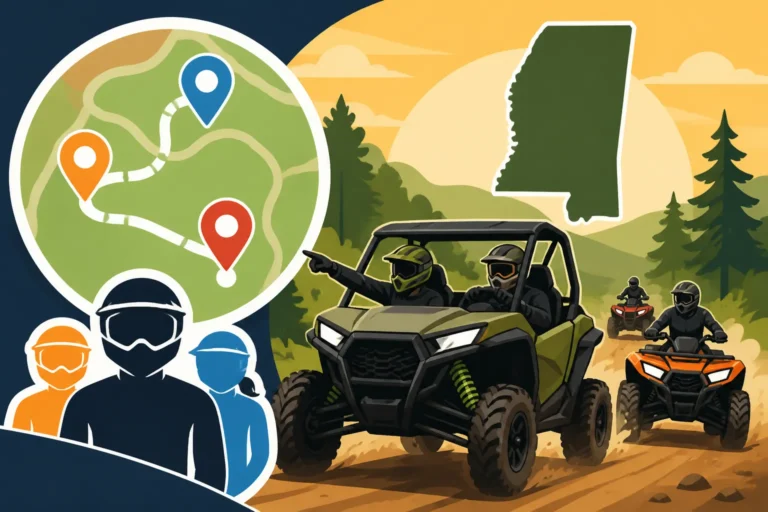
Digital maps can help you compare routes, note trailheads, and keep a group oriented. onX Offroad may be useful as one planning aid, but a mapped line should never be treated as proof that a trail is open or legal for your machine. Verify access with the land manager or property owner and obey posted signs and gates.
Before leaving home, save the location of your trailhead and a backup route to the nearest paved road. If you use onX Offroad or another mapping tool, make sure you know how it behaves when cell service drops and have a backup plan, such as an offline map or a paper map where appropriate. Cell coverage can be unreliable in rural areas, and a screen that won’t load is not much help when your group has split up.
For an overview of mapping options and preparation, see [Mississippi ATV Trail Map Downloads]. Use a map to support good decisions—not to override closures, land boundaries, or a sign that says the road is closed.
Preparing for a deep-mud ride
Check conditions and access before you load
Rain can make a trail more challenging, but it can also make it unsafe or cause a closure. A trail that was rideable last weekend may now have standing water, damaged sections, or restrictions in place. Check the park or land manager’s current notices before you tow your machine across Mississippi. If the status is unclear, call and ask whether the route is open for your vehicle type and whether recent weather has affected access.
Keep a short list of questions ready:
- Is the area open to ATVs, UTVs, or both?
- Are any trails or mud features closed today?
- Are there width, sound, passenger, or equipment requirements?
- Is there a designated staging or trailer-parking area?
- Are recovery services available, or must riders bring their own equipment?
- Are there special rules about washing machines or disposing of mud?
Check conditions again before you set off, especially if rain is forecast. If the area closes, don’t try to find an unofficial route around the closure. Choose another approved place or reschedule. The [Mississippi Trail Etiquette Locals Expect] guide is also worth reviewing before riding with other groups or using shared trails.
Pack for traction, recovery, and a long day
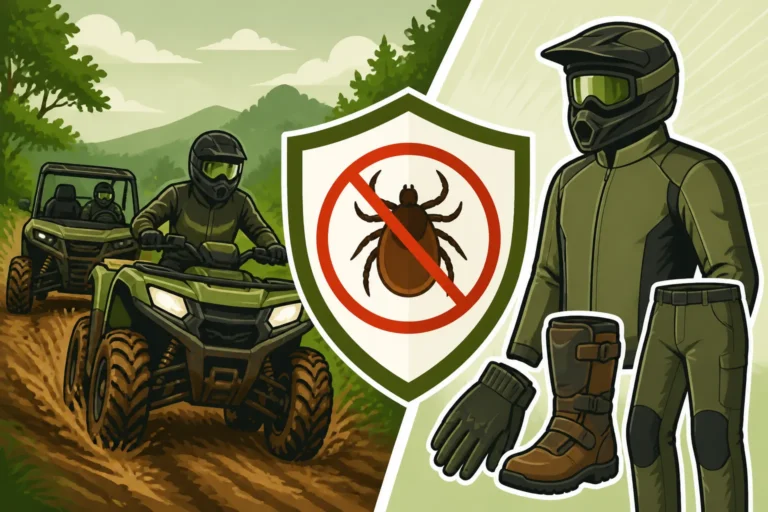
A mud ride can take longer than expected. Bring water, food, a first-aid kit, a charged phone, and the clothing you’ll need if you get wet and the temperature drops. Wear a helmet and suitable eye protection, and use protective footwear that won’t easily come off in mud. Keep loose straps and clothing away from wheels and other moving parts.
For the machine, consider a basic pre-ride check: inspect tires and wheels, confirm the battery is secure, look over the brakes and lights, and make sure the winch—if installed—works before you need it. Carry recovery gear appropriate to your machine and know how to use it. A winch is not a reason to enter water you cannot evaluate; it is one tool in a plan that should also include turning back.
Mud and water can hide debris and make footing unstable. If a machine gets stuck, avoid standing in the path of a loaded recovery line. Keep bystanders clear, use rated recovery equipment, and follow the equipment maker’s instructions. If you don’t know how to recover a vehicle safely, ask the park about help or stay out of the feature.
Ride with respect for the land and other visitors
Repeatedly spinning tires in the same spot can deepen ruts and damage trails. Stay on routes the property manager has designated, avoid cutting around a closed section, and give other riders room to pass. On public land, posted access rules and closures still apply even when a shortcut looks harmless.
Good etiquette also means leaving a gate as you found it, keeping noise under control, and not sending mud or water toward another rider’s face or machine. If a trail is crowded, wait your turn instead of trying to force a pass through a narrow or muddy section. For a longer ride on forest land, review [Mississippi Forests With No OHV Trail] so you don’t mistake a forest road for an authorized ATV route.
What to do when conditions are worse than expected
Turn around before a small problem becomes a recovery
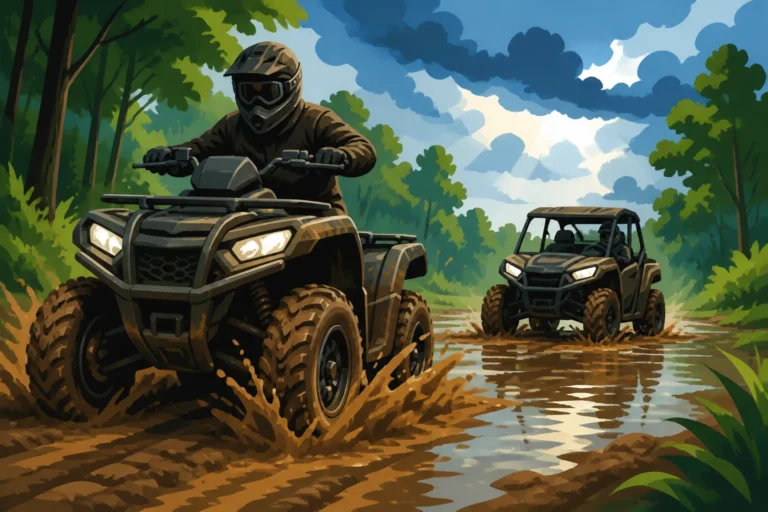
A route that looks manageable from the seat can hide deep ruts, soft shoulders, or a hole with an abrupt drop. Stop before entering a crossing if you cannot judge its depth or see a safe exit. Walking a section may help you assess it, but only do so where it is safe to leave the machine and the ground is stable. Never wade into water if you can’t assess the footing, current, or hazards.
If the trail is getting worse, the group is running low on daylight, or a rider is uncomfortable, turn back. That can feel disappointing when you’ve driven a long way, but a muddy day is not a test of who can get stuck the deepest. A conservative decision often saves time, equipment, and stress.
Keep the group together and communicate
Before riding, choose a meeting point in case the group becomes separated. Agree on simple signals for stopping, slowing down, or reporting a problem. Keep enough space between machines to avoid being struck by mud or debris, but don’t leave so much distance that a rider disappears around a turn without anyone noticing.
If someone is stuck, pause the rest of the group in a safe location. Don’t have several machines crowd around the recovery area or pull from improvised attachment points. If the park has staff or a designated recovery process, follow it. If you are on public land, use the appropriate contact information for the managing office or emergency services when needed.
A deep-mud ride in Mississippi can be a great day out when the location, machine, and conditions line up. Choose a place that permits the kind of riding you want, verify the rules directly, and be ready to turn around when the ground or weather changes. The best ride is not the one that leaves the most mud on the machine; it’s the one where everyone and everything makes it back to the trailer safely.
Disclaimer
This article is for general informational purposes only and does not constitute professional advice. Laws, prices and regulations vary by location and change over time. Consult a qualified professional for guidance on your specific situation.