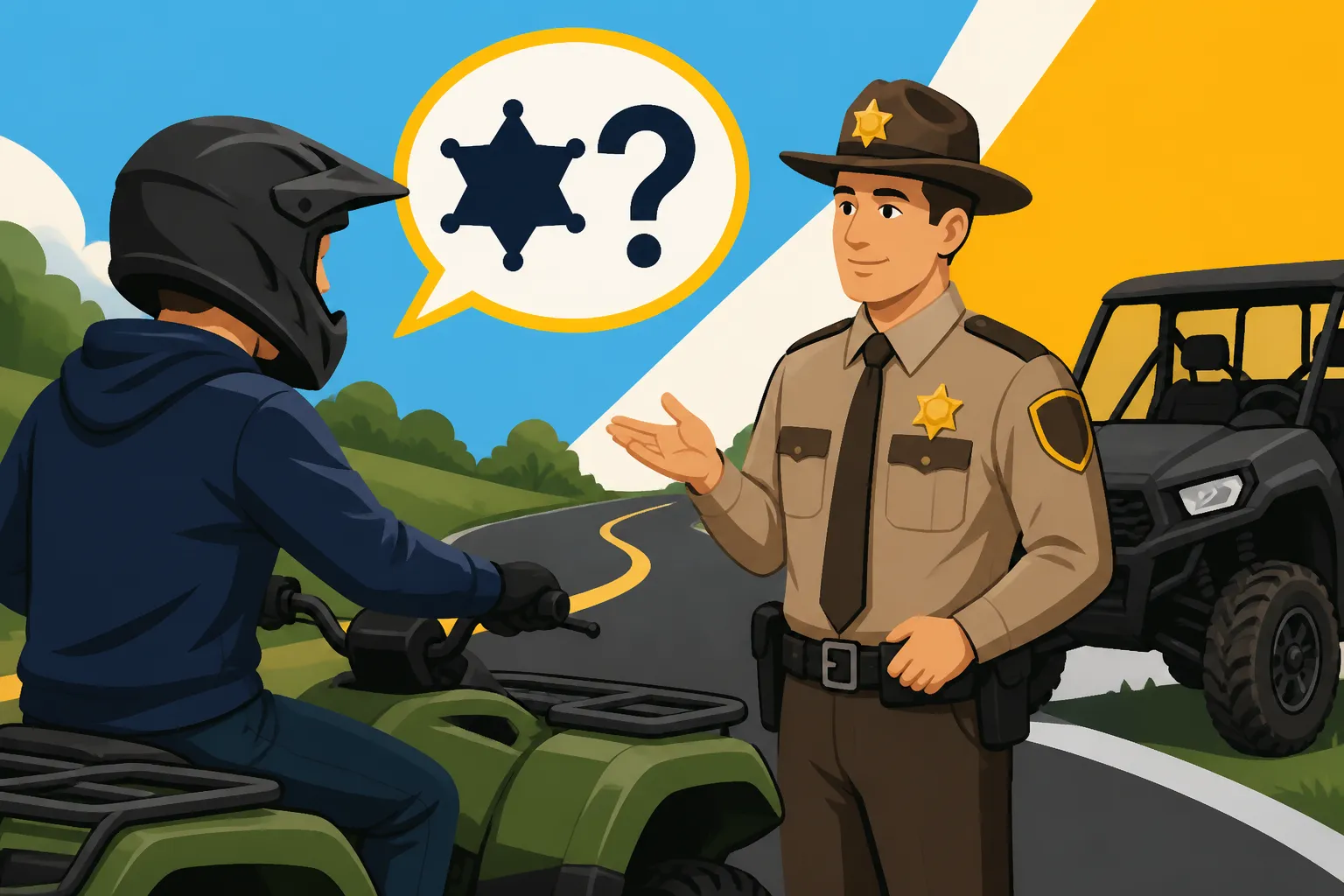
Asking the Sheriff’s Office About Road Riding
A ride route can look harmless on a map and still put you on a public road where an ATV or UTV is not allowed. Calling the sheriff’s office can help you understand local enforcement, but it is important to ask the right questions: an informal answer is not the same as legal permission. This guide explains how to prepare, what to ask, and what to do with the response.
What the sheriff’s office can and cannot tell you
A sheriff can explain enforcement, not create an exception
In Mississippi, an ATV or UTV being titled, insured, or equipped with lights does not automatically make it legal to ride on a public road. State law and applicable local rules determine where a machine may be operated. A deputy or dispatcher can help explain how the sheriff’s office handles complaints and stops, but a verbal okay from an employee does not change the law or create a new road-use exception.
That distinction matters when a route includes a short stretch of pavement between a home, a trail, and a private property entrance. A neighbor may say riders use the road all the time, or someone at a store may tell you that a particular county “doesn’t care.” Neither is dependable legal permission. Ask what rule applies and who has authority to confirm it. For a broader overview of the state framework, read [Can You Ride an ATV on the Road in Mississippi?] and [Mississippi ATV Road Rules Under 63-31-3].
If the answer is unclear, do not treat uncertainty as approval. Ask for the name of the office or agency responsible for the relevant rule, and request the ordinance or statute number if one applies. If the situation involves a city street, the municipality may be the right place to verify local rules; if it involves a county road, the county or sheriff’s office may be able to point you toward the correct authority.
A dispatcher’s answer may be general rather than location-specific
When you call, you may reach a dispatcher who handles many kinds of urgent and non-urgent calls. They may be able to explain the office’s general approach, but may not know the details of a particular neighborhood ordinance, road classification, or private-land agreement. That is not necessarily a brush-off. It may mean your question needs to go to a supervisor, city clerk, county attorney, or another office.
Be especially careful with broad answers such as “you can ride on back roads” or “it’s fine if you stay close to home.” Ask what the answer means for the specific road you have in mind. Is it a public county road, a city street, a private road, or a trail on land where you have permission? Those categories can lead to very different answers.
A useful follow-up is: “Could you tell me which office can confirm that in writing?” That keeps the conversation practical and helps you avoid relying on a casual statement that may not apply to your exact route. You can also compare what you are told with [Mississippi Local Ordinances Are the Only Path], while remembering that a local rule cannot simply override state law.
How to prepare before you call
Identify the road and the machine
Before contacting the office, write down the road name, nearby cross streets, town or community, and the specific segment you want to use. If you know whether the road is maintained by the city, county, or state, include that information. If you do not know, say so and ask which office can identify the road’s status. “Can I ride near my house?” is harder to answer than “Can I operate this machine on the public section of Oak Street between these two intersections?”
Describe your machine accurately. Say whether it is an ATV or a side-by-side, and give its make, model, and general configuration if asked. Do not assume that a UTV is treated like a golf cart simply because it has seats, a steering wheel, or a windshield. Road rules can distinguish between vehicle types, and a side-by-side should not be described as a golf cart unless the relevant legal definition actually fits. For questions focused on that distinction, see [Mississippi Rules for a Side-by-Side Driver].
It also helps to clarify your purpose. Are you asking about riding along a road, crossing it to reach a trail, moving a machine between two pieces of private property, or driving to a local business? Those are different scenarios. If your question is specifically about crossing rather than traveling along the road, ask about that separately and review [Mississippi Rules for Crossing a Highway]. Do not assume that a rule for one situation applies to the other.
Gather details that help the office give a precise answer
A simple call sheet can keep the conversation focused:
| Detail to prepare | Why it helps |
|---|---|
| Exact road and segment | The answer may depend on whether it is a city street, county road, state highway, or private road |
| Machine type | ATVs, UTVs, golf carts, and low-speed vehicles may be treated differently |
| What you intend to do | Crossing a road is different from riding along it |
| Time and conditions | Night riding, passenger use, or a planned group ride may raise separate questions |
| Existing local guidance | A posted sign or ordinance may affect the answer, but should be verified |
If the ride involves private land, bring the landowner’s permission into the conversation, but do not assume it permits use of a public road to reach the property. Likewise, an ATV title or bill of sale may help establish ownership, yet ownership documents do not by themselves authorize road use. If your question is about what to carry during an encounter, [What Happens When a Deputy Stops You Riding] can help you think through the distinction between ownership paperwork and permission to operate in a particular place.
For a multi-town route, list every road segment and municipality involved. A route may start on private land, pass through an unincorporated area, and then enter city limits. One answer from one office may not settle the rules for the entire trip. Check each relevant jurisdiction instead of relying on the most permissive answer you hear.
Questions to ask during the call
Ask for the rule, the location, and the responsible authority
Start with a concise description: “I have an ATV or side-by-side, and I’m trying to determine whether I may use this specific road segment. Can you tell me what rule applies, or direct me to the office that can confirm it?” Then pause and let the person clarify what information they need.
If the person says riding is allowed, ask what makes it allowed. Is there a written town ordinance? Does the answer concern only a road crossing? Is the road private? Does it apply to your vehicle type, or only to golf carts and low-speed vehicles? These questions are not meant to argue; they help prevent a misunderstanding that could lead to a citation or an unsafe ride.
Ask for a copy, public link, or identifying number for any relevant ordinance or written policy. If the sheriff’s office does not keep that information, ask whether the city clerk, county administrator, county attorney, or road department is the proper contact. For help checking the local-government side of the question, see [How to Check If Your Town Has an Ordinance] and [Asking Your County Supervisor Where You Can Ride].
Use direct questions rather than asking for a vague yes or no
A yes-or-no question can hide important conditions. Instead of asking, “Can I ride my UTV on the road?” ask questions that define the situation:
- “Does this answer apply to the exact road segment I named?”
- “Does it apply to an ATV, a side-by-side, or both?”
- “Does it cover riding along the road, or only crossing it?”
- “Is the permission written in a statute or local ordinance?”
- “Are there limits on hours, passengers, equipment, or the route?”
- “Which office can confirm the rule in writing?”
If the response is “we don’t usually stop people,” clarify that enforcement habits are not the same as legal authorization. A quiet road may have little traffic, but a complaint, crash, road project, or change in patrol activity can bring attention to the same ride. The safest decision is based on the rule, not the odds of being stopped.
Take notes while you speak: the date and time of the call, the office you reached, the name or role of the person if offered, and the exact wording of the guidance. Notes are useful for follow-up, but they are not a substitute for an ordinance or other authoritative written rule. If the answer conflicts with a posted sign or written law, pause and verify before riding.
What to do after the call
Confirm the answer before planning the ride
If the office points you to a local ordinance, read the actual text and check that it covers your vehicle and the location you plan to use. An ordinance about golf carts may not apply to an ATV or UTV. A rule for a particular city may end at the city limit. A statement about a crossing may not authorize riding down the road. This is where checking the exact wording matters more than relying on a neighbor’s interpretation.
If two offices give different answers, ask each one to identify the legal basis for its response. You can also contact the municipal clerk or county attorney’s office for clarification. Keep your question narrow and factual: name the machine, route, and intended use. A general question about “ATV road rules in Mississippi” can produce general guidance that misses a key detail in your situation.
When no one can confirm that road use is permitted, choose a route that avoids public roads. Arrange a trailer, use a legal access point, or ride only on land where you have permission and where machine use is allowed. If a route depends on a private road, get the landowner’s permission directly and establish where the private road ends and the public road begins.
Do not confuse safety accessories with road approval
Helmets, lights, mirrors, flags, seat belts, and other equipment can matter for safety or for rules at a specific riding location. They do not, by themselves, make an off-road machine street legal. Accessory sellers such as SuperATV may offer equipment intended to improve visibility or comfort for off-road use, but adding accessories should never be treated as proof that a machine is authorized on a public road.
If you already own road-oriented accessories, describe them accurately if an officer asks, but do not lead with them as a reason you believe the ride is legal. The central questions remain whether the road is open to that vehicle type and whether state or local rules permit the activity. SuperATV equipment may be useful for trail visibility or protection, but the product itself cannot grant road access.
For a road crossing or a short transition between riding areas, confirm the rules before you set out, rather than deciding at the edge of the pavement. If you cannot verify that the movement is allowed, avoid making it. SuperATV accessories, a title, a safety course, and landowner permission may each serve separate purposes, but none should be assumed to replace the legal authority needed for public-road operation.
Keep a record and reassess when circumstances change
Save any written answer, ordinance copy, or official contact information with your machine paperwork. If you ride with family or a group, share the actual rule rather than passing along a simplified version like “the sheriff said it’s okay.” Include the road segment and any conditions so that other riders do not mistakenly apply the answer elsewhere.
Recheck before using a different road, entering a new town, riding at night, carrying a passenger, or joining an organized event. A route that begins legally on private property may still reach a public road where the rules change. Signs, temporary closures, construction, or a change in local policy may also affect access.
The most useful call is one that ends with a clear next step: a written ordinance to read, a specific official to contact, or confirmation that the planned public-road ride is not permitted. If you cannot establish that it is allowed, do not rely on a casual verbal assurance. Choose a legal route and keep the machine off public roads unless the applicable rules clearly authorize the particular use.
Disclaimer
This article is for general informational purposes only and does not constitute professional advice. Laws, prices and regulations vary by location and change over time. Consult a qualified professional for guidance on your specific situation.