Why a Cart Ordinance Does Not Cover a UTV
It's incredibly frustrating when you're looking for ways to enjoy your UTV, perhaps even run a quick errand, and you hear whispers about golf cart ordinances opening up local roads. You might think, "My side-by-side is basically a souped-up golf cart, right? It's got headlights, seatbelts, a horn… why can't I just get it approved under the same rules?" Unfortunately, this line of thinking often leads to confusion and potential legal trouble because, in Mississippi, the law draws a very distinct line between a golf cart and an off-road vehicle like your UTV, even if they share some superficial similarities. This guide is here to help you understand precisely why a local golf cart ordinance won't extend to your UTV, saving you from headaches and fines down the road.
The Fundamental Legal Divide: Why Mississippi Sees Carts and UTVs Differently
When we talk about vehicles and their legality on public roads in Mississippi, it's crucial to understand that the law isn't just looking at what a machine looks like, but what it's defined as and designed for. This is where the core difference between a golf cart and a UTV truly lies in the eyes of the state.
Distinct Legal Definitions in Mississippi Law
Mississippi has specific legal definitions for different types of vehicles, and these definitions are the bedrock of what's allowed where. A golf cart, by statutory definition, is generally a low-speed, four-wheeled vehicle designed for operation on a golf course. It typically has a top speed that doesn't exceed 20 or 25 miles per hour and is built for traversing manicured greens and paths, not public thoroughfares. These vehicles are designed with light-duty use in mind, primarily for recreational purposes on private property. [Mississippi Golf Cart Statutes] clearly lay out these parameters.
On the other hand, your UTV, or utility task vehicle, falls under the broader category of an off-road vehicle (ORV) or recreational off-highway vehicle (ROV). These machines are built for much more rugged terrain, higher speeds, and greater utility. Think about the heavy-duty suspension, the powerful engines, and the significant ground clearance that make your UTV perfect for hunting, farming, or tearing through mud. These design elements push them far beyond the definition of a golf cart. Even if you've added turn signals and a horn from a company like SuperATV, the fundamental classification by the state as an off-road machine remains unchanged. You can find these distinctions outlined in [Mississippi ATV and ROV Legal Definitions].
Intended Use vs. Actual Use
One of the biggest misunderstandings comes from thinking that if you use your UTV like a golf cart (i.e., driving it slowly around a neighborhood), it becomes a golf cart in the eyes of the law. This is a common pitfall. The law cares about the intended design and purpose of the vehicle, not how an individual operator chooses to use it on a given day. A UTV is intended for off-road use, hauling, and tackling challenging terrain. Its robust construction, higher horsepower, and often larger footprint are all indicators of this primary purpose.
Consider a pick-up truck. You might use it to haul groceries, much like a sedan, but it doesn't suddenly become a sedan in the eyes of the Department of Public Safety. It's still a truck, subject to truck regulations. The same principle applies here. Your UTV, regardless of your personal use case or any street-legal conversion kits you might install, is still fundamentally classified as an off-road vehicle due to its manufacturer's original design and specifications. This distinction is crucial because it dictates where and how the vehicle can be legally operated.
Design Differences: More Than Just a Golf Bag Carrier
While a golf cart and a UTV might both have four wheels, a steering wheel, and seating, their engineering and safety features are fundamentally different, and these differences are a major reason why their road-use regulations diverge so sharply.
Safety Standards and Construction
Golf carts are designed for low-speed environments, often on private property or within contained communities. Their construction reflects this. They typically have lighter frames, less sophisticated suspension systems, and braking systems intended for slower speeds and flatter surfaces. The safety features, such as basic seatbelts or grab handles, are appropriate for their intended environment.
UTVs, on the other hand, are engineered for much more demanding conditions. They feature robust roll-over protection systems (ROPS), heavy-duty frames, advanced suspension designed to absorb significant impacts, and powerful braking systems capable of stopping a heavier machine at higher speeds. They also often come with higher ground clearance, larger tires (sometimes from brands like SuperATV, built for aggressive traction), and powerful engines that produce significantly more torque and speed than a typical golf cart. These features, while excellent for off-road adventures, are part of what categorizes them as off-road vehicles rather than low-speed road-going machines. The very design choices that make a UTV capable of tackling a challenging trail are precisely what set it apart from a golf cart in a regulatory sense.
Speed and Power Capabilities
Perhaps the most obvious difference lies in their performance. Most golf carts are speed-limited, either by design or by regulation, to 20-25 mph. This controlled speed is a key factor in why some municipalities consider them safe enough for limited road access. They simply don't have the power to keep up with regular traffic, making them less of a hazard when integrated into specific low-speed zones.
UTVs, conversely, are built for power and performance. Even a "utility" UTV can often reach speeds far exceeding typical golf cart limits, and sport UTVs can easily hit highway speeds. This greater power, acceleration, and top speed mean they present a different set of risks and challenges when sharing roads with cars, trucks, and motorcycles. Their ability to accelerate quickly and travel at higher speeds demands different safety considerations and, therefore, different legal classifications. Simply put, a machine capable of 60 mph on a dirt trail isn't going to be treated the same as one maxing out at 20 mph on a paved path, regardless of how you modify it.
Local Ordinances vs. State Law: The Crucial Discrepancy
This is where many riders get tripped up. They hear about a local town allowing golf carts on certain streets and assume that this local rule somehow overrides or extends to their UTV. The reality is far more complex and involves understanding the hierarchy of laws in Mississippi.
State-Level Road Bans for Off-Road Vehicles
The fundamental issue is that [Mississippi Bans ATVs on Public Roads]. This state law is broad and comprehensive. It generally prohibits the operation of off-road vehicles, which include ATVs and UTVs, on any public street, road, or highway. There are very, very few exceptions, and these are usually for specific agricultural purposes (and even then, with strict limitations) or for law enforcement/emergency services. There is no blanket "farm road exception" as some might hope. The state's position is clear: these machines are not designed or intended for public road use. [Mississippi Code Section 63-31-3] outlines this prohibition in detail, making no distinction between a "small" UTV and a "large" one.
This state-level prohibition acts as an umbrella over local regulations. A city or county cannot pass an ordinance that directly contradicts state law. They cannot, for example, declare that UTVs are now street legal across their jurisdiction, because the state has already said they are not. This is why even when towns like Hattiesburg or Ocean Springs pass ordinances for low-speed vehicles, they specify golf carts or Low-Speed Vehicles (LSVs), not ATVs or UTVs. [Mississippi Towns That Refuse ATVs on Streets] often do so precisely because they cannot override state law.
The Limited Scope of Golf Cart Ordinances
Local golf cart ordinances are very specific and operate within the confines of state law. They might allow golf carts on certain streets within city limits, usually those with lower speed limits (typically 30 mph or less), during daylight hours, and often with specific safety equipment requirements (headlights, taillights, turn signals, horn, mirror). [Mississippi Golf Cart and LSV Ordinances] are designed for machines that already fit the legal definition of a golf cart or LSV, which are generally slow-moving electric vehicles built to federal safety standards for low-speed vehicles.
These ordinances are not a loophole for UTVs. Even if your UTV has all the accessory lights and mirrors you bought from SuperATV, it still doesn't change its fundamental classification as an off-road vehicle under state law. Attempting to use a golf cart ordinance to justify riding a UTV on public roads is a misunderstanding that can lead to significant fines and penalties. A local deputy or city police officer is bound by state law, and they know the difference between a cart and a UTV. The consequence for non-compliance can be an inconvenient stop and a ticket for [Mississippi Penalties for an Illegal Road Ride].
Navigating the Rules: What UTV Owners Can Do in Mississippi
So, if public roads are largely out, what can you do with your UTV in Mississippi? The good news is that there are still plenty of fantastic opportunities to enjoy your machine responsibly and legally.
Sticking to Designated Off-Road Trails and Private Land
The most straightforward and legal way to enjoy your UTV in Mississippi is on designated off-road trails and private property with permission. Mississippi boasts some incredible riding areas, from national forest trails to private mud parks. Places like Bethel OHV Trails in the Bienville National Forest offer miles of marked trails designed specifically for off-road vehicles. Similarly, private parks such as Red Creek Off-Road and Meridian OHV Park provide diverse terrains, from mud pits to challenging rocky sections, where your UTV can truly shine. These locations understand and cater to the specific needs of UTVs and ATVs.
When riding on private land, always ensure you have explicit permission from the landowner. Trespassing is a serious offense, and it can quickly sour relations between riders and property owners. For public lands, always check the specific rules and regulations of that area, as they can vary. For example, [Mississippi WMA Riding Rules] often restrict off-road vehicles to designated roads during certain times of the year.
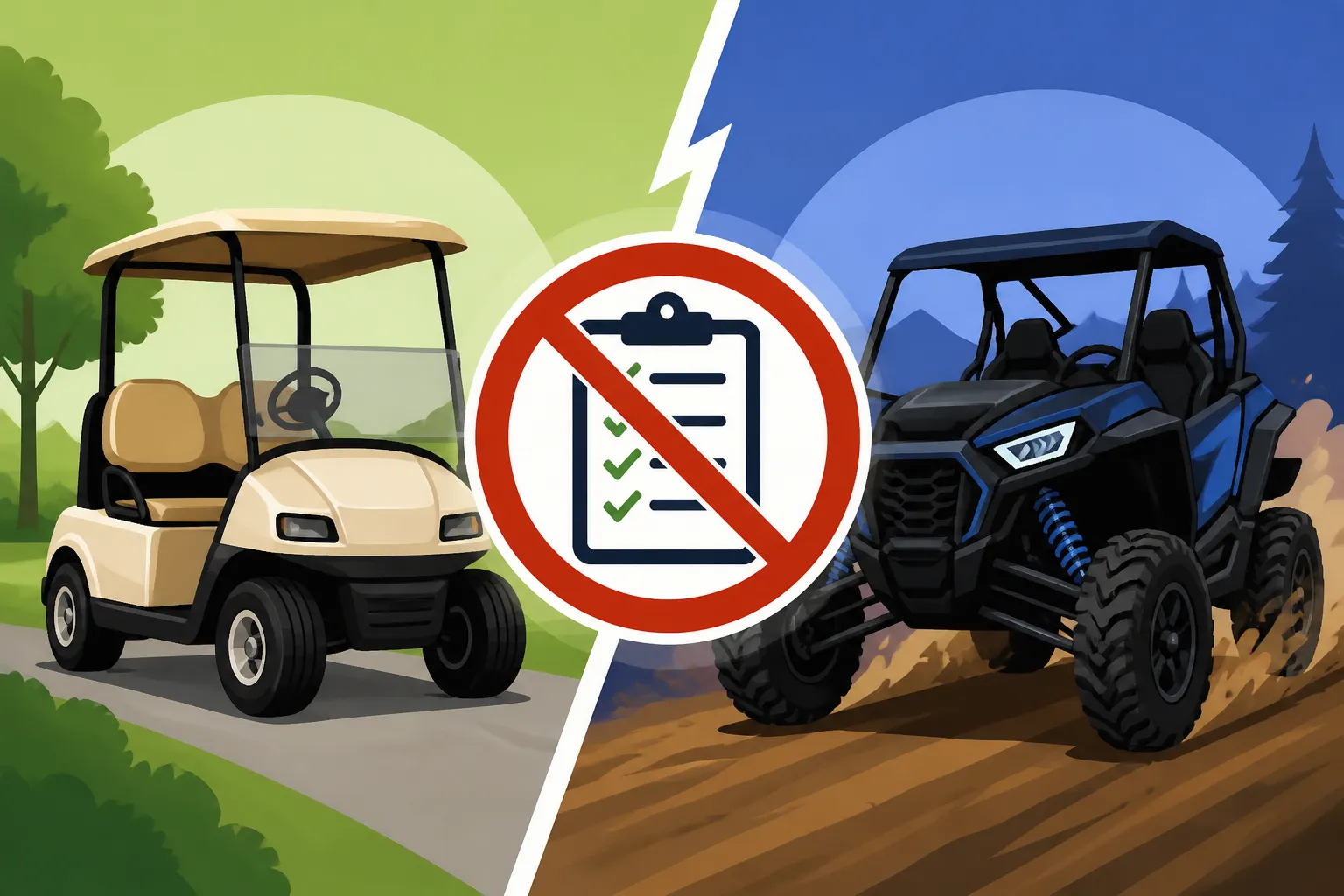
| Feature | Typical Golf Cart | Typical UTV / ROV |
|---|---|---|
| Primary Design | Low-speed transport on golf courses/private communities | Off-road recreation, utility, hunting, farming |
| Top Speed | 15-25 mph (often speed-limited) | 30-70+ mph |
| Engine/Power | Small electric motor or gas engine (low HP) | Powerful gas engines (significant HP & torque) |
| Suspension | Basic, light-duty | Advanced, long-travel, heavy-duty for rough terrain |
| Frame/ROPS | Lighter frame, minimal or no rollover protection | Heavy-duty frame, integrated Roll-Over Protection System |
| Tires | Street-oriented or turf-friendly, low-speed rating | Aggressive tread, high-ply, off-road specific (e.g., SuperATV tires) |
| Road Legality | Allowed on specific low-speed local roads by ordinance | Generally banned on all public roads by state law |
| Safety Features | Basic seatbelts, minimal lighting | Full seatbelts, often advanced lighting, robust chassis |
Exploring Potential Avenues for Limited Road Use (With Caveats)
While outright street legality for UTVs on general public roads is highly unlikely under current Mississippi law, it's worth understanding the very narrow paths that might exist or that people sometimes confuse.
One such area is when operating on a private road that looks public but is legally maintained as private. Another is for specific agricultural use cases, where a UTV might be allowed to cross a public road or operate on the shoulder for very limited distances when moving between fields. However, these are exceptions, not rules, and they are typically accompanied by strict conditions, such as flashing lights, slow speeds, and direct routes. Always verify with local law enforcement or the Department of Public Safety before assuming such an exception applies to you. Ignorance of the law is not a defense, and misinterpreting these limited allowances can still result in a citation. [Mississippi Law Flatly Bars ATVs From Public Roads] underscores the severity.
Finally, while not making your UTV street legal, ensuring your machine is properly insured is always a wise decision. Even if not mandated by law for off-road use, an ATV insurance policy can protect you from liability and cover damages to your machine in case of an accident. [Why Mississippi Riders Still Buy ATV Insurance] is a good resource to consider. This way, even if you can't hit the pavement, you can still enjoy your rides with peace of mind.
Ultimately, understanding the clear distinction between a golf cart and a UTV in Mississippi law is paramount. By sticking to designated riding areas and respecting state statutes, you can safely and legally enjoy your machine without the frustration of navigating legal grey areas that often don't exist.
Disclaimer
This article is for general informational purposes only and does not constitute professional advice. Laws, prices and regulations vary by location and change over time. Consult a qualified professional for guidance on your specific situation.