Mississippi Rules for a Visiting Louisiana Rider
Many of us from neighboring states, especially Louisiana, often dream of loading up our ATVs or UTVs and heading across the Mississippi border for some fresh trails and scenery. However, without a clear understanding of Mississippi's unique laws and regulations for off-road vehicles, that exciting day trip can quickly turn into a frustrating encounter with law enforcement or, worse, an expensive ticket. This guide is here to walk you through everything a visiting Louisiana rider needs to know about Mississippi's ATV and UTV rules, from navigating public road access to understanding required paperwork and finding legitimate riding spots, helping you avoid common missteps and enjoy your ride responsibly.
Understanding Mississippi's Strict Road Rules for ATVs and UTVs
For many out-of-state riders, particularly those from Louisiana where road access laws might be more varied or permissive, Mississippi's stance on ATVs and UTVs on public roads is often the biggest surprise and a critical point of confusion. It’s absolutely essential to grasp this fundamental difference before you even consider trailering your machine across the state line.
The Flat Ban on Public Roads
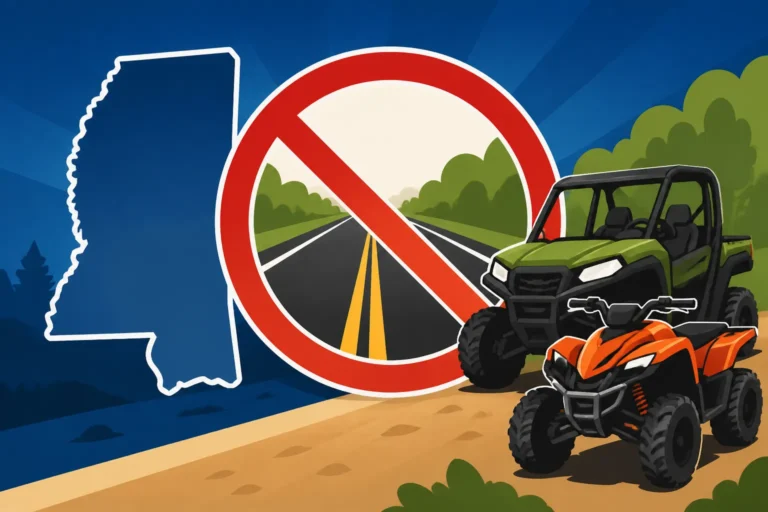
Let's get straight to the point: Mississippi has a very straightforward and strict prohibition against operating ATVs and UTVs on public roads and highways. This isn't a recommendation or a guideline; it's a firmly established legal reality, deeply ingrained in [Mississippi's ATV Law Is Only Two Sections Long], particularly [Mississippi Code Section 63-31-3]. This means that whether you're talking about bustling four-lane highways, quiet rural county roads, or even the small, paved streets within a town, your ATV or UTV is, with extremely limited exceptions, not permitted to be ridden on them.
Imagine you've just unloaded your side-by-side at a buddy's hunting camp, and you're thinking of taking a short spin down the county road to scout a different section of land, or perhaps just to get a feel for the local area. In many other places, this might be a common practice. In Mississippi, however, this seemingly innocent maneuver could lead to a quick stop by a sheriff's deputy, resulting in a citation. The state categorizes ATVs and UTVs as off-road machines, purpose-built for dirt, trails, and private property, and not for integration into public road traffic. Your home state's rules, which might allow you to traverse short distances on roads or even use certain secondary routes, simply do not apply here. This means that despite having invested in high-quality accessories from a company like SuperATV, such as turn signals, mirrors, or street tires, these modifications, while excellent for safety, do not grant you the right to operate your off-road vehicle on public roads in Mississippi. The safest, most compliant approach is always to transport your machine via a trailer or other approved vehicle to and from any designated riding area or private land.
Limited Exceptions and Local Ordinances
While the general rule in Mississippi is a firm "no" to ATVs and UTVs on public roads, there are a handful of very specific, narrow exceptions, and it's crucial not to misunderstand their scope. One common exception pertains to agricultural use, allowing farmers to cross roads for direct access between fields. However, this is typically tightly regulated and not a general allowance for recreational riding. These agricultural exceptions are for specific, task-oriented purposes and not for general travel.
Beyond that, the most frequently misunderstood area relates to local ordinances. Some cities and towns within Mississippi have indeed passed their own municipal laws permitting certain types of low-speed vehicles (LSVs) or golf carts on their local streets. These ordinances often come with strict conditions, such as limiting use to streets with speed limits of 30 mph or less, and may even restrict hours of operation. However, a critical point for ATV and UTV riders to understand is that these local ordinances almost universally do not extend to traditional ATVs or UTVs. Often, the language of these ordinances is very precise, explicitly defining what vehicles are allowed and, just as importantly, what vehicles are not. For instance, while [Hattiesburg Opened Its Streets to Golf Carts], this doesn't mean you can ride your sport quad through town. In fact, [Mississippi Towns That Refuse ATVs on Streets] are quite common.
For a visiting Louisiana rider, relying on these local ordinances is fraught with peril. It requires meticulous research to ascertain if a specific town even has such an ordinance, what vehicle types it covers, and if your machine meets the exact criteria. This typically means making direct contact with the local police department or city clerk's office, as information can vary wildly from one municipality to the next. The overarching state law remains the primary authority, and local exceptions for ATVs/UTVs are exceedingly rare for recreational purposes. To avoid fines or other penalties for [Mississippi Penalties for Illegal Road Riding], it is always best to assume the statewide ban applies unless you have verifiable, specific information to the contrary for a precise, limited use. Do not let secondhand information or wishful thinking lead you astray; always confirm directly with local authorities.
What Paperwork and Gear Visiting Riders Need to Carry
When you're riding in an unfamiliar state, being prepared with the right documentation and safety gear isn't just a good idea—it's essential for a smooth and enjoyable trip. For Louisiana riders visiting Mississippi, understanding these requirements can prevent a minor inconvenience from becoming a major headache.
Proof of Ownership and Identification
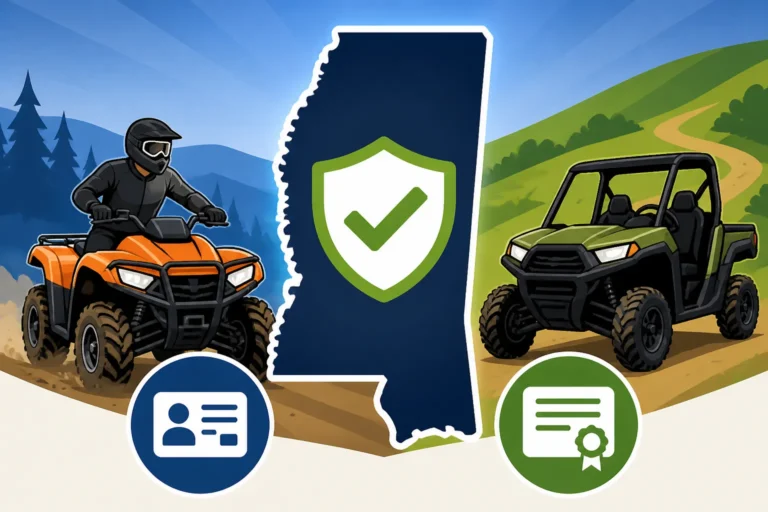
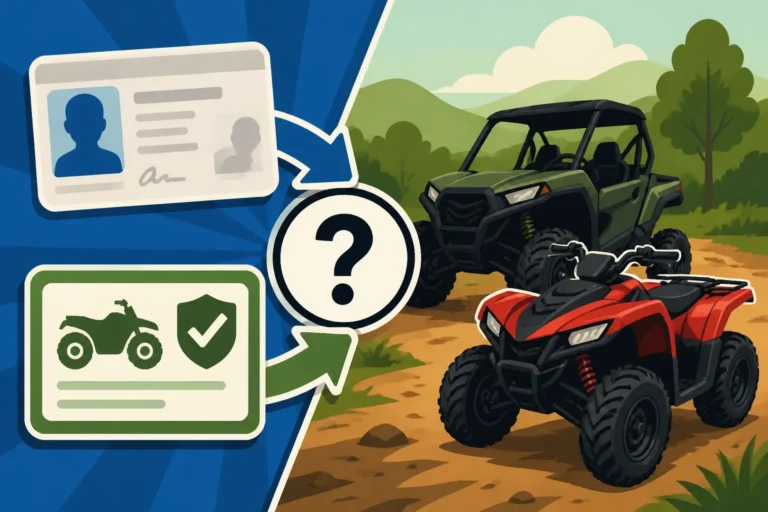
Even though Mississippi does not have a statewide ATV registration system for off-road use, and therefore you won't be looking for a Mississippi license plate or sticker, carrying proof of ownership for your ATV or UTV is absolutely crucial. For a Louisiana rider, this means you should always have your Louisiana vehicle title or a current registration document with you. If the machine is brand new and you haven't received a title yet, a bill of sale can serve as interim proof. The primary reason for this is verification: if you are stopped by a Mississippi deputy—whether on private land with permission or at a designated trail system—they need to be able to confirm that the machine you are operating legitimately belongs to you. Without proper documentation, you could face significant delays, extensive questioning, or even the impoundment of your ATV or UTV until ownership can be verified. This is a hassle no one wants, especially when you're away from home.
In addition to proof of ownership for your machine, you must also carry valid personal identification. Your Louisiana driver's license is typically sufficient for this. For younger riders who may not have a driver's license, another form of government-issued identification is advisable. While Mississippi does not mandate insurance for off-road vehicles, it is always a smart practice to carry proof of any insurance policy you do have (liability, comprehensive, or theft) and, importantly, your personal health insurance information. Accidents can happen, and being prepared means having all your information readily accessible. Consider investing in a small, waterproof pouch or container for these vital documents, keeping them either on your person or securely attached to your machine. The aim is to ensure any interaction with authorities is as brief and uneventful as possible, allowing you to return to your adventure without delay. For more general advice on being prepared, check out [Carrying Papers on a Southern Back Road].
Safety Gear and Machine Requirements
Mississippi's safety regulations, particularly concerning helmets for younger riders, are important for all visitors to understand. If any member of your riding party is under the age of 16, wearing a helmet is not just recommended, it is a legal requirement on public lands. This helmet must meet specific safety standards, such as being DOT-approved. Even if you are an adult over 16, wearing a helmet is a highly advisable safety measure, whether you're on private land or a public trail. Beyond helmets, other essential protective gear includes eye protection (goggles or a visor), long pants, long sleeves, and sturdy, over-the-ankle boots. These items collectively offer significant protection against branches, debris, and potential injuries in the event of a fall.
Beyond personal protective equipment, your ATV or UTV itself may need to meet certain criteria depending on where you plan to ride. For example, if your destination is a national forest trail system like [Bethel OHV Trails in Mississippi], your machine will almost certainly be required to have a functioning spark arrestor. This device is critical for preventing wildfires and is routinely checked by rangers. Failing to have one can result in being denied access to the trails or even a citation. Many public and private riding parks also impose specific width limits (for instance, [Bethel's 43 Miles Are Built for 50-Inch Machines] for ATVs, with different allowances for side-by-sides), noise limits (typically measured in decibels), and sometimes even require a safety flag for enhanced visibility. Before you pack your bags and load up your SuperATV-modified side-by-side, it's always prudent to contact the specific park or trail system you intend to visit. A quick phone call can confirm their current rules and machine requirements, saving you from potential disappointment or a wasted trip.
Where a Louisiana Rider Can Actually Ride in Mississippi
Given Mississippi's stringent stance on ATV and UTV road access, identifying legal and appropriate riding locations is paramount for a visiting Louisiana rider. You can't just expect to ride anywhere; intentional planning is key to a rewarding experience.
National Forests and State-Designated Trails
Since public roads are largely off-limits for ATVs and UTVs in Mississippi, your primary and most reliable option for legal riding will be on designated off-road vehicle (OHV) trail systems. The state is fortunate to host parts of the De Soto National Forest, which includes popular riding areas like the [Bethel OHV Trails in Mississippi]. These trails offer many miles of riding through diverse southern landscapes, from dense pine forests to sandy tracks. However, access to these national forest trails is not free. You will need to purchase a special land-use pass, which is a federal permit, not a state registration. Information on [Mississippi National Forest OHV Passes] is readily available online, at local ranger stations, or through authorized vendors. It’s crucial to purchase and display this pass as instructed, as forest rangers actively patrol and enforce these regulations.
Beyond the national forests, other state-managed or designated trails might be available. Wildlife Management Areas (WMAs) across Mississippi sometimes permit OHV use, but these opportunities are typically very restricted. WMA regulations often limit ATVs and UTVs to specific designated access roads and are frequently tied to certain seasons (e.g., for game retrieval during hunting season). It is absolutely essential to thoroughly review the specific WMA's rules and maps before planning any ride, as [Mississippi WMA Riding Rules] are known for their strictness. Attempting to ride off designated paths or outside permitted times can lead to fines and other penalties. Always check for current trail conditions and any temporary closures, especially after periods of heavy rain, which can make trails impassable or cause environmental damage. The overarching principle here is to be deliberate in seeking out and adhering to approved riding locations; never assume that any dirt path or unpaved road is open for recreational ATV/UTV use.
Private Parks and Land Access
For many riders, particularly those who enjoy specific types of terrain, such as expansive mud pits, or simply desire more freedom than public lands might offer, Mississippi's private off-road parks are an excellent choice. Parks like [Red Creek Off-Road in Mississippi] provide hundreds, and sometimes thousands, of acres dedicated exclusively to ATV and UTV riding. These facilities often boast a wide variety of trails, ranging from easy, family-friendly routes to challenging mud bogs and technical sections designed to test even the most experienced riders. A significant advantage of private parks is that they establish their own rules, which, while still operating within state law, can offer more flexibility regarding machine types or riding styles. Visitors typically pay a day-use fee and are required to sign a liability waiver. Many private parks also offer amenities such as wash stations, camping sites, and even cabins, making them ideal destinations for a weekend trip.
Another viable option for riding in Mississippi is through private land access. This could involve riding on land you own, property belonging to friends or family, or through a membership in a hunting club or a land lease. When riding on private land with explicit permission, many of the statewide public road bans and permit requirements do not apply directly to your riding on that property. However, you still need to legally transport your machine to and from the private land, which means using a trailer. It is absolutely vital to secure clear, explicit permission from the landowner before you ride. Carrying a written copy of this permission can prevent misunderstandings or issues should a local deputy or game warden inquire. [Written Permission From a Southern Landowner] can be your best friend in such situations. While companies like SuperATV provide the gear to make your machine perform its best, even the most capable rig needs a legal place to be ridden, and private parks or sanctioned trails offer the safest and most reliable options for an out-of-state rider.
Avoiding Common Pitfalls for Out-of-State Riders
As a Louisiana rider venturing into Mississippi, it's easy to fall prey to common misconceptions or overlook nuances in local laws. Being aware of these potential pitfalls can save you a lot of trouble.
Ignorance of Local Ordinances
One of the most common and easily avoidable traps for out-of-state riders is the assumption that the vehicle laws from their home state, or even from one Mississippi county, apply uniformly across the entire Magnolia State. This misunderstanding is particularly prevalent regarding local ordinances and road access. As we discussed, a very small number of Mississippi towns have enacted specific local laws allowing golf carts or certain low-speed vehicles on some of their streets. The critical mistake many riders make is interpreting these very limited allowances as a blanket permission for ATVs or UTVs to be ridden on public roads. This is almost never the case. For example, while it's true that [Hattiesburg Opened Its Streets to Golf Carts], this ordinance does not magically grant your high-powered quad or side-by-side legal access to Hattiesburg's municipal streets. Often, these ordinances are meticulously worded, specifying exact vehicle types allowed and frequently excluding ATVs and UTVs.
The consequence of this misunderstanding is not just a polite warning. Depending on the specific local ordinance and the discretion of law enforcement, you could receive a citation for illegal road riding. While the direct fine might sometimes seem relatively low (see [Mississippi Fines for Road Riding]), the associated court costs, the time spent dealing with legal proceedings, and the potential hassle of having your machine impounded can quickly escalate the cost and frustration. To avoid this, it is always prudent to be overly cautious. Before you even contemplate riding your ATV or UTV on any paved surface in a Mississippi town, make a direct phone call to that city's police department or clerk's office. Ask specifically about their local ordinances pertaining to off-road vehicles. Do not rely on information from online forums, social media, or hearsay. Obtain clear, direct information, and if any doubt remains, assume that public road use for your ATV or UTV is prohibited. This proactive research can save you significant stress and expense during your visit.
Misconceptions About Insurance and Permits
Another area where visiting riders often hold incorrect assumptions is regarding insurance and permits. In Louisiana, you might carry comprehensive insurance on your ATV or UTV, which is a very smart move for protecting your investment and mitigating risks. However, it's important to note that Mississippi does not mandate insurance for off-road use of ATVs or UTVs. This means that if you are stopped on a trail or private land, state law enforcement isn't going to check for proof of insurance. That said, having liability and comprehensive coverage is still highly recommended for your own protection in the event of an accident or theft. What you absolutely will need if you plan to ride on specific public lands, such as national forest trails, is a dedicated land-use permit. This is not a state-issued registration; rather, it's a pass you typically purchase directly from the U.S. Forest Service or an approved vendor, as discussed in [Mississippi National Forest OHV Passes].
Similarly, for younger riders, Mississippi has specific requirements. Any rider under the age of 16 operating an ATV on public lands is required to possess a safety certificate. A Louisiana rider in this age group should ensure they carry verifiable proof of having completed an approved safety course that meets Mississippi's standards. While [Mississippi Has Nothing to Reciprocate] in terms of state-issued ATV registration stickers from other states, they do expect compliance with their safety regulations for minors. Don't assume that a safety course completed in Louisiana automatically fulfills Mississippi's requirements without checking. For adult riders, your Louisiana driver's license serves as sufficient identification on public trails. However, always be prepared to present both your identification and proof of ownership for your machine. Overlooking these critical details—from the necessity of a forest pass to the specific safety requirements for young riders—can unfortunately lead to your riding day being cut short.
To help visualize the difference, here's a brief comparison of some key considerations for Louisiana vs. Mississippi riding:
| Feature | Louisiana (General Context) | Mississippi (General Context) | Implications for Visiting Riders |
|---|---|---|---|
| Road Access for ATVs | Varies; some parishes/towns allow limited access or certain types of machines. | Strictly prohibited on public roads (state law), with rare, narrow local exceptions primarily for golf carts/LSVs. | DO NOT plan to ride your ATV/UTV on any public road in MS. Always trailer to riding locations. |
| State Registration | May have state registration/titling requirements for ATVs. | No statewide ATV registration (only titling for newer machines starting July 2025). | No MS sticker/plate to display; always carry LA registration/title for proof of ownership. |
| Insurance Mandate | Liability insurance may be required for road-legal machines. | No state mandate for ATV insurance for off-road use. | Insurance is highly recommended but not required by MS law for off-road riding. |
| Helmet Law | State helmet laws vary by age and jurisdiction. | Required for riders under 16 (on public land). Recommended for all. | Ensure all riders under 16 have DOT-approved helmets. |
| Youth Safety Course | May have requirements for minors. | Required for riders under 16 (on public land). | Carry proof of an approved safety course for young riders. |
| Public Land Permits | Varies by state park or forest. | National Forest Pass required for USFS trails (e.g., Bethel). | Purchase necessary USFS passes before arriving at the trailhead. |
| Local Ordinances | Many towns/parishes have specific rules. | Few allow ATVs/UTVs on streets, and often only golf carts/LSVs. | Do not assume local road access; call local authorities to confirm. |
By being fully aware of these distinctions, especially when it comes to the blanket ban on public roads and the specific permit requirements for public riding areas, you can ensure your Mississippi riding trip is memorable for all the right reasons. From preparing your SuperATV accessories for the trails to making sure all your paperwork is in order, a little bit of homework goes a long way in the Magnolia State. Riders from other neighboring states, like those covered in [Mississippi Rules for a Visiting Alabama Rider], face very similar challenges, underscoring the importance of understanding these unique local rules.
Disclaimer
This article is for general informational purposes only and does not constitute professional advice. Laws, prices and regulations vary by location and change over time. Consult a qualified professional for guidance on your specific situation.