Who Decides If an ATV Course Counts
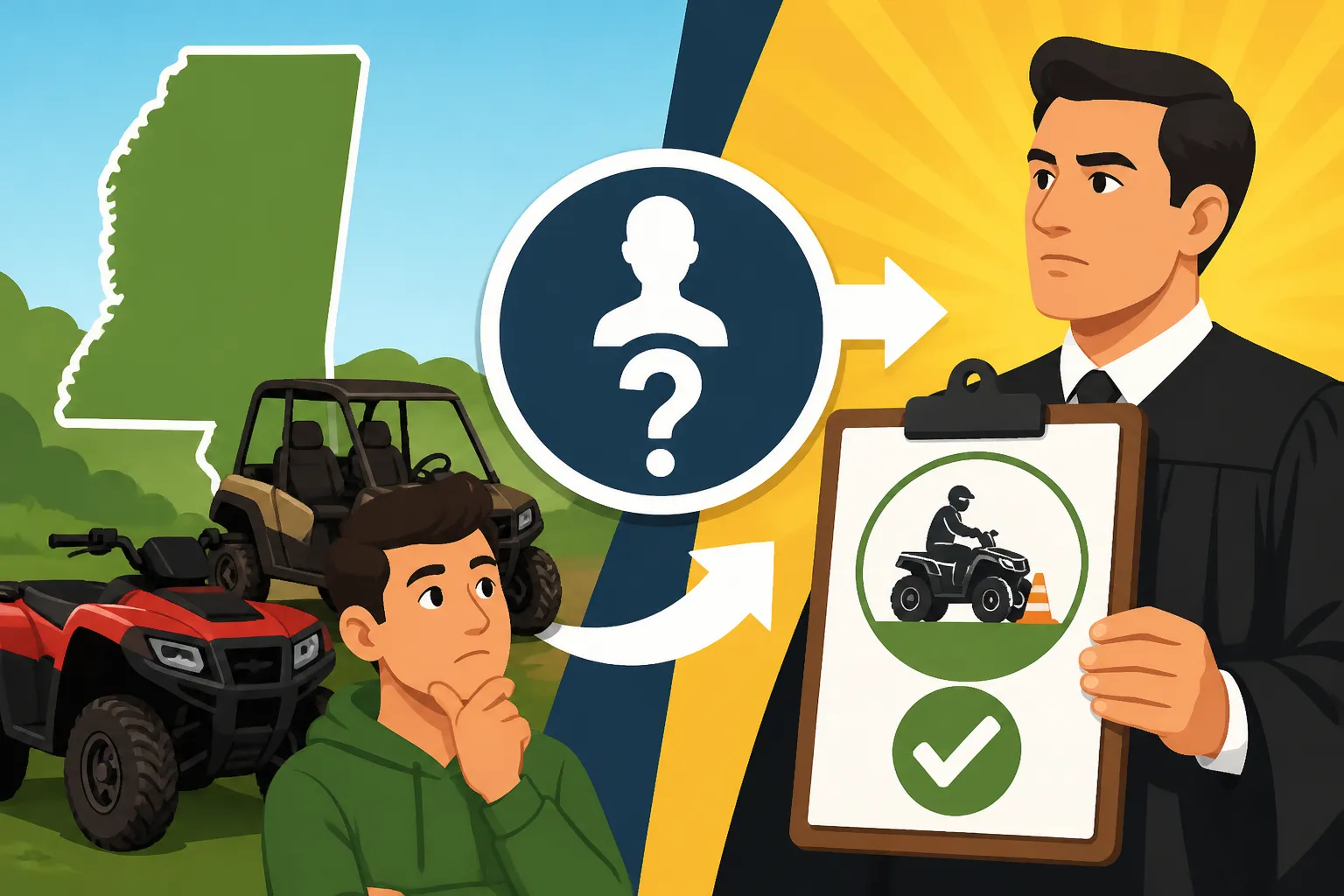
An ATV safety card is useful only if the right authority accepts the course behind it. In Mississippi, that can mean checking more than a course provider’s claim: you need to know who recognizes the training, where the card will be used, and what proof to carry. Here’s how to verify whether a course counts before you ride.
Who decides whether an ATV course counts in Mississippi
The key question is not simply whether a class covers ATV safety. It is whether the course is approved for the specific legal or access requirement you need to satisfy.
For Mississippi’s state-level safety-card requirement, the relevant authority is the Mississippi Department of Public Safety. A course provider may teach ATV safety and issue a completion document, but that alone does not establish that the course meets the state’s approval requirement. The provider should be able to identify the approving authority and explain what certificate or card successful students receive.
This distinction matters because course descriptions can use broad phrases such as “certified,” “recognized,” or “state-approved.” Ask who approved the course and what rule or access requirement that approval covers. If the provider cannot give a clear answer, confirm with the Mississippi Department of Public Safety before relying on the course.
A safety card can serve as an alternative to a driver’s license in some circumstances involving operation on public property. The applicable requirement depends on the rider and location, so don’t assume a card gives permission to ride anywhere. For an overview of the basic distinction, see Mississippi Requires a License or a Safety Card and Mississippi Safety Certificates as an Alternative.
There may also be separate rules set by a particular trail, park, or public-land manager. A facility can require a specific card, a minimum rider age, a signed waiver, or other proof even when a rider has completed a course accepted for a state requirement. In other words, course approval by one authority does not automatically settle every question about access.
| What you need the course for | Who to check with | What to confirm |
|---|---|---|
| Meeting a Mississippi state safety-card requirement | Mississippi Department of Public Safety | Whether the course and its completion document satisfy the requirement |
| Entering a specific trail or park | The trail or park manager | Whether that location accepts your course card and has additional rules |
| Riding on a particular public land area | The agency or land manager responsible for that area | Whether the card is required, accepted, and enough for the intended activity |
| Using a course from another state | The Mississippi authority or site where you plan to ride | Whether Mississippi or that site accepts the specific credential |
When the intended riding location has its own rules, ask that manager directly. A state-approved course may satisfy one part of the requirements without replacing a land pass, a driver’s license where required, a waiver, or compliance with other safety rules.
How to verify a course before signing up
Before paying for a class or relying on a course you already completed, get specific answers. The goal is to connect the exact course and document you will receive to the requirement you need to meet.
- Identify where you plan to ride. Write down the trail, park, public land, or other setting. Rules can vary by location, and a card accepted at one place may not answer another place’s requirements.
- Name the requirement you are trying to meet. Ask whether you need a safety card as an alternative to a license, proof for a particular facility, or training for a young rider. Those are not necessarily interchangeable.
- Ask the provider who approves the course. Request the name of the approving authority, not just a general assurance that the course is “recognized.”
- Confirm the credential issued. Find out whether you receive a certificate, card, or other document, and whether it shows the rider’s name and course completion.
- Verify with the authority or land manager. Give them the course name and provider. Ask whether that exact course and document count for your intended use.
- Ask about age and expiration conditions. Confirm whether the rule differs for a rider’s age or whether the credential must be renewed. Do not assume a card has no conditions simply because it does not show an expiration date.
- Keep the answer and the proof. Save any written confirmation and carry the completion document if the authority or location requires it.
A direct question is more useful than asking, “Is this course certified?” For example: “Will a completion card from this provider meet Mississippi’s safety-card requirement for this rider?” If you are calling a trail operator, add the name of the trail and ask whether the card is accepted there.
The state-focused explanation in Which ATV Safety Courses the State Will Accept can help you frame that question. If you are considering a course connected with Mississippi State University Extension or youth instruction, check the details in Mississippi Extension Service Courses. The course’s teaching materials or affiliation may be useful information, but verify that the specific course and document match the requirement you have.
What a course card does and does not prove
A course card is evidence of course completion. It is not a general riding permit, a vehicle registration, or a promise that every public or private riding area will admit the holder.
That distinction is easy to miss because several different requirements can come up on the same ride. A rider might need to show a safety credential, meet an age rule, follow a facility’s helmet policy, and pay for or carry a required land pass. Satisfying one requirement does not cancel the others.
A course card also does not grant permission to ride on land where riding is prohibited. Nor does it turn a closed road or trail into an open one. Confirm the access rules for the place you intend to use, especially if the ride involves public land or a designated trail system.
For riders under 16, age-specific rules deserve particular attention. A safety certificate may be relevant to the rider’s requirements, but it does not necessarily remove helmet, supervision, equipment, or site-specific rules. See Mississippi Safety Certificates for Young Riders and Mississippi Forest Rules for Riders Under 16 for related considerations.
Visiting riders should not treat an out-of-state safety card as a guarantee that every Mississippi site will accept it. Mississippi’s lack of a state sticker requirement for visiting machines is a separate issue from whether a course credential is accepted. Check Mississippi Visitors Need No State Sticker for the sticker question, and ask the course or land authority about the card itself. The absence of a sticker to reciprocate does not settle course recognition; Mississippi Has No Sticker to Honor From Another State covers that separate point.
Keep these questions distinct when you call:
- Does the rider need a license, a safety card, or either one for this activity?
- Is this exact course approved for the state requirement?
- Does this particular trail or park accept the card?
- Are there additional age, helmet, waiver, pass, or supervision rules?
- Does a visiting rider’s card meet the same requirement?
Getting each answer separately avoids a common mistake: assuming that “course approved” means “all access requirements met.”
What to carry and how to handle unclear answers
Once you have confirmed that a course counts, keep the completion document somewhere it will remain readable. A paper certificate can be damaged by water, mud, or repeated handling. If you receive a card, check that the name and completion information are legible before leaving the provider.
A clear photograph or digital copy can be a useful backup, but do not assume it substitutes for an original if a trail operator or agency specifically asks to see the card or certificate. Ask what forms of proof are accepted. A small waterproof document sleeve, including one available through Amazon, can help protect a paper credential; it does not change what the credential qualifies you to do.
If the provider’s answer and the agency’s answer conflict, rely on confirmation from the authority responsible for the requirement or from the land manager responsible for the site. Give them the exact course name, provider, and document type. Keep a note of whom you spoke with and when, and request an email or other written confirmation if the answer affects a planned trip.
If no one can confirm the course, do not assume it counts just because it was completed. Ask the state authority what course options it recognizes, or choose a course whose approval can be verified. If the course is only for access to a specific private park, ask that park whether it will accept the completion document before enrolling.
The practical rule is simple: verify the course for the purpose and place where you need it. A course can be worthwhile training even when it does not satisfy a particular legal or access requirement. But if you need the card as proof, confirm the approval first, keep the document, and check the rules that apply at the riding location.
Disclaimer
This article is for general informational purposes only and does not constitute professional advice. Laws, prices and regulations vary by location and change over time. Consult a qualified professional for guidance on your specific situation.