Mississippi WMA Firearm Distance Rules
An ATV can make it easier to reach a hunting spot on a Mississippi Wildlife Management Area, but it does not make a road or trail a safe place to handle or fire a gun. The key issues are where firearms may be discharged, how far from a road to stay, and how to transport a firearm while riding. Here’s how to think through those rules before you go.
The 100-foot road buffer and what it means
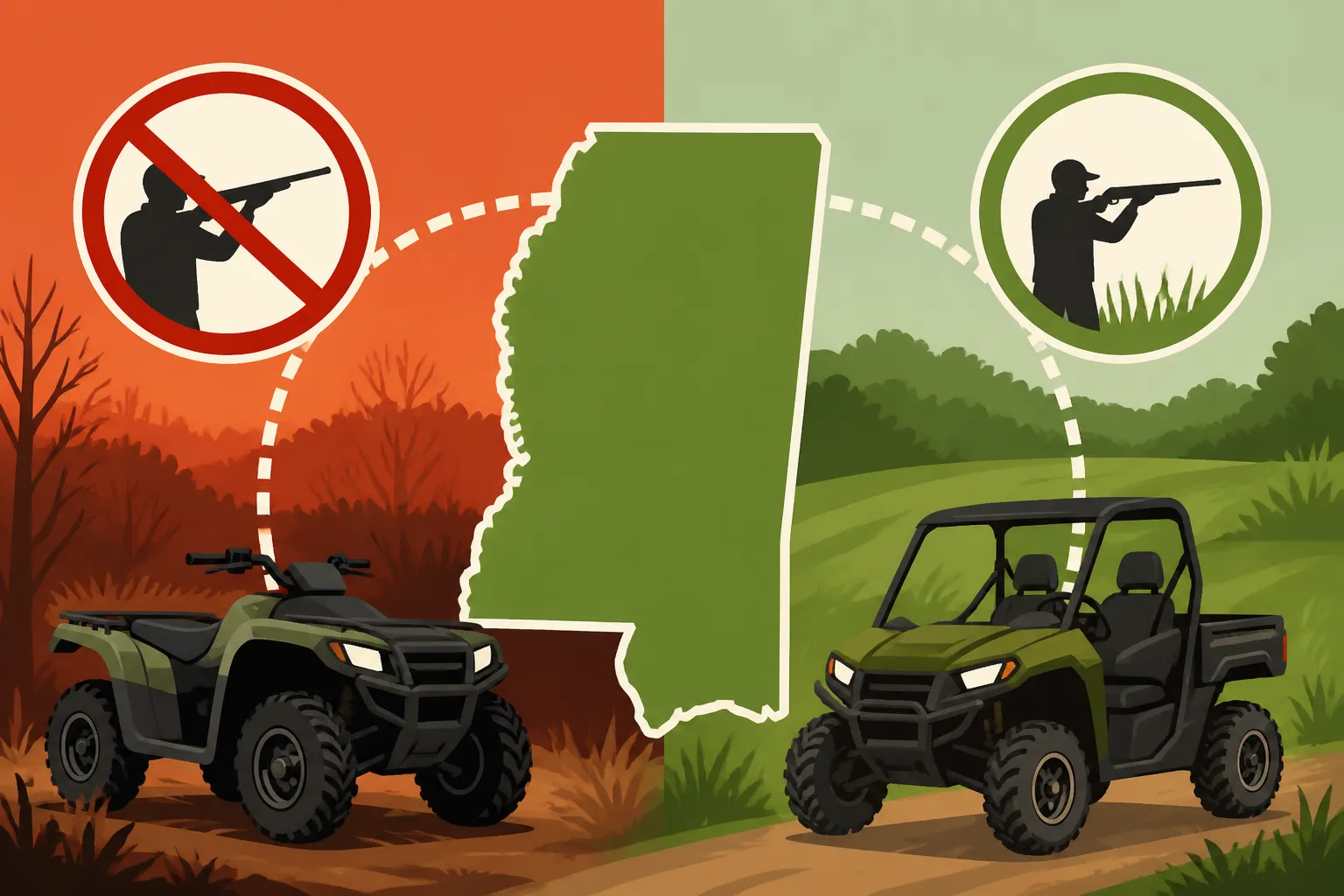
Mississippi WMA rules include a firearm setback of 100 feet from roads in specified circumstances. Treat that as a minimum buffer wherever the applicable WMA rule requires it. Do not assume that being on a small road, trail, or ATV means the restriction does not apply.
The distance rule concerns firearm use near a road, not simply how far an ATV may travel from one. A machine on a designated road and a hunter firing a firearm are subject to different considerations. Being allowed to ride a road does not make it lawful to shoot from the road, across it, or from a spot too close to it.
The exact application can depend on the WMA, the type of road, the hunting season, and the current area regulations. Before relying on a general rule, check the current regulations for the specific area and read signs at its entrance and along its roads. Start with Mississippi WMA Rules for Riders and Mississippi WMA Firearm Distance Rules for related information.
A practical way to apply the buffer is to stop well away from the road before handling a firearm for hunting. Allow room for the full area in which a shot could travel, not just the spot where you are standing. A road may have bends, rises, other riders, hunters, or vehicles approaching out of sight. If you cannot clearly confirm that your position and the direction of fire meet the applicable rule, do not take the shot.
| Situation | Safer approach |
|---|---|
| Riding on a WMA road | Keep the firearm unloaded and secured while riding. |
| Stopping to hunt | Move away from the road and confirm the required distance for that WMA and season. |
| Considering a shot near a road | Do not shoot from, across, or too close to a road. Check the area rule and the full line of fire. |
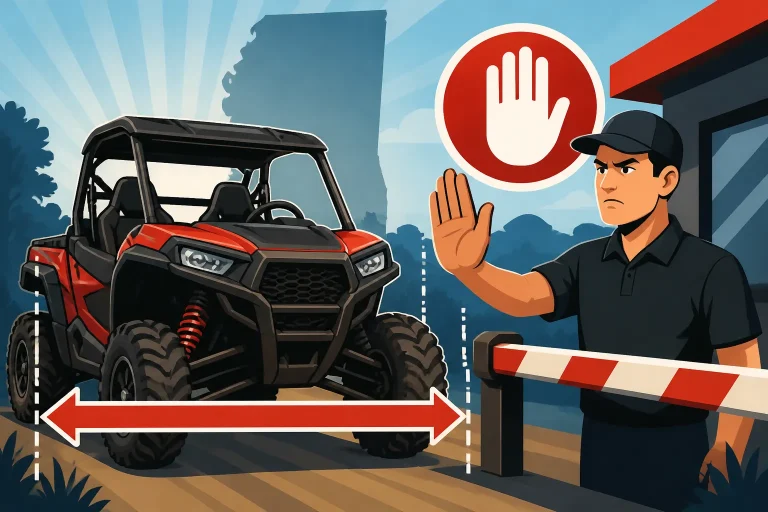
| Reaching a gate or closed road | Stop and obey the closure. Do not ride around a barrier or assume the road is open to ATVs. |
| Unsure what a sign means | Do not handle or discharge a firearm there until you have clarified the rule. |
The 100-foot figure should not be treated as a universal safe shooting distance. It is a regulatory buffer in circumstances where the rule applies; safe firearm handling still requires a clear target, a safe direction, and awareness of what lies beyond it. A legal minimum is not a substitute for judgment.
Carrying a firearm while riding an ATV
A firearm should not be loaded while you are riding on a WMA. Keep it unloaded and secured so it cannot fall, shift, or be reached unintentionally. This matters even on a slow, familiar road: a rut, sudden stop, or rollover can turn a poorly secured firearm into a serious hazard.
Before loading or unloading, stop the machine in a safe place, away from the road and other people. Keep the muzzle pointed in a safe direction, keep your finger away from the trigger, and check the firearm’s condition rather than assuming it is unloaded. Do not load while moving or while another rider is operating the machine.
A suitable case or purpose-made mount can help keep a firearm stable, but a mount does not make a loaded firearm appropriate for transport. Check that the firearm is secure before setting off, and make sure its position does not interfere with steering, brakes, passengers, or the machine’s controls. Do not carry a firearm in a way that leaves the muzzle pointed at the rider or passenger.
Keep ammunition separate from the firearm during transport when practical, and follow the current WMA and hunting rules about firearm condition and transport. A passenger should not handle a firearm while the ATV is moving. If more than one person is riding, agree on how the firearm will be carried and who is responsible for checking it before departure.
If a firearm must be moved from the machine to a hunting position, stop first and unload it before taking it off its mount. Recheck the chamber and magazine as appropriate. When returning to the ATV, unload again before securing it for the ride. These steps may feel repetitive, but they reduce the chance of a firearm being handled carelessly during a busy transition.
WMA access rules also matter. Riders may be limited to designated roads, and permission to ride an area does not automatically allow travel behind a gate or onto a closed road. Review Mississippi WMA Riding on Designated Roads and Mississippi WMA Road Closure Signs before planning a route. A route that looks passable is not necessarily open to vehicles.
How firearm rules and WMA riding rules work together
On a WMA, check both sets of rules: those governing firearms and hunting, and those governing motorized access. An ATV does not create an exception to a firearm restriction. Likewise, a hunting permission or season does not necessarily authorize riding anywhere you choose.
First confirm that the road or route is open to the kind of machine you plan to use. Some areas restrict motorized travel to designated roads, and gates, signs, or other barriers may mark a closure. Then check the current firearm rules for the area and season, including any road-related setback. If those rules do not clearly cover your situation, contact the relevant land manager before riding or hunting there.
Do not assume that a county road rule, a private hunting club rule, or a rule from another state applies on a Mississippi WMA. Visiting riders should check Mississippi requirements rather than relying on a permit, license, or sticker from home. Mississippi does not use an ATV registration sticker system that automatically settles public-land access; the area’s own rules control where riding is allowed. Mississippi Has No Sticker to Honor From Another State explains why out-of-state paperwork is not a substitute for checking local access requirements.
A useful pre-ride check is to confirm:
- The WMA is open to the public for your planned activity and the relevant season.
- Your ATV route uses roads open to motorized travel.
- No gate, sign, or temporary closure blocks the route.
- You know the current firearm setback and any limits on discharge near roads.
- The firearm will remain unloaded and secured while the machine is moving.
- Every rider and hunter understands where the firearm will be handled and where shots are prohibited.
Keep in mind that WMA boundaries and roads can be confusing on the ground. A trail may cross onto private property, a closed section may begin beyond a turn, or a road may be reserved for a different purpose. A map is useful, but it does not override a posted closure or current area-specific direction. If you reach a barrier, turn back rather than looking for a way around it.
Hunters using a machine to retrieve game should also check whether that use is allowed on the area and under the current season rules. Authorization to retrieve an animal does not mean every road is open or that firearms may remain loaded during travel. See Mississippi WMA Game Retrieval Rules for the separate access questions involved.
What to do when a road or distance rule is unclear
When the exact setback is uncertain, do not estimate from memory or another WMA’s rules. Check the current regulations for the specific area, including any season-specific provisions, and follow signs posted at the site. If the written rule and a sign seem to conflict, pause and ask the appropriate area office or land manager for clarification before hunting there.
Be especially cautious when the road is not clearly marked. A narrow track may still be a road for purposes of the rule, and a trail used by ATVs can also carry other traffic. Do not assume that low traffic means the restriction is irrelevant. If you cannot identify the road type or determine where the setback begins, choose a different location.
If another rider or hunter approaches, stop handling the firearm and give them room. Do not fire toward a road or use a road as a backstop. If a shot would put another person, vehicle, building, or occupied area at risk, do not take it, even if you believe you are outside the stated buffer.
It also helps to plan where you will park before leaving home. Choose an open, permitted location where the machine can be secured without blocking traffic, a gate, or access for other users. Do not leave a firearm unattended on an ATV, and do not use a road shoulder as a place to load or unload if other people may pass close by.
These precautions are useful whether you are a resident, a visitor, or riding with a group. For related access details, see Mississippi WMA Access for a Quad, and check Mississippi Rules for a Visiting Alabama Rider if you are crossing into Mississippi from Alabama. The simplest rule is to keep the firearm unloaded and secured on the machine, stay well clear of roads when preparing to hunt, and verify the current WMA-specific restrictions before you ride.
Disclaimer
This article is for general informational purposes only and does not constitute professional advice. Laws, prices and regulations vary by location and change over time. Consult a qualified professional for guidance on your specific situation.