The $60 Annual Pass for National Forest Trails
Mississippi riders planning a National Forest trip can mistake an annual pass for blanket permission to ride anywhere in the woods. It is better understood as one part of the access rules: you still need an eligible machine, an open designated route, and compliance with local restrictions. Here’s what the $60 annual pass does, what it does not do, and what to check before loading up.
What the $60 annual pass is for
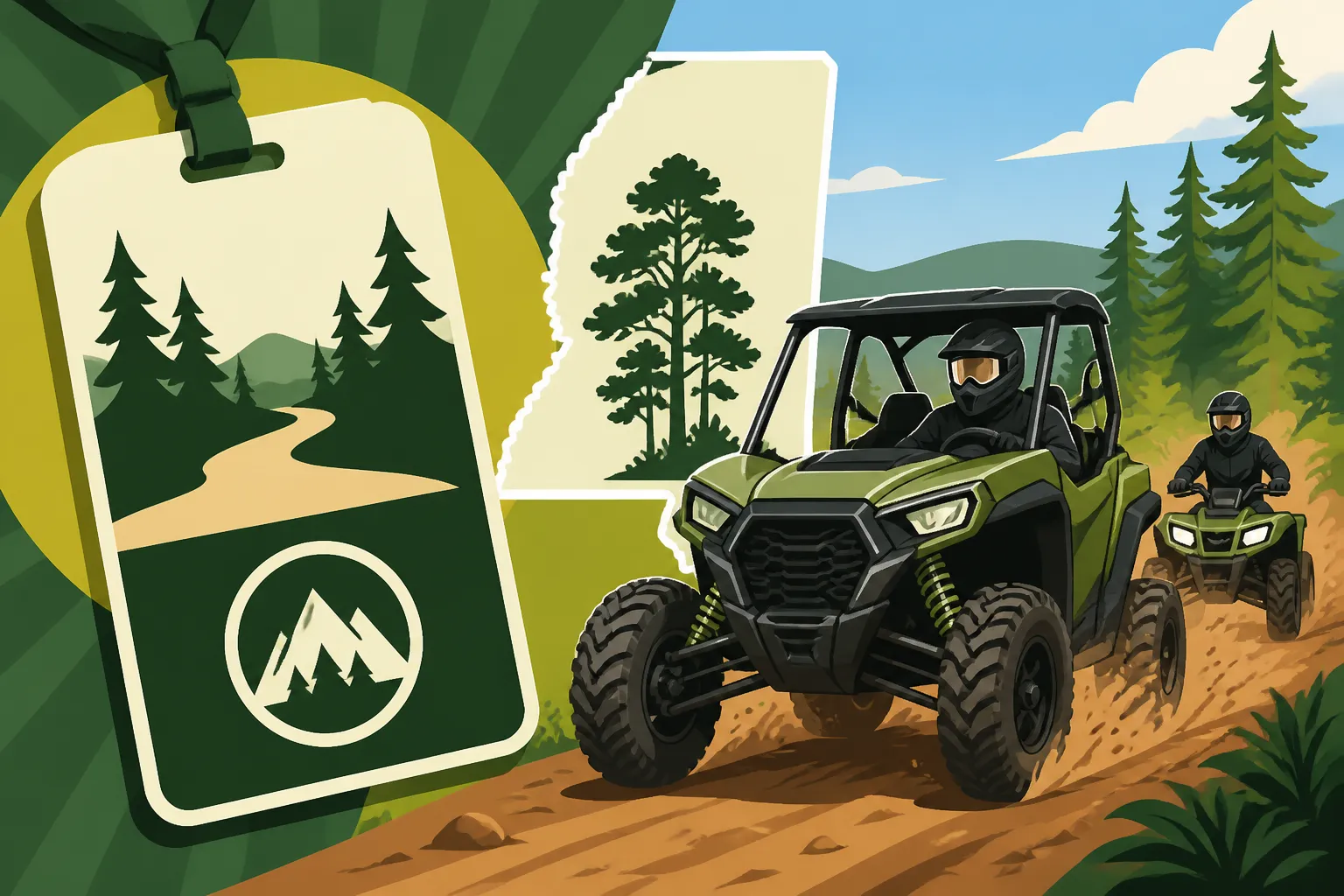
The annual National Forest pass is an access permit for eligible off-highway vehicle riding opportunities in Mississippi’s National Forests. It is not a general license to ride on every forest road, trail, or patch of public land. The practical distinction is important: a pass may be required, but it does not make an unmarked or closed route legal to ride.
The pass is associated with designated OHV access, subject to the route’s own rules. Those rules can include vehicle-width limits, seasonal closures, surface conditions, and restrictions on who may operate a machine. A pass also does not override posted signs or a closure announced by the land manager.
The pass is commonly described as a $60 annual pass. Because fees and permit procedures can change, confirm the current amount and conditions with the responsible National Forest office before buying. The key issue is not just the price: it is whether the pass covers the specific riding area and machine you plan to use.
For a fuller outline of eligible locations and the pass program, see Mississippi Forest Pass Coverage and Mississippi National Forest OHV Passes. The short version is that the pass is an access requirement for designated opportunities, not a replacement for checking the rules of the particular trail.
| Item | What to understand |
|---|---|
| Purpose | Allows access to eligible designated OHV riding areas under their rules |
| Term | Annual; check the pass for its exact effective dates |
| Price | Commonly described as $60; confirm the current fee before purchase |
| Coverage | Limited to eligible designated routes and locations, not every forest road |
| Vehicle fit | Route and permit rules may restrict machine width or type |
| Other requirements | Age, license or safety-certificate, equipment, and closure rules may also apply |
| Reciprocity | A pass from another state should not be assumed to satisfy Mississippi requirements |
The annual permit can make it easier to plan repeated trips, but it does not replace basic trip research. If your destination is a specific riding area, identify the area and the route first, then make sure the pass applies there. A permit that is valid for one type of designated trail does not automatically cover a different trail system or a public road that happens to pass through forest land.
That distinction is why Which Trails the $60 Forest Pass Opens and What a Mississippi Forest Pass Does Not Cover are useful follow-ups. Check the current official trail information rather than relying on an old map, a social media post, or a friend’s description of where a machine was ridden previously.
Where the pass applies and where it does not
“National Forest” describes a large area of managed land, not a promise that every part of it is open to motorized recreation. Some roads may be open to ordinary vehicles, some routes may have limits on vehicle type or width, and some tracks may be closed to OHVs altogether. A forest pass does not turn every road or trail into an OHV route.
Start with the location’s official route information. Identify the trail system or designated route by name and check that it is open to the kind of machine you own. Then check any posted width limits. A 50-inch limit is an important restriction associated with Mississippi OHV access, but do not assume it is the only rule or that it applies in the same way to every route. Look at the specific trail information and posted signs.
The width of a UTV or side-by-side can be a particular problem. A machine that fits one trail’s limit may be too wide for another. Measure the machine as it will be ridden, including any accessories that affect its overall width, and compare that measurement with the route’s stated limit. If the trail information does not make clear whether a measurement includes accessories, contact the land manager instead of guessing at the entrance.
The pass also does not authorize riding on:
- A closed route or a route marked for another use.
- Private property without the owner’s permission.
- A road or trail where motorized travel is not designated.
- Land managed under separate rules that do not accept the pass.
- A route that is temporarily closed because of weather, maintenance, fire danger, or another management concern.
The last point matters after rain. A route that was open during a previous visit may be closed or unsuitable after heavy weather. Check Mississippi Trail Conditions After Rain before heading out, and verify conditions with the local office when a trip depends on a particular route being open. A pass does not guarantee that a trail will be available on the day you arrive.
A forest pass also should not be confused with access to Bethel OHV Trail, a state park, a private mud park, or a wildlife management area. Those locations can have separate fees, passes, permits, or operating rules. Even if a route is near National Forest land, that alone does not establish that the forest pass covers it. Ask the site operator or land manager which permit is required for that specific location.
For a practical reminder about the limits of a pass, read What a Mississippi Forest Pass Does Not Cover. When in doubt, ask the office responsible for the route. Describe the actual machine and destination, not just the county or forest name. “Can I ride this 60-inch-wide side-by-side on the named trail?” is a better question than “Are ATVs allowed in the forest?”
Who needs a pass and what reciprocity means
The permit requirement is about access to a managed riding area. It is separate from the question of whether Mississippi issues state registration for an ATV or UTV. A forest pass does not serve as a state registration card, title, license plate, or proof that a vehicle is street legal.
This distinction can confuse riders visiting from another state. A neighboring state may issue a sticker, registration, or trail permit for its own system. Do not assume Mississippi will accept that document in place of its National Forest pass. Mississippi does not have a state OHV registration system whose sticker another state’s system can simply match. For that reason, out-of-state riders should confirm the forest’s current permit requirement rather than rely on reciprocity. See Mississippi Has No OHV Registration to Reciprocate for the related state-registration issue.
A visiting rider should check three separate questions:
- Does the destination require the Mississippi National Forest pass?
- Does the machine meet that destination’s route restrictions?
- Does the operator meet the age, license, or safety-certificate requirements for that land?
A pass answers only the first question. It does not remove any separate operator requirements. Rules for young riders and public land can depend on the location and the type of riding, so check the applicable rules before the trip. Do not assume that a parent’s pass or the presence of an adult automatically satisfies every requirement for a child operating a machine.
Also ask how the permit is assigned. Is it tied to a specific machine, owner, or other information? Can it be moved to a replacement vehicle? Does each machine in a group need its own pass? These details can affect a family with several ATVs or a household that shares machines. The pass rules and purchase instructions should answer them; if not, confirm with the issuing office before buying. [Mississippi Forest Pass for a Second Machine] addresses the multi-machine question.
If a rider has a pass from another state, keep it if it is relevant to riding elsewhere, but do not treat it as proof of Mississippi access. The same principle works in reverse: a Mississippi National Forest pass should not be assumed to cover a riding area in another state. Permit systems are created for particular lands, and a similar name or sticker does not establish that two systems recognize one another.
The pass is also not a substitute for ownership paperwork. Keep the title, bill of sale, or other useful proof of ownership with your travel documents, especially when transporting a recently purchased machine or riding far from home. Permit and proof-of-ownership questions are separate, and a pass does not resolve a title problem. For the difference between state ownership paperwork and forest access, see Mississippi Proof of Ownership on the Trail.
How to buy and use the pass
Before purchasing, confirm the current fee, the permitted locations, and the application process. Do not rely solely on an old receipt or a previous season’s instructions: the office may change its process, the pass term may be defined by specific dates, and riding areas can change their open status.
Use this process to avoid buying the wrong permit or arriving without required proof:
- Choose the riding destination. Find the named trail or designated OHV area you expect to use. A general plan to “ride in the National Forest” is not specific enough to confirm coverage.
- Check its current status. Look for official route information, notices, closures, and current operating conditions. If the map and a sign disagree, obey the posted closure and contact the responsible office.
- Confirm machine eligibility. Check the route’s width limit and vehicle-type rules. Measure your machine rather than relying on its model description or a seller’s estimate.
- Ask how the pass is assigned. Confirm whether it is issued per machine or under another arrangement, whether it must be displayed, and whether a receipt or other proof must be carried.
- Verify the current fee and purchase method. Follow the official instructions and keep proof of purchase. If the online information is unclear, contact the office before traveling.
- Review operator and equipment rules. Check age, license or safety-certificate requirements, helmet rules, and any equipment standards that apply to the area.
- Recheck before departure. A trail can close after the pass is purchased. Confirm conditions again close to the trip, especially after significant rain or during a period of seasonal restrictions.
If the pass must be displayed on a machine, follow the placement instructions exactly. If the program instead requires a receipt or other document, keep it where it can be retrieved without unpacking the trailer. Do not alter a sticker or rely on a phone image if the official instruction requires the original permit. The issuing office can confirm what counts as valid proof.
Keep a copy of the purchase confirmation and note the pass’s effective period. An annual permit does not necessarily mean twelve months from the day you buy it; the actual validity dates are set by the program. Check those dates rather than assuming that a pass purchased late in the year will remain valid for a full twelve months.
If you have several machines, confirm the requirement for each before the group travels. A family may be able to use one purchase for more than one machine under some systems, but that should never be assumed. A group arriving with multiple machines and only one permit can lose riding time while trying to resolve the question at the trailhead.
The purchase process and current instructions are covered further in How to Buy a Mississippi Forest Pass and Mississippi Forest Pass Cost. Use those as starting points, then confirm details with the official office responsible for the trail system.
Planning a trip without access surprises
A permit is only one item in a good riding plan. Start by matching the machine to the trail, then plan for the conditions and paperwork that matter at the destination. That reduces the chance of reaching a trailhead only to discover that the route is too narrow, closed, or not covered by the pass you bought.
Match the machine to the route
Do not base a decision only on whether a machine is called an ATV, UTV, or side-by-side. Width and route classification can matter more than the marketing category. If you ride a wider side-by-side, verify the trail’s width limit before leaving home. If the machine is modified, measure its actual width in its riding configuration.
A pass does not make an oversized machine eligible for a narrow trail. It also does not mean every trail in a pass program allows every machine that can fit through the entrance. Follow posted restrictions and the official description of the route.
Carry useful records
Bring the pass or proof of purchase in the form the program requires. Keep your machine’s ownership documents and any operator certificate or license required for the area accessible. A practical paper copy can be useful if a phone battery dies or there is no service, but it does not replace whatever the land manager requires.
If a deputy or ranger asks questions, be prepared to explain where you are riding and show the relevant documents. The ability to show a pass does not prove that a particular road is open to OHVs. Route signage and current land-management rules still control.
Plan for closures and changing conditions
Forest trails can be affected by rain, maintenance, fire conditions, seasonal use, or other management decisions. Check the official condition information shortly before departure and again if your travel plans are flexible. A pass is not a reservation and does not guarantee a route will be open.
If a route is closed, do not ride around a gate or take an unmarked bypass. Such detours can damage land, violate closures, and create safety risks. Choose an open route or reschedule instead.
Keep land boundaries clear
National Forest access rules apply to the land and route covered by those rules. A trail may approach private property, a different public-land unit, or a road with a separate restriction. Do not infer permission from the fact that the ground looks similar or that other riders have used it.
Before unloading, check the trailhead signs and make sure the permit, machine, and route all match. If something is unclear, call the relevant office rather than treating the annual pass as all-purpose permission. For a broader look at the pass’s boundaries, see Mississippi Forest Pass Coverage.
Frequently Asked Questions
Does the $60 pass let me ride on any National Forest road in Mississippi?
No. It is for eligible designated OHV access under the applicable rules. It does not make every forest road or trail open to OHVs. Check the route information and signs.
Does a pass from another state work in Mississippi?
Do not assume that it does. Mississippi does not have a state OHV registration sticker system that automatically reciprocates with another state’s system. Confirm the Mississippi permit requirement for your destination.
Does the pass cover a wide UTV?
Only if the machine meets the rules for the specific route. Check the trail’s width limit and vehicle restrictions before traveling. A pass does not override a width restriction.
Is the pass valid for a full year from the purchase date?
Check the pass terms. “Annual” describes the permit period, but its exact effective dates and renewal rules should be confirmed with the issuing office.
Do I still need to check for trail closures after buying the pass?
Yes. A pass does not guarantee that a trail is open on a particular day. Check current conditions and obey closures and posted signs.
Disclaimer
This article is for general informational purposes only and does not constitute professional advice. Laws, prices and regulations vary by location and change over time. Consult a qualified professional for guidance on your specific situation.