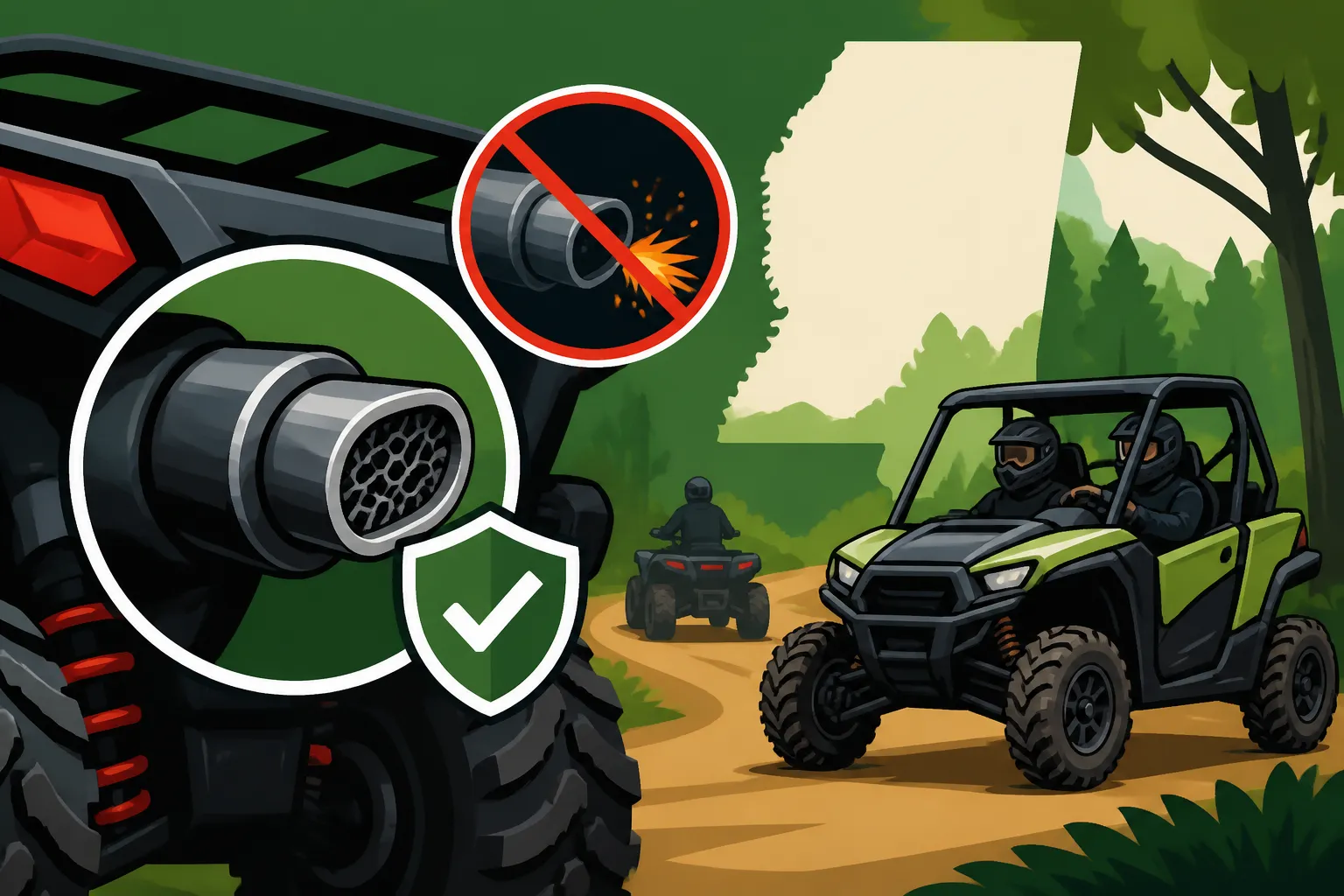
Mississippi State Park Spark Arrestor Rules
A spark arrestor is easy to overlook when you are loading an ATV or UTV for a Mississippi state park, but arriving without a working one can disrupt the ride. The practical approach is to check the machine’s exhaust before you leave, understand what park staff may look for, and confirm the rules with your destination.
What Mississippi state park spark arrestor rules mean
A spark arrestor is a device in an engine’s exhaust system that helps keep hot particles from leaving the exhaust and igniting dry material. It is not the same thing as a muffler: a muffler reduces noise, while a spark arrestor serves a different purpose. Some original equipment exhaust systems include one as part of the muffler assembly; other machines may use a separate insert or screen.
For ATV and UTV riding at a Mississippi state park that allows off-highway machines, plan on having a spark arrestor that is installed and in serviceable condition. A machine that came with one should not be ridden with it removed, damaged, clogged or bypassed. A louder aftermarket exhaust is not a substitute for a spark arrestor, and adding a spark arrestor does not automatically make a machine compliant with every other park rule.
Park access is a separate question from equipment compliance. A spark arrestor does not give you permission to ride on a road or trail that is closed to ATVs, nor does it mean every state park has routes open to off-highway machines. Check which sites allow machines and what areas are designated for riding before you plan a trip. Which Mississippi State Parks Allow Machines
It also helps to separate the state park’s requirements from rules that apply elsewhere. A machine accepted at a private riding park or on private land may still need to meet state park equipment rules. National forest routes, wildlife management areas and private parks can have their own requirements, closures and inspection practices. Do not assume one pass, sticker or equipment check covers every place you might ride.
A spark arrestor requirement is about the exhaust equipment on the machine, not the rider’s age, driving credentials, waiver or proof of ownership. Those may be separate requirements. Before heading to a state park, review its rules as a complete set, including [Mississippi State Park Waiver Steps], State Parks Require a Helmet for Every Rider and State Parks Allow Passengers Only on Factory Seats.
The simple rule to follow
If your machine has an original spark arrestor, keep it installed and properly maintained. If you have changed the exhaust, confirm that the current setup still includes a suitable arrestor before visiting. If you cannot tell from the parts or paperwork, contact the park or a qualified service shop rather than relying on the sound of the exhaust or a seller’s general assurance.
That is a conservative preparation rule, not a substitute for checking the rules at the park you plan to visit. A park may have its own process for checking equipment, and current instructions from that park should guide your decision.
How to check your ATV or UTV before you go
You do not need to be an exhaust specialist to do a useful pre-trip check. You do need to know whether the arrestor is present, intact and appropriate for the exhaust system fitted to your machine. If the exhaust has been modified or its history is unclear, get confirmation before you travel.
1. Check the owner’s manual and parts information
Start with the owner’s manual or the manufacturer’s parts information for your exact make, model and year. Look for exhaust-system descriptions, maintenance instructions and any mention of a spark arrestor. Model names alone are not enough: an ATV or UTV may have different exhaust equipment depending on its year, trim or previous modifications.
If the machine is used, ask the seller whether the exhaust is original and whether any internal parts have been removed. A used machine can sound normal while missing an insert or screen, so sound alone is not a reliable check.
2. Inspect the exhaust while the machine is cool
Never reach into an exhaust system that is hot. After the machine has cooled completely, inspect the visible outlet and the parts you can safely access. Look for obvious damage, a missing insert, loose fasteners, heavy corrosion or signs that someone has cut, drilled or altered the exhaust.
A visual check has limits. Some arrestors sit inside the muffler and cannot be confirmed just by looking at the outlet. Do not dismantle a hot exhaust, force parts apart or modify the system to make it easier to inspect. If you cannot verify the configuration safely, use the manual, a dealer or a repair shop familiar with that machine.
3. Check maintenance condition
A screen or insert can become clogged with soot or damaged through use. Follow the manufacturer’s service instructions for inspection and cleaning. Avoid scraping, drilling or removing material in a way that changes the arrestor’s construction. If a part is broken, missing or badly corroded, replace it with a part specified for the machine rather than attempting a makeshift repair.
An arrestor that is present but poorly maintained may still be a problem. Keep the exhaust system in the condition intended by the manufacturer, and do not treat a loose or damaged component as good enough because the machine starts and runs.
4. Be cautious with aftermarket exhausts
Exhaust changes are a common source of uncertainty. A replacement muffler may or may not include a spark arrestor, and a removable insert may be sold separately. Before buying or installing an exhaust, confirm that the complete setup retains the required equipment and does not conflict with applicable noise rules.
If you are comparing replacement parts through a marketplace such as Amazon, match the listing to the machine’s exact model and year, then verify the part details with the manufacturer or a qualified dealer. A product description or customer review is not proof that a particular part meets a park’s requirements. Keep the packaging or product documentation if it helps identify what was installed, but do not assume a receipt alone establishes compliance.
5. Ask for help when the setup is unclear
A service shop can inspect an unfamiliar or modified exhaust and tell you whether the specified arrestor is present and functioning as intended. Bring the machine’s identifying information and explain that you are preparing for state park use. Ask the shop to identify the part, not simply to say that the exhaust sounds acceptable.
If the concern is park admission, call the destination as well. A repair shop can assess the machine, but the park sets its own entry and inspection procedures. [Questions Worth Asking a Southern Forest Office] is useful for public-land access questions, while a state park office is the better contact for a state park visit.
What to expect at the park
A spark arrestor check may be part of a broader equipment review at the entrance or before a machine uses designated riding areas. The exact process can vary. Staff may look at the exhaust, ask about the machine’s equipment or direct riders to correct an issue before riding. Do not assume that every visit will involve the same inspection, or that the absence of a check means the equipment rule does not apply.
The practical consequence of arriving with an uncertain or visibly altered exhaust is that you may lose riding time while you seek clarification. If staff determine that the machine does not meet the park’s requirements, you may be told not to ride it there. Do not argue from the fact that the machine is legal to own, was accepted at another venue or passed an earlier inspection. Those points do not necessarily answer whether it meets the current rules at this park.
A useful pre-trip call should cover more than “Do I need a spark arrestor?” Ask clear questions:
- Does the park currently allow ATVs or UTVs in the area you plan to visit?
- Is a spark arrestor required for the machine type you are bringing?
- Is there a specific equipment inspection or check-in process?
- Does the park provide guidance on how staff identify an acceptable arrestor?
- Are there additional exhaust or noise requirements?
- Are there temporary closures or other conditions that could affect the ride?
Keep the answers focused on the specific park and machine. If you have a modified exhaust, describe it accurately; if possible, provide the make, model and year. A general answer about “ATVs” may not resolve a question about a side-by-side with a non-original exhaust.
Noise is another issue to check independently. Mississippi state park materials identify a muffler noise limit, and the park may assess noise separately from the presence of a spark arrestor. A spark arrestor does not make an excessively loud exhaust acceptable. Review State Parks Cap ATV Mufflers at 90 Decibels for the related noise issue, and verify the park’s current testing or enforcement procedure before relying on any particular measurement method.
Do not remove an insert to improve performance or sound before the trip. Do not assume a quiet machine has an arrestor, either. The two checks answer different questions: whether the exhaust has the required spark-control equipment, and whether it meets the park’s noise requirements.
Plan for permits, other rules and changing conditions
An arrestor is one item in a state park riding checklist, not a permit to ride wherever you choose. State park rules may also address which machines can enter, where they may operate, who can ride or carry a passenger, required protective equipment, waivers and noise. Follow the posted signs and staff directions at the site, even if you have visited before.
Do not confuse a state park visit with reciprocity
A riding pass, sticker or permit from another state should not be treated as a Mississippi state park permit. Likewise, equipment compliance in Mississippi does not grant access at an out-of-state trail system. For visitors, confirm the park’s own entry and riding requirements rather than assuming a neighboring state’s paperwork carries over. Mississippi Visitors Need No State Sticker explains the separate question of a statewide sticker for visiting machines; it does not replace a park’s rules or fees.
The reverse is also true: a park waiver or entry process does not automatically authorize use of other public land. If you plan to ride more than one place, check each land manager separately. Mississippi Private Park Waivers and Rules covers why private venues can set their own conditions.
Keep ownership and rider documents separate from equipment checks
A park may require documents or other check-in steps that have nothing to do with the exhaust. Carry any items the park tells you to bring, and keep ownership paperwork accessible if it is required or useful for confirming the machine. See Mississippi Proof of Ownership on the Trail for the related paperwork question.
Also confirm requirements for every person riding, not just the person who hauls the machine. Age, helmet, passenger and supervision rules can differ from the spark arrestor requirement. A compliant exhaust does not cure a missing waiver or an ineligible passenger. Check Mississippi State Park ATV Rules before your trip and read any park-specific rules supplied at booking or at the entrance.
Recheck before every visit
Park rules and operating conditions can change. A route may be closed, a facility may have seasonal hours, or staff may apply updated instructions. Recheck the park’s information shortly before you leave, especially after rain or when the trip is planned well in advance. If a closure or inspection requirement is unclear, call the park rather than relying on an old post, a previous visit or a secondhand account.
A short checklist helps keep the exhaust question from getting lost among the other preparations:
- Confirm that the park allows the machine and that the intended riding area is open.
- Verify that the spark arrestor is installed, intact and maintained according to the manufacturer’s instructions.
- Check whether the exhaust has been modified and, if so, confirm the configuration with a qualified shop.
- Ask the park about inspection, noise and any additional equipment requirements.
- Gather the documents, waiver information and rider equipment the park requires.
- Recheck access and closure information before loading the trailer.
If you cannot confirm the arrestor or the park’s rule, do not gamble on making the drive anyway. Resolve the question first or choose a place whose requirements you can meet.
Frequently Asked Questions
Does every ATV or UTV need a spark arrestor to ride at a Mississippi state park?
Plan to bring a machine with a working spark arrestor when riding at a Mississippi state park that permits off-highway machines. Confirm the current rule and inspection procedure with the specific park, particularly if the exhaust has been modified.
Is a muffler the same as a spark arrestor?
No. A muffler reduces exhaust noise; a spark arrestor helps prevent hot particles from exiting the exhaust. Some exhaust systems combine these components, but one does not automatically prove that the other is present.
Will the park inspect my machine at the gate?
Inspection practices can vary. A park may check equipment or ask questions before allowing a machine to ride. Call ahead to learn what the destination currently requires, and arrive prepared rather than counting on there being no check.
Does a spark arrestor make a loud aftermarket exhaust acceptable?
No. Spark arrestor equipment and noise limits are separate concerns. Check both the exhaust setup and the park’s current noise rules before riding.
Can an out-of-state pass replace Mississippi state park requirements?
Do not assume it can. Confirm entry, riding and equipment requirements with the Mississippi park you plan to visit. A pass from elsewhere does not necessarily meet a particular park’s rules.
Disclaimer
This article is for general informational purposes only and does not constitute professional advice. Laws, prices and regulations vary by location and change over time. Consult a qualified professional for guidance on your specific situation.