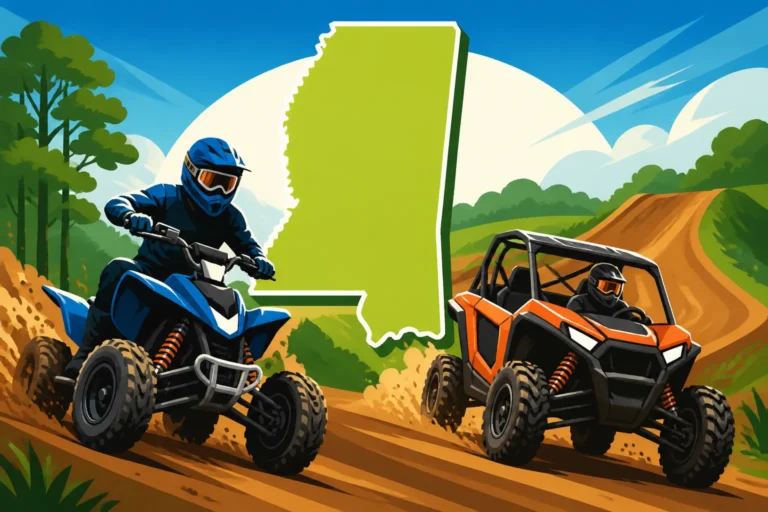
20 Miles of Private Trail
A listing that promises 20 miles of private trail sounds like a full day of riding, but mileage alone won’t tell you whether the routes suit your ATV, UTV, or skill level. This guide explains what to check before you go, how private riding differs from public trails, and how to plan a safer Mississippi ride.
What 20 Miles of Private Trail Really Means
Trail mileage is not the same as ride time
A park’s mileage may describe the combined length of its routes, not one continuous loop. For example, a property might have several short trails that branch off a central route, or separate areas for mud, woods, and beginner riding. You may cover the same stretch more than once as you explore different branches.
The terrain matters just as much as the number. Twenty miles of firm, winding forest trail can take less time than a much shorter route with deep mud, steep ruts, water crossings, or frequent obstacles. Riding at a relaxed pace with children or newer riders also stretches the day—and that is usually a good thing.
Before planning around a mileage figure, ask the park how it counts trail distance. Does the total include connectors, loops, or trails that are closed in certain conditions? Are all routes open to every machine, or do some areas have separate access rules? A quick call can prevent the disappointment of arriving with a big side-by-side only to learn that the trails you hoped to ride are too narrow.
Private land does not mean unrestricted access
Private trails are available because the owner or operator allows riders to use them under specific conditions. Access may depend on opening hours, admission arrangements, a signed waiver, age restrictions, machine rules, or temporary closures. Those details can differ from one park to another, so don’t assume that last month’s rules—or a friend’s experience at another property—will apply.
A private riding area may also have designated parking, staging, or unloading spots. Stay within the signed riding area, keep away from closed gates and adjoining land, and follow staff directions even when a route looks open. A trail that appears to continue beyond a boundary may lead onto land where you do not have permission to ride.
If you’re comparing properties, [Mississippi Private Mud Parks] can help you think about the kinds of private riding options available. For a specific place such as [Red Creek Off-Road in Mississippi], confirm the current operating details directly with the park before loading the trailer. Don’t treat an online mileage claim as proof that every trail will be open on your visit.
Match your machine to the route
A trail that works well for a narrow ATV may be frustrating or unsuitable for a wide UTV. Ask about trail width, surface, turning space, steep sections, and whether side-by-sides are allowed on the routes you want to ride. If you’re bringing a UTV, clarify whether passenger seating and machine dimensions affect access.
That question is particularly important if your group has different machines. A family might arrive with youth quads, adult ATVs, and a four-seat side-by-side. If each machine is limited to a different area, the group may need to split up or choose a park with routes that accommodate everyone. Check [Mississippi Trails That Allow Side-by-Sides] and [Mississippi Trails With Width Limits] when comparing trail options.
| What to ask | Why it matters |
|---|---|
| Is the mileage total one loop or several routes? | Helps set realistic expectations for the day |
| Are all trails open to ATVs and UTVs? | Prevents access problems for wider machines |
| Do conditions affect which routes are open? | Mud or recent rain may change the available riding |
| Are there beginner or youth-friendly areas? | Helps match terrain to the least experienced rider |
| What are the parking, waiver, and check-in procedures? | Makes arrival smoother and clarifies entry requirements |
| Are helmets or other safety gear required? | Lets everyone arrive prepared |
How to Plan a Private Trail Ride in Mississippi
Check access details before you leave home
Start with the park’s own current information. Confirm its location, operating schedule, entry process, machine restrictions, and whether you need to reserve a spot. Ask what happens if weather changes the trails or the park closes part of the property. Private operators set their own procedures, and a social media post or old review may not reflect today’s arrangements.
If the park requires a waiver, find out who must sign it and whether a parent or guardian needs to complete paperwork for a minor. Read the waiver rather than treating it as a formality. [Signing a Waiver at a Private Mud Park] and [Mississippi Private Park Waivers and Rules] offer useful context for the questions riders should consider.
Plan for the drive as carefully as the ride. Check your route to the property, allow time to unload and check in, and make sure your trailer and tie-downs are ready. If you are heading toward a rural area around Perkinston or elsewhere in southern Mississippi, don’t assume you’ll find fuel, food, or a repair shop right beside the trailhead. Handle essentials before you reach the park.
Use maps for orientation, not permission
A mapping app can help you plan the drive, understand the general layout, and keep track of your route. Tools such as onX Offroad may be useful when preparing for a ride, but a map does not grant access to private land. Follow the park’s directions and posted signs, and use only trails the operator has opened to riders.
If cell service is unreliable, download or save the information you’ll need before leaving home. Share the meeting location with your group, especially if riders are arriving in separate vehicles. Agree on a simple plan for regrouping if someone takes a wrong turn or the group gets separated. A map is helpful; a clear plan and respect for the property rules matter more.
For a private park, the trail operator’s signs and instructions take priority over a route shown in a mapping app. If a map appears to show a connector that is blocked or marked closed, do not ride around the barrier. Ask staff where the permitted route goes instead. onX Offroad can support trip preparation, but it should not replace the park’s access rules or on-site guidance.
Prepare for changing Mississippi trail conditions
Rain can turn a manageable route into a slow, tiring ride. Clay, standing water, and deep ruts may affect traction and visibility, while wet roots and slopes can be slippery. Ask whether recent weather has changed trail access before you set out. For more on planning around wet conditions, see [Mississippi Trail Conditions After Rain].
Bring enough water for the group, appropriate riding gear, and basic supplies for the day. In warm, humid weather, riders can become tired faster than they expect, especially while working through mud or helping recover a stuck machine. Check that everyone knows where the first-aid supplies are and how to reach the group’s designated meeting point.
Avoid treating a deep mud hole as a challenge that every machine must attempt. Water can hide ruts, stumps, or sudden changes in depth, and a recovery can become risky when several machines crowd around one stuck vehicle. If a section looks beyond your ability or equipment, turn around. A fun ride is not measured by how many obstacles you force your way through.
Ride Safely and Respect the Property
Set expectations for the group
Before unloading, agree on a pace that works for the least experienced rider. Decide who leads and who rides at the back, and establish a stopping point where the group can regroup. On a narrow trail, leave room between machines so the lead rider can react to a turn or obstacle without being crowded.
Youth riders need extra attention. Check the park’s age rules and supervision expectations before the visit, and choose routes that fit a young rider’s experience and machine. A child who is comfortable on a familiar field may find a wooded trail, mud hole, or steep slope very different. Keep the first part of the ride conservative and build confidence gradually.
Make sure everyone understands basic trail etiquette: slow down near other groups, avoid roosting dirt toward people, and give way when appropriate. [Mississippi Trail Etiquette Locals Expect] is a helpful reminder that a good ride depends on sharing the space, not simply getting through it quickly.
Use the right protective gear
Ask the park what safety gear it requires, then make sensible choices beyond the minimum. Helmets, eye protection, gloves, sturdy footwear, and clothing suited to the conditions help reduce common riding risks. If your group includes children or newer riders, check gear fit before leaving home rather than discovering a loose helmet in the parking area.
A private park may set its own rules for helmets and other equipment. Review [Mississippi Private Park Helmet Rules] and verify the operator’s requirements for your visit. Requirements can vary by property and may depend on the type of machine or rider, so do not rely on what another park allows.
Inspect machines before riding. Check tires, brakes, lights, throttle operation, fuel, and any visible damage. For a UTV, confirm that passengers have appropriate seating and that the load is secured. A basic check in the staging area is far easier than discovering a problem deep in the woods.
Leave the property as you found it
Stay on marked trails, pack out trash, and don’t cut through vegetation to get around a muddy section. Leaving the route can damage the property, create erosion, or put riders on land that is not part of the park. If a trail is blocked, closed, or badly damaged, tell staff rather than making a new route around it.
Be courteous to other visitors and nearby residents. Keep noise under control in parking or camping areas, follow posted speed limits, and avoid unnecessary engine revving. If a park has quiet hours or restrictions on pets, alcohol, or camping, follow them. The details may seem small, but responsible behavior helps keep private riding areas available to the public.
A Practical Checklist for Your Visit
Before the trip
Call or check the park’s official information to confirm access, trail availability, machine rules, and check-in steps. Ask what the mileage figure includes and whether the routes are suitable for your group’s machines and experience. If weather has been wet, ask whether any trails are closed or difficult to ride.
Pack helmets and other protective gear, water, food, basic tools, a first-aid kit, and any supplies needed for your machines. Make sure your trailer is road-ready and that the machines are secured properly. Save the address and any instructions you may need if phone service drops.
Use onX Offroad or another mapping tool to help organize the trip, but treat the operator’s directions and posted signs as authoritative for access. Share the plan with everyone in the group, including the park’s address and the agreed meeting point.
At the park
Check in before riding, complete any required paperwork, and ask staff about current trail conditions. Make sure every rider knows which areas are open to their machine. If a route is marked for a different vehicle type or skill level, choose another trail rather than testing the rule.
Start with an easier section to get familiar with the terrain. Check in with the group as the ride progresses, and take breaks before people become overheated or worn out. If the conditions or a trail feature feel unsafe, turn back. There is no need to complete every route in one visit.
Before you head home
Walk around the machines and trailer, secure loose equipment, and collect trash from your staging area. Let the operator know if you encountered a damaged trail, confusing sign, or issue that could affect other riders. If you enjoyed the property, follow its rules on future visits and encourage your group to do the same.
A “20 miles of private trail” description is a useful starting point, not a complete picture of the ride. The best visit comes from confirming access, matching the trails to your machine, and staying flexible when Mississippi weather or trail conditions change. A little preparation makes it easier to spend the day riding rather than sorting out avoidable surprises.
Disclaimer
This article is for general informational purposes only and does not constitute professional advice. Laws, prices and regulations vary by location and change over time. Consult a qualified professional for guidance on your specific situation.