Why a Titled ATV Gets No License Plate
You've just gone through the process of getting your ATV or side-by-side titled in Mississippi, perhaps you even navigated the paperwork with your county tax collector or used the [Mississippi Fast Track Titles Explained] service. Now you're holding that official title document, but you're probably scratching your head asking, "Where's the license plate?" This is a really common point of confusion for many riders, and it highlights a significant difference in how our state handles off-road vehicles. This guide is here to clear up that mystery, explaining why your titled ATV won't ever get a traditional license plate in Mississippi and what that means for you as an owner and rider.
The Essential Difference: Titling Versus Registering a Machine
When we talk about vehicles, "titling" and "registering" often get used interchangeably, but in the world of ATVs and UTVs in Mississippi, they are distinctly different processes with very different outcomes. Understanding this distinction is key to comprehending why your off-road machine gets a title but no license plate.
What a Title Really Means for Your Machine
Think of a title as the official birth certificate and ownership record for your ATV or side-by-side. It's a legal document issued by the state that proves who the rightful owner of the machine is. When you buy a new machine, the dealer will often help you with this process, submitting a [Mississippi Requires an MCO for a New Machine] to the state. For a used machine, you'll rely on a [Mississippi Bills of Sale for a Used Machine] from the previous owner.
A title is crucial for several reasons, even without a license plate. It establishes a clear chain of ownership, which is incredibly important for deterring theft and recovering a stolen machine. It's also where any liens are recorded – if you financed your ATV, the lender's interest will be noted right there on your title, often for a [Mississippi Lien Recording at $5] fee. This document also simplifies the process of buying or selling your machine privately, as it provides undeniable proof of transfer. Without a title, these transactions can become incredibly messy and risky, often requiring a [Mississippi Title Bond Procedure] if crucial paperwork like a bill of sale or Manufacturer's Certificate of Origin (MCO) has been lost.
Why Registration Involves a License Plate
Registration, on the other hand, is generally about permission to operate a vehicle on public roads and highways. When you register your car or truck, you pay a fee, receive a license plate, and that plate acts as a visible identifier that your vehicle is legally allowed to share the road with others. It signifies that your vehicle meets certain safety and emissions standards (though emissions checks aren't a thing in Mississippi for any vehicle type) and that you've paid the necessary taxes and fees associated with road use.
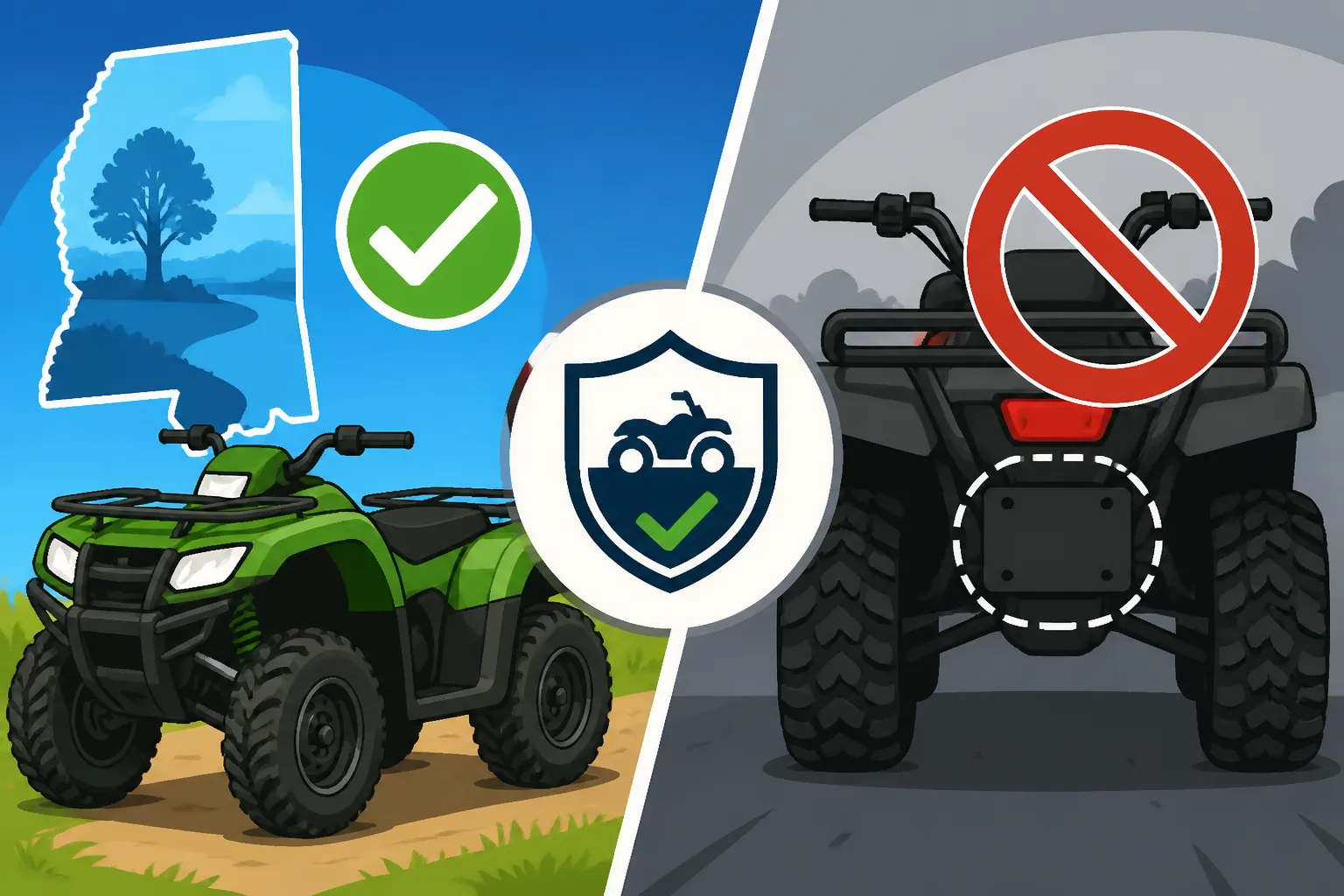
Mississippi's laws, however, draw a very clear line: off-road vehicles like ATVs and UTVs are simply not designed or permitted for public road use. Because they are not legal for street operation, the state has no mechanism to "register" them in the traditional sense, and therefore, no reason to issue a license plate. A license plate implies road legality, and that's precisely what Mississippi's state law explicitly denies ATVs.
Mississippi's Unique Approach to ATVs and UTVs
Mississippi's stance on ATVs and UTVs is quite specific, setting it apart from how some other states handle these popular machines. Our laws are designed to clearly separate off-road recreation and utility from public road transportation.
How Mississippi Defines an Off-Road Vehicle
The state of Mississippi defines an "all-terrain vehicle" or "ATV" and a "recreational off-road vehicle" or "ROV" (which typically covers side-by-sides) very clearly under state law. These definitions, often found in [Mississippi ATV and ROV Legal Definitions], describe machines built for off-highway use, often with specific width and weight limits, and non-highway tires. For instance, ATVs are generally limited to a [Mississippi ATV Width Limit of 50 Inches] and a [Mississippi ATV Weight Limit of 1,000 Pounds], while ROVs might have a [Mississippi ROV Width Limit of 65 Inches] and a [Mississippi ROV Weight Limit of 2,000 Pounds].
Crucially, these definitions explicitly categorize them as vehicles not intended for public roads. This foundational legal distinction is the bedrock of why they are titled for ownership but never registered for street use. They aren't just "different" vehicles; they are legally distinct from cars, trucks, and even motorcycles that are built and regulated for road operation.
The Legislative Intent Behind Titling Without Registration
The legislative intent behind Mississippi's titling process for ATVs, especially with the new mandatory titling for machines built after a certain date, isn't to open up public roads. Instead, it's about providing a clear, official record of ownership. Before the new titling laws, many ATVs changed hands with just a bill of sale, or sometimes even less. This made it incredibly difficult to track stolen machines, resolve ownership disputes, or properly record liens for financed purchases.
The new system, which mandates titles for newer machines and offers [Mississippi Voluntary Titles for Older Machines], aims to bring order and security to the ATV market. It’s about consumer protection, law enforcement aid, and facilitating legitimate transactions, all while maintaining the core principle that these machines are for off-road environments. The state wants to ensure that when you buy an ATV, especially from a private seller, you have a solid document proving your ownership, and when you sell one, you can definitively transfer that ownership, regardless of whether it ever sees a public road.
Implications for Riding Legally in Mississippi
Since your titled ATV won't have a license plate, it's vital to understand what that means for where and how you can legally ride in Mississippi. The absence of a plate isn't just a quirk; it's a direct reflection of your machine's legal status within the state.
The Road Ban and Why It Matters
The most significant implication of not having a license plate is the strict [Mississippi Bans ATVs on Public Roads]. This isn't a suggestion; it's state law. Without a license plate, your ATV or UTV is not considered road-legal, and riding it on any public street, highway, or thoroughfare can lead to fines and other penalties. This includes county roads, city streets, and even crossing a highway if there isn't a specific, legally designated crossing point.
Many riders, especially those new to the state or new to ATVs, often misunderstand this. They might think that if they're just going a short distance, or if the road is rural, it's okay. Unfortunately, that's not the case. The law is clear: if it's a public road, your ATV (without a license plate) shouldn't be on it. This prohibition is the primary reason why a license plate is never issued for these vehicles, as issuing one would imply a legality that simply doesn't exist. This is also why [Mississippi Has No Insurance Mandate] for ATVs, as insurance is typically tied to road-legal operation.
Proving Ownership Without a Plate
While you won't have a license plate on your ATV, you will have a title. This title becomes your primary proof of ownership. When you're out riding, especially on private land or at designated off-road parks, it's always a good idea to have some form of proof that the machine belongs to you. While you might not carry the original title document in your pocket (that's usually kept in a safe place at home), having a copy or at least knowing where your paperwork is can save you a lot of hassle.
Consider a scenario where you're riding on a timber company's land with permission, and a deputy stops you to check on things. They might ask for proof of ownership. If you've just purchased the machine, you'll want to have your bill of sale handy, and ideally, show that you've started the titling process within the [Mississippi's 30-Day Application Window]. Your title, even without a plate, is the definitive document proving you own the machine and aren't riding something stolen. This is also why, even in a private sale, a clear and legally sound bill of sale (which you can often draft using resources like LawDepot) is paramount to smooth the transition of ownership and later, the titling process.
Understanding the New Titling Requirements
The landscape of ATV and UTV ownership in Mississippi has evolved with new laws regarding titling. These changes, starting in July 2025, solidify the importance of the title document even in the absence of a license plate.
Machines Built After July 2025 and Titles
Starting in July 2025, [Mississippi ATV Titling Starts July 2025] will become mandatory for all new ATVs and ROVs manufactured on or after that date. This means if you buy a brand-new quad or side-by-side that was built in the fall of 2025, you will be required by law to obtain a title for it. This isn't about getting a license plate; it's solely about establishing an official record of ownership with the state. The process will involve submitting your Manufacturer's Certificate of Origin (MCO) to the Department of Revenue through your local county tax collector's office, along with paying the applicable [What a Mississippi ATV Title Costs] (which includes a nominal [Mississippi Title Fee of $9]) and [Mississippi Sales Tax at 7 Percent].
This new requirement is a significant step towards formalizing the ownership of off-road vehicles. It provides a more robust framework for tracking these machines, which can be particularly helpful in cases of theft or when trying to sell a machine that has been financed. Even though you're jumping through an official hoop, remember, it's purely for ownership records, not for gaining road access.
Voluntary Titling for Older Machines
What about all those machines built before July 2025? The state hasn't left them out entirely. Owners of ATVs and ROVs manufactured before the July 2025 cutoff can opt for [Mississippi Voluntary Titles for Older Machines]. This means you aren't legally required to title your older quad, but you have the option to do so. Many riders find this beneficial, especially if they plan to sell their machine, want to finance it, or simply desire the peace of mind that comes with having an official ownership document.
Voluntary titling can provide the same benefits as mandatory titling: clear proof of ownership, a record for lienholders, and a smoother process for future sales. If your older machine has only ever had a bill of sale, or perhaps no paperwork at all, getting a voluntary title is a smart move. You might need to go through the [Mississippi Title Bond Procedure] if you don't have a clean chain of ownership documents. Even for an older machine, the title fee is typically just the standard [Mississippi Title Fee of $9], making it an affordable way to secure your investment.
Here's a quick comparison of Titling versus Registration in Mississippi for ATVs:
| Feature | ATV Titling in Mississippi | Vehicle Registration in Mississippi (for cars/trucks) |
|---|---|---|
| Purpose | Proves ownership, records liens | Grants permission for public road use |
| Document Issued | Official Title | Registration card, License Plate, Decals |
| Road Use | No – ATVs are banned from public roads | Yes – Required for legal road operation |
| Cost | [Mississippi Title Fee of $9] + sales tax | Varies by vehicle type, weight, and county; annual |
| Frequency | One-time (unless title replaced or reissued) | Annually (typically) |
| Requirement | Mandatory for machines built after July 2025; voluntary for older | Mandatory for all road-legal vehicles |
| Legal Basis | For ownership and anti-theft measures | For highway safety, tax collection, and identification |
What to Carry When You Ride
Since a license plate isn't part of the Mississippi ATV experience, you might be wondering what important documents you should have on hand when you hit the trails or ride on private land. Being prepared can save you a lot of hassle and potential issues.
Essential Documents for Your Glove Box or Pack
Even without a license plate, it's smart to keep certain documents or copies readily accessible when you ride your ATV or UTV. While you don't need the original title document itself (keep that in a secure location at home, like with your other important papers or a safe deposit box), having proof of ownership can be very important.
- Proof of Ownership (Copy): A copy of your title or, if you've recently purchased it, a copy of the bill of sale. This proves the machine belongs to you.
- Proof of Permission: If you're riding on private land that isn't your own, always carry written permission from the landowner. This could be a simple note or a more formal agreement, especially if you're on timber company or hunting club property.
- Forest Pass/Park Entry: If you're riding at a public park like Bethel OHV Trails in Mississippi or a private mud park like Red Creek Off-Road, you'll need proof of entry or your annual forest pass. For example, [Mississippi National Forest OHV Passes] cost about $60 annually and are required for designated federal trails. Keep your pass or day-use ticket stub handy.
- Driver's License/Safety Certificate: If you're riding on public land, you'll need to carry a valid driver's license. If you're under 16, [Mississippi Safety Course Certificates] are required, so make sure you have that on you.
Having these documents neatly organized in a waterproof bag or the glove box of your side-by-side can make a world of difference if you encounter law enforcement or park officials. It demonstrates that you're a responsible rider who understands the rules, even if those rules don't involve a license plate.
Beyond Paperwork: Safety and Legal Readiness
Beyond the documents, your overall readiness as a rider is equally important. In Mississippi, while there's no state-mandated ATV insurance, many riders choose to carry it for peace of mind, especially for liability protection in case of an accident. [Why Mississippi Riders Still Buy ATV Insurance] often comes down to protecting their investment and themselves.
It's also crucial to understand the nuances of local ordinances. While the state bans ATVs from public roads, some towns have enacted specific ordinances for golf carts and low-speed vehicles, which do not extend to ATVs or UTVs. Don't assume an ordinance allowing carts means your side-by-side is also welcome. Always check with local authorities.
Finally, remember that the lack of a license plate is a constant reminder of where your machine belongs: off-road. Embracing responsible riding, knowing your local laws, and being prepared with your paperwork, even without a plate, will ensure you have enjoyable and legal experiences on Mississippi's trails and private lands. [Mississippi Title Questions Collectors Hear] often revolve around these very distinctions, so don't hesitate to reach out to your local county tax collector if you have further questions.
Disclaimer
This article is for general informational purposes only and does not constitute professional advice. Laws, prices and regulations vary by location and change over time. Consult a qualified professional for guidance on your specific situation.