How Hattiesburg’s Golf Cart Ordinance Actually Works
It's incredibly frustrating when you're an ATV or UTV owner in Mississippi, passionate about exploring the backroads and trails, only to feel like you're constantly running into roadblocks when it comes to riding on public streets. You see golf carts zipping around town, seemingly without a care in the world, and it leaves you scratching your head, wondering, "Why can't my machine do that?" This guide is here to unravel that confusion, specifically diving into how Hattiesburg's golf cart ordinance actually works, and crucially, why it creates a distinct set of rules that, unfortunately, don't extend to your trusty quad or side-by-side. We'll explore the specific provisions of this local ordinance and the critical differences that separate golf carts from other off-road vehicles in the eyes of the law.
The Crucial Distinction: Golf Carts Are Not ATVs or UTVs in Hattiesburg
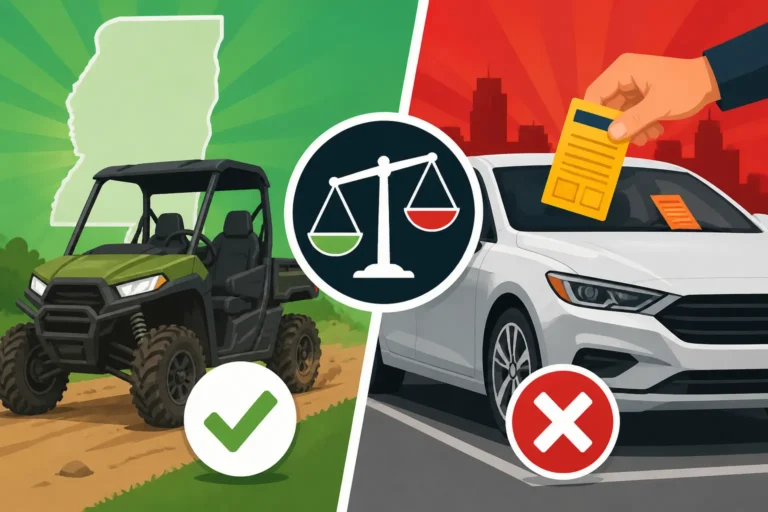
Let's cut right to the chase: the biggest source of confusion and frustration for many off-road enthusiasts stems from a fundamental misunderstanding of how the law categorizes different types of vehicles. When you see a golf cart legally traversing city streets in Hattiesburg, it's not because Mississippi suddenly decided to open up all roads to every type of recreational vehicle. It's because municipalities like Hattiesburg have specific authority to enact ordinances for certain low-speed vehicles, which typically does not include ATVs or UTVs.
Why the Law Treats Them Differently
At the heart of it, the law treats these vehicles differently due to their original design and intended purpose. A golf cart, as its name suggests, was designed for golf courses and low-speed, private property transport. They are built lighter, often with less robust frames, and designed to move at a leisurely pace. They lack many of the safety features inherent in street-legal automobiles and often, in their basic form, even those of an ATV.
On the other hand, your ATV (All-Terrain Vehicle) or UTV (Utility Terrain Vehicle, often called a side-by-side) is designed for rugged, off-highway use. They feature powerful engines, aggressive suspension, and often higher ground clearance, making them ideal for trails, hunting, farm work, or just plain fun off the pavement. The state of Mississippi, as you might already know from bitter experience, draws a very clear line here. [Mississippi Law Flatly Bars ATVs From Public Roads], with virtually no exceptions at the state level. This blanket prohibition is largely due to safety concerns and the fundamental design differences we just discussed. A golf cart's slower speed and more predictable handling on paved surfaces make it a candidate for limited street use, whereas an ATV's design is simply not considered safe for sharing roads with conventional traffic.
This creates a significant point of contention for many riders. You might have a well-equipped UTV that feels perfectly safe at low speeds, or a high-performance ATV that you feel you could operate responsibly. However, the legal definitions don't care about your feelings or your machine's capabilities. What the law counts as an off-road vehicle dictates where you can and cannot ride, and unfortunately, a side-by-side, even one with aftermarket upgrades, is not a golf cart. This is also why [Why a Cart Ordinance Does Not Cover a UTV] is such a crucial piece of information for Mississippi riders.
The Local Ordinance Power
So, how does Hattiesburg get around the state's strict rules for off-road vehicles? The answer lies in the specific power granted to local municipalities. While the state of Mississippi has a very thin chapter of laws concerning off-road vehicles, mainly focused on banning them from public roads, it does allow cities to create their own ordinances regarding certain types of low-speed vehicles. [Mississippi Golf Cart and LSV Ordinances] are a prime example of this local legislative authority.
Hattiesburg, like several other towns across the state, has exercised this power to carve out a specific legal pathway for golf cart owners to operate their vehicles on designated city streets. This isn't a state-wide mandate, but rather a hyper-local decision made by the Hattiesburg city council. It's important to understand that these local ordinances are not a loophole for ATVs or UTVs. They are precisely worded to apply only to golf carts, which meet a specific definition in terms of speed, weight, and sometimes even physical dimensions. If your machine doesn't fit that narrow definition of a "golf cart" as defined by the Hattiesburg ordinance, then you're still subject to the state's overarching ban on ATVs and UTVs on public roads. This is also why [Mississippi Towns That Refuse ATVs on Streets] often have golf cart ordinances—the two are not mutually exclusive, but rather operate on different legal foundations. The state sets the baseline, and cities can adjust for very specific vehicle types.
Navigating Hattiesburg's Streets: What the Golf Cart Ordinance Allows
Now that we've cleared up why golf carts can roam Hattiesburg streets while ATVs generally cannot, let's delve into the specifics of what the ordinance actually permits. It's not a free-for-all; there are clear guidelines and requirements that golf cart owners must adhere to if they want to drive legally within city limits.
Permitted Roads and Speed Limits
One of the most critical aspects of Hattiesburg's golf cart ordinance revolves around where these vehicles can operate and how fast they can go. The ordinance explicitly states that golf carts are generally permitted on streets where the posted speed limit is 30 miles per hour or less. This is a common stipulation in many municipal golf cart ordinances, as it aligns with the low-speed nature of these vehicles and helps minimize collision risks with faster-moving traffic. [Golf Carts Only on Streets Posted 30 mph] is a key phrase to remember.
So, if you're picturing taking your golf cart down Hardy Street or traversing a major four-lane thoroughfare, think again. The ordinance typically restricts golf cart use to residential streets, local business access roads, and other lower-speed areas within the city. Hypothetically, if you live in a neighborhood where the maximum speed limit is 25 mph, you might be able to drive your permitted golf cart to a nearby convenience store, a friend's house a few blocks away, or even to a local park that's accessible via low-speed roads. However, attempting to drive on a street posted at 45 mph, even for a short distance, would be a direct violation of the ordinance. The idea is to allow convenient local travel without creating undue hazards on high-traffic or high-speed roads.
Essential Equipment for Street-Legal Golf Carts
Just because it's a golf cart doesn't mean it's ready for the streets right off the course. Hattiesburg's ordinance, like most, has specific equipment requirements that must be met to ensure safety for both the golf cart operator and other motorists. These requirements are designed to make the golf cart more visible and predictable in traffic.
Typically, a golf cart operating on Hattiesburg streets must be equipped with:
- Headlights: For visibility, especially during dawn, dusk, or overcast conditions.
- Taillights and Brake Lights: To signal presence and braking to vehicles behind.
- Turn Signals: Essential for indicating intended direction of travel.
- A Horn: For warning other drivers or pedestrians.
- A Rearview Mirror: To see traffic approaching from behind.
- Safety Reflectors: For added visibility, particularly from the sides.
Many golf cart owners find they need to add turn signals, a horn, or a rearview mirror to meet city requirements. Companies like SuperATV, while primarily known for their extensive range of ATV/UTV accessories, also offer a variety of universal lighting kits, mirrors, and horns that can help golf cart owners get their vehicles up to spec for street legality. It’s all about making sure your cart can communicate its intentions clearly and be seen easily by others on the road. Without these modifications and proper functioning equipment, even if you're on a 30 mph street, your golf cart won't be considered street-legal by the city of Hattiesburg.
Who Can Drive a Golf Cart on Hattiesburg Streets
Operating a golf cart on public streets, even under a local ordinance, isn't something just anyone can do. The ordinance typically has specific requirements for drivers, primarily revolving around licensing and age. In Hattiesburg, as is common in most places, the operator of a golf cart on a public street must possess a valid driver's license. [Mississippi Driver's License on Public Property] is generally a requirement for operating any motorized vehicle on public roads, and golf carts are no exception when they venture beyond private property.
This means that if you're a teenager without a license, or an adult whose license is suspended, you cannot legally drive a golf cart on Hattiesburg's streets. The rationale is clear: even though golf carts are slow-moving, operating any vehicle in traffic requires a certain level of knowledge of traffic laws, situational awareness, and responsible decision-making, which a driver's license is intended to certify. Additionally, there might be stipulations regarding passengers, such as ensuring all passengers have a seat and are not exceeding the manufacturer's recommended capacity. These rules are in place not to restrict fun, but to ensure the safety of everyone sharing the road.
The Permit Process and Consequences of Non-Compliance
So, you've got your golf cart equipped, you know the speed limits, and you've got a valid driver's license. You're almost ready to roll! But before you hit those Hattiesburg streets, there's one more crucial step: obtaining the necessary permit from the city.
Getting Your Golf Cart Permitted in Hattiesburg
The process for getting your golf cart permitted usually involves a few key steps with the city. While the exact department might vary, it’s often handled by the city clerk's office or even the local police department, which is usually responsible for inspections. You'll typically need to:
- Complete an Application: This form will ask for details about you (the owner) and your golf cart, including its make, model, and serial number.
- Provide Proof of Ownership: A bill of sale or title (if applicable for your golf cart) will likely be required.
- Undergo an Inspection: Your golf cart will need to pass an inspection to ensure it meets all the equipment requirements we discussed earlier (headlights, taillights, turn signals, horn, mirrors, etc.). Ensuring your golf cart meets all the local safety standards before an inspection is key. Whether it's beefing up your suspension for a smoother ride or adding a better windshield, a lot of golf cart enthusiasts look to specialized retailers like SuperATV for quality parts that stand up to the rigors of daily use. They might not be specifically for golf carts, but many universal parts can cross over.
- Pay a Fee: There's usually a nominal fee associated with the application and permit.
- Receive a Decal/Permit: Once everything is approved, you'll be issued a permit or a decal that must be displayed prominently on your golf cart, indicating its street-legal status within Hattiesburg.
It’s always a good idea to check the City of Hattiesburg's official website or call the relevant city department directly for the most current information, forms, and fees. This ensures you're following the precise steps outlined in [Hattiesburg's Cart Ordinance in Mississippi]. Don't assume the rules are the same as another town, because they can vary significantly even within the same state.
Penalties for Breaking the Rules
Operating a golf cart on Hattiesburg's streets without adhering to the ordinance's rules can lead to various penalties. While these might not always be as severe as those for major traffic violations in a car, they are certainly not trivial and can quickly put a damper on your joyride. Consequences for non-compliance can include:
- Fines: The most common penalty, typically escalating for repeat offenses. These fines can add up, making a seemingly innocent ride quite costly.
- Impoundment: In some cases, if the golf cart is being operated dangerously, without a valid permit, or by an unlicensed driver, it could be impounded, requiring you to pay towing and storage fees to retrieve it.
- Citation for Traffic Violations: Even if your golf cart is permitted, you can still be cited for common traffic offenses like reckless driving, speeding (even if it's over the 30 mph limit), or failure to yield. These can carry additional fines and points against your driver's license.
It's a stark contrast to the state's approach to ATVs and UTVs. For an ATV/UTV, simply riding on a public road in Mississippi, without any local ordinance, is often enough to warrant a citation. [Mississippi Penalties for an Illegal Road Ride] for an ATV can range from fines to even impoundment, highlighting the zero-tolerance stance the state takes. For golf carts in Hattiesburg, the penalties are specifically for violating the terms of the allowance, rather than a blanket ban on their presence. The key takeaway is that having an ordinance for golf carts doesn't mean a relaxed attitude towards enforcement; it means specific rules that will be enforced.
Comparing Road Rules: Golf Carts vs. ATVs/UTVs in Hattiesburg
To truly grasp the Hattiesburg ordinance, it's helpful to see a direct comparison of the rules for golf carts versus the general state rules for ATVs and UTVs. This highlights why the frustration for ATV/UTV owners is so palpable.
| Feature / Vehicle Type | Hattiesburg Golf Cart Ordinance | Mississippi State Law for ATVs/UTVs (General) |
|---|---|---|
| Road Access | Permitted on streets with posted speed limit 30 mph or less | Flatly barred from public roads and highways |
| Driver's License | Required | Required if operating on private land that allows public access or crossing a road legally (briefly) |
| Equipment Requirements | Headlights, taillights, brake lights, turn signals, horn, rearview mirror, reflectors | Spark arrestor, working muffler (no specific street-legal equipment mandated for road use as it's banned) |
| Permit/Registration | City-issued permit/decal required | No state registration; no city permits for road use (as it's illegal) |
| Primary Use | Local transportation, recreation (golf courses) | Off-road recreation, utility, farm/timber work |
| Legal Authority | Local city ordinance | State statute (Mississippi Code Section 63-31-1 and 63-31-3) |
| Potential Penalties | Fines, impoundment for ordinance violations | Fines, impoundment for illegal road riding |
This table clearly illustrates the divergent paths. While Hattiesburg has created a limited avenue for golf carts, it has no such provisions for ATVs or UTVs. This distinction is not arbitrary; it's rooted in the design, safety features, and original intent of these different vehicle types, as defined by law. The state has historically taken a very cautious approach to opening roads to vehicles not primarily designed for on-road use, and even recent legislative efforts, such as [Mississippi Senate Bill 2258 and What It Would Have Done], which sought to expand road access for certain off-road vehicles, have faced significant hurdles. For now, the status quo remains for ATVs and UTVs: stick to the trails and private land.
Navigating the rules for ATVs, UTVs, and even golf carts in Mississippi can certainly feel like trying to solve a complex puzzle with missing pieces. While Hattiesburg's golf cart ordinance offers a glimpse into how local municipalities can create specific allowances, it’s a crucial reminder that these provisions are highly specialized and rarely extend to the broader category of off-road vehicles. For ATV and UTV enthusiasts, the path to street legality in Mississippi remains largely closed at the state level, with only a few, highly restricted exceptions. Always make it your mission to know your local laws, because what's permissible for a golf cart in one city is almost certainly not for your quad in another, and certainly not across the state for your machine.
Disclaimer
This article is for general informational purposes only and does not constitute professional advice. Laws, prices and regulations vary by location and change over time. Consult a qualified professional for guidance on your specific situation.