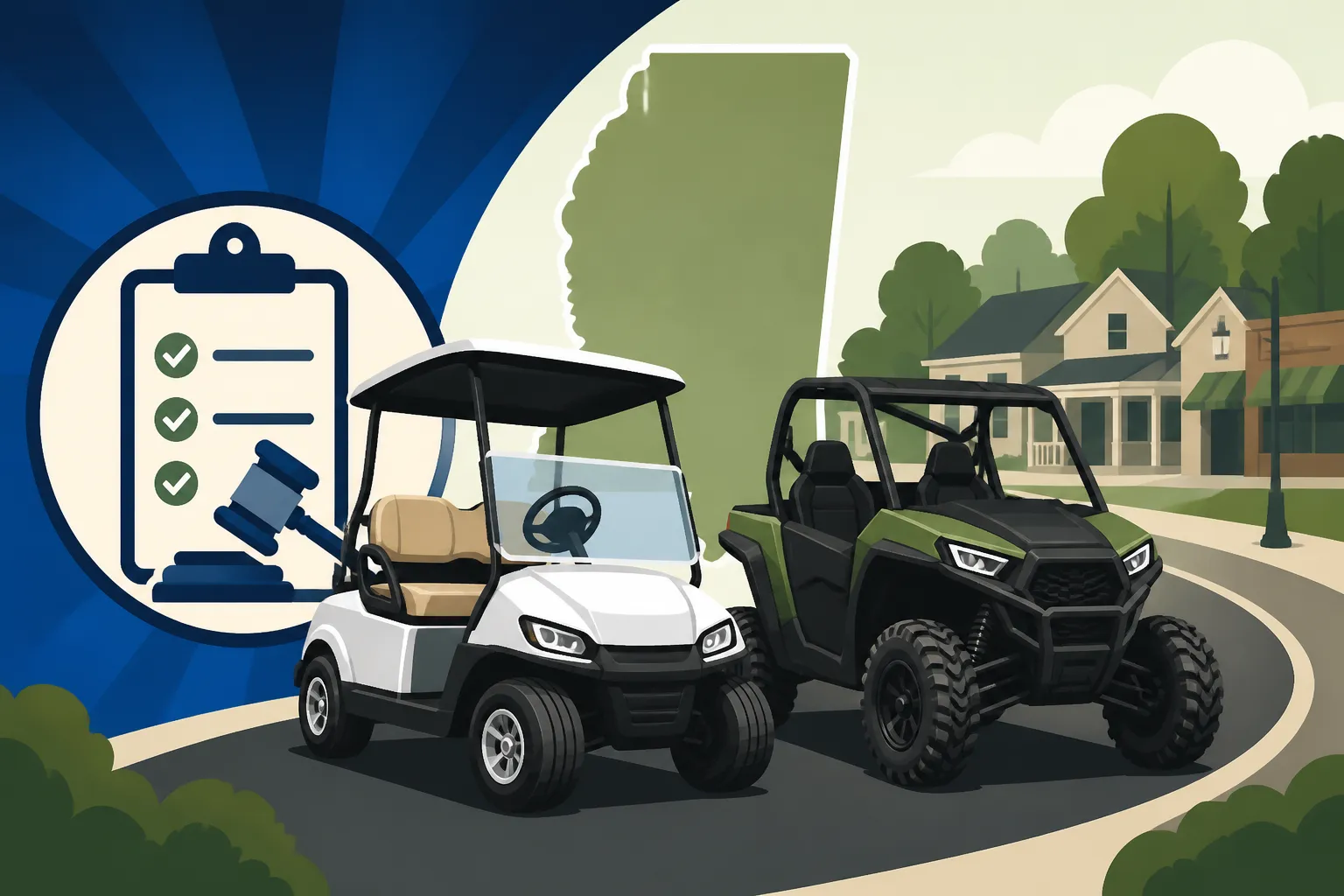
Mississippi Golf Cart and LSV Ordinances
Oh, the tangled web of rules and regulations for riding anything with an engine on public roads in Mississippi! It's a question that plagues so many of us who just want to enjoy our machines, whether it's a zippy golf cart for a quick trip to the neighborhood store or a beefy side-by-side that we'd love to use to cross town. The frustration is real when you hear about one town allowing something that's absolutely forbidden just a few miles down the road. This guide is here to untangle that mess, specifically focusing on the ins and outs of golf cart and Low-Speed Vehicle (LSV) ordinances across our beautiful Magnolia State, helping you understand what's legal where, and why it's so darn confusing.
The Frustrating Reality of Mississippi's ATV Road Ban
Let's just get this out of the way upfront: Mississippi's state law concerning ATVs and UTVs on public roads is, frankly, pretty sparse and overwhelmingly restrictive. For many of us who love the off-road lifestyle, it's a constant source of head-scratching and disappointment. We see these machines everywhere else, used for everything from farm work to neighborhood cruising, and yet, here in Mississippi, it often feels like we're fighting an uphill battle.
Why State Law Offers Little Guidance
The core issue is that our state legislature hasn't exactly embraced the idea of ATVs and UTVs being legitimate forms of on-road transportation. In fact, if you look at the actual statutes, you'll find that [Mississippi's ATV Law Is Only Two Sections Long]. That's right, just two short sections attempting to cover an entire class of vehicles that are incredibly diverse in their uses and capabilities. These sections primarily focus on defining off-road vehicles and then, almost immediately, slapping a blanket prohibition on their use on public roads. This means that, at the state level, there's no nuance for different types of terrain, different times of day, or different types of machines. It's a broad, sweeping "no," which is incredibly frustrating for owners of utility-focused side-by-sides or even those smaller ATVs that feel perfectly safe on a quiet residential street.
This minimalist approach from the state leaves a massive void. When the state doesn't provide clear guidelines or exceptions, people are left in a legal gray area, forced to guess or, worse, assume that because a machine looks like it could be road-worthy, it is. This disconnect between common sense usage and legal reality is a major pain point for riders. Many come from other states where off-road vehicles have a more integrated role in local transportation, and they're often shocked by Mississippi's hardline stance, which only adds to the confusion. The lack of detailed state guidance means that riders expecting a clear statewide answer are often left scratching their heads, realizing that what applies in one county might be entirely different in the next.
The "Local Ordinance" Loophole
Here's where things get interesting, and often, more complicated. While the state says a resounding "no" to ATVs and UTVs on public roads, it does allow individual cities and towns to create their own ordinances regarding certain types of vehicles, primarily golf carts and sometimes Low-Speed Vehicles (LSVs). This isn't a free-for-all, by any means, but it creates a patchwork quilt of regulations across Mississippi. What might be perfectly legal in a coastal town like Ocean Springs could be strictly forbidden in a municipality deeper inland.
This local control means that if you live in, say, Hattiesburg, your rules might be completely different than someone living in Madison. You might hear from a friend about how they cruise their golf cart to the store, and think "Great! I can do that too!" only to find out that your specific city has never passed such an ordinance, or has one with entirely different stipulations. This disparity is precisely why relying on a friend's town's rules can get you in trouble; what works for them could lead to a hefty ticket for you. It's not uncommon for riders to be pulled over, genuinely bewildered, because they simply assumed a universal application of local rules they heard about, without realizing that [Mississippi Local Ordinances Are the Only Path] to any kind of street legality for these machines, and those paths vary wildly.
Understanding Golf Cart Definitions and State Limitations
To truly navigate the local ordinances, it's crucial to understand how different vehicles are legally defined, especially the distinction between a "golf cart" and everything else. This isn't just bureaucratic jargon; these definitions dictate which rules apply to your machine, and whether your local town even has the authority to let you ride it on their streets.
What Exactly is a Golf Cart in Mississippi Law?
When we talk about a "golf cart" in the context of Mississippi law and local ordinances, we're generally referring to a very specific type of vehicle. These are typically small, two- or four-person vehicles, often electric, designed primarily for use on a golf course. From a legal standpoint, they're typically restricted in terms of speed, usually topping out somewhere around 20-25 miles per hour. Their physical characteristics—lightweight construction, open-air design, and limited safety features—are key to their definition. Unlike an ATV or a UTV, which is built for off-road performance, rugged terrain, and often higher speeds, a golf cart is fundamentally designed for low-speed, contained environments.
This distinction is absolutely critical when it comes to local ordinances. Towns often draft rules specifically for "golf carts" because they are perceived as less of a hazard on residential streets than, say, a roaring quad. The smaller size, lower top speed, and intended usage profile make them a more palatable option for local lawmakers to allow on public roads, often with specific caveats. An ordinance that permits golf carts generally does not automatically extend to ATVs or UTVs, even if your UTV could theoretically fit on the street. This legal segregation of vehicle types is often the first hurdle many off-road enthusiasts face when trying to understand if their machine can go from the trail to the town square.
The Role of Low-Speed Vehicles (LSVs)
Beyond the traditional golf cart, there's another category that often gets lumped into the discussion of street-legal small vehicles: the Low-Speed Vehicle, or LSV. These are a different beast entirely, defined by federal and state regulations, and they typically come with a much higher bar for street legality. An LSV is generally a four-wheeled vehicle with a top speed between 20 and 25 miles per hour, but no more than 25 mph. What sets them apart is that they are manufactured with a whole host of safety features required for on-road use. Think of them as a golf cart that went to finishing school and got all the proper accouterments.
These required safety features for an LSV often include headlights, taillights, turn signals, stop lights, reflective devices, a parking brake, a rearview mirror, seatbelts, a windshield, a vehicle identification number (VIN), and sometimes even a horn. Essentially, they're designed to be mini-cars. Because they meet these stringent safety standards, LSVs are generally treated more like conventional vehicles and are eligible for state registration and title, just like a car. This means that an LSV often bypasses many of the restrictive local ordinances that apply to regular golf carts because they are already recognized by the state as road-worthy, albeit within their speed limitations. If you're looking for true street legality and don't want to rely solely on fickle local rules, an LSV might be your best bet, though you'll still need to ensure your town or county doesn't have specific bans on them that contradict state allowances, which can, unfortunately, happen.
Diving into Local Ordinances: What to Look For
Since state law provides such limited options for riding off-road vehicles on public roads, local ordinances become your primary focus. But how do you even begin to figure out what's allowed in your specific town or city? It's not always as straightforward as you'd hope, and it requires a bit of detective work.
Identifying Towns with Existing Ordinances
The first step, and often the most challenging, is simply finding out if your town, or any town you plan to visit, actually has an ordinance on the books regarding golf carts or LSVs. Unlike state laws that are compiled into neat codes, municipal ordinances are local documents. Your best bet is to start by checking your city's official website, if they have one. Many municipalities now post their ordinances online. Look for sections related to traffic, vehicles, or recreation. If you can't find it online, or if the website seems outdated, your next move should be a phone call or visit to the city clerk's office. They are the keepers of all official municipal records, including ordinances. Be prepared to be specific in your request: "I'm looking for any ordinances related to golf carts or Low-Speed Vehicles on city streets."
It's important to remember that not every town has an ordinance, and those that do can vary wildly. For instance, you'll find places like [Hattiesburg's Cart Ordinance in Mississippi] which explicitly lays out rules for golf cart use, or [Ocean Springs' Cart Rules in Mississippi], which have their own set of specific regulations. These examples highlight the fact that you absolutely cannot assume that what's allowed in one town will be allowed in another. Some towns have embraced the golf cart culture, especially those with large retirement communities or coastal areas where people prefer a slower pace. Other towns, for various reasons, have chosen not to enact such ordinances, or have even passed ones that are particularly restrictive. The challenge lies in this decentralized information, making a general statewide assumption nearly impossible and often leading to confusion for riders just trying to do the right thing.
Common Restrictions You'll Encounter
When you do find an ordinance, you'll likely notice some recurring themes in the restrictions. These are the details you absolutely need to pay attention to, as they are the keys to legally operating your golf cart or LSV on public streets. One of the most common restrictions involves speed limits. Many ordinances specify that golf carts are only allowed on streets where the posted speed limit is 30 mph or lower. This is a crucial safety measure, as golf carts are not designed for higher speeds and would be a hazard on faster roads. You'll often see this explicitly stated as [Golf Carts Only on Streets Posted 30 mph], meaning that even if the cart is street-legal, it cannot venture onto main arteries or highways.
Another frequent restriction involves specific streets or zones. Some towns might only allow golf carts within a certain historic district, a residential area, or a neighborhood directly adjacent to a golf course. They might explicitly list streets where they are permitted and, just as importantly, streets where they are prohibited. Time of day restrictions are also common, often barring golf cart use after dark unless the cart meets specific lighting requirements—which ties into equipment, as we'll discuss next. Driver age and licensing are also significant; typically, you'll need a valid driver's license to operate a golf cart on public roads, regardless of its classification. Finally, while not always strictly mandated by local ordinances, many municipalities will strongly recommend, or even require, proof of liability insurance. Even if your town's ordinance doesn't explicitly demand it, having insurance is always a wise decision to protect yourself in case of an accident.
Equipment Requirements for Street Legality
Beyond where and when you can ride, local ordinances (and state LSV laws) will almost certainly detail what your vehicle needs to have to be considered street-legal. For a standard golf cart, an ordinance might require basic safety equipment. This often includes functional headlights, taillights, brake lights, and turn signals. You'll also typically need a rearview mirror, a horn, and sometimes seatbelts for all occupants. These requirements aim to make the golf cart more visible and predictable to other drivers on the road, increasing overall safety for everyone.
However, the equipment demands really step up if your vehicle is classified as an LSV. As mentioned before, LSVs are built to a higher standard, reflecting their more robust integration into street traffic. For these, you'll likely need everything listed above, plus a windshield (often made of safety glass), a parking brake, and a Vehicle Identification Number (VIN) to allow for state registration. This is the difference between a "golf cart" that's simply allowed by local rule and a "street-legal golf cart" that meets a higher standard for road use. For many riders, upgrading their standard golf cart to meet these requirements often involves aftermarket parts. Companies like SuperATV offer a wide range of accessories, from turn signal kits to rearview mirrors and upgraded lighting, that can help transform a basic golf cart into a more road-ready machine that complies with local or LSV standards. It's crucial to ensure that any additions not only enhance safety but also meet the specific legal specifications outlined in your local ordinance or state LSV definition.
The Crucial Differences: Golf Carts vs. ATVs/UTVs on City Streets
This is often where the most confusion and frustration arise for off-road enthusiasts in Mississippi. Many UTV owners look at a golf cart cruising down a residential street and wonder, "Why can't my side-by-side do that? It's bigger, safer, and faster!" The answer, unfortunately, lies in a combination of legal definitions, public perception, and legislative inertia.
Why Towns Treat Them Differently
The primary reason towns draw a sharp distinction between golf carts and ATVs/UTVs is rooted in perception and design intent. Golf carts are generally seen as slow-moving, non-threatening vehicles primarily used for recreational purposes or short-distance travel within a contained community. Their speed, size, and relatively quiet operation make them seem less disruptive and less dangerous to other motorists and pedestrians. Local officials often view them as a way to enhance community mobility without significantly impacting traffic flow or safety.
ATVs and UTVs, on the other hand, are designed and marketed for off-road use. They are often larger, more powerful, and can achieve higher speeds than golf carts. Even if a UTV owner intends to use their machine responsibly on city streets, the inherent design, noise level, and aggressive appearance of many ATVs and UTVs often trigger public safety concerns for local governments. There's a common misconception that all ATVs and UTVs are "mud machines" or "hooning vehicles," regardless of their actual use case, like utility work or quiet neighborhood cruising. This perception gap is a significant hurdle. Furthermore, state law clearly designates ATVs and UTVs as off-road vehicles, making it a much larger leap for a municipality to grant them street access compared to the relatively innocuous golf cart. This difference in classification and public perception is precisely [Why a Cart Ordinance Does Not Cover a UTV], leaving many UTV owners scratching their heads.
The Frustration of UTV Owners
This disparity is a constant source of frustration for many UTV owners, and it's completely understandable. Modern side-by-sides, especially utility and multi-passenger models, often come equipped with many of the safety features you'd expect on a Low-Speed Vehicle: headlights, taillights, turn signals, seatbelts, and even full enclosures. They feel robust and capable, arguably more so than many flimsy golf carts. Yet, despite their advanced engineering and safety features, these UTVs are still largely banned from Mississippi's public roads by state law, even in towns that welcome golf carts with open arms.
Imagine owning a comfortable, four-seat side-by-side like those offered by various manufacturers, perfect for a short hop to the local grocery store or taking the kids to a friend's house in a quiet subdivision. It feels perfectly "street-ready," perhaps even more so with aftermarket additions like full windshields or street-legal conversion kits from a company like SuperATV. But because it's technically an "Off-Road Vehicle" by state definition, it remains relegated to private property or designated off-road parks. This is further complicated by the rare instance where a town might even name specific brands or types of machines that they bar or allow, as seen in [Brands Written Into an Ordinance] in some extreme cases. The desire of UTV owners to see their versatile machines included in local ordinances is strong, but the legal and perceptual barriers are formidable.
The Push for Broader Road Access (and Why it's Slow)
There has been, and continues to be, a desire among many riders and even some lawmakers to expand road access for ATVs and UTVs statewide. Every legislative session, bills are introduced that aim to create some form of statewide framework for allowing these machines on certain public roads, often with specific safety requirements or speed restrictions. Unfortunately, these efforts often face significant hurdles and frequently stall out. We've seen bills like [Mississippi's Failed 2025 Road Access Bill] that pass one chamber of the legislature with strong support, only to die in committee in the other chamber.
Why is it so slow? A combination of factors. Public safety advocates often raise concerns about mixing powerful off-road vehicles with traditional traffic, citing potential accident risks. Law enforcement agencies, too, sometimes express concerns about enforcement and the difficulty of regulating a new class of vehicles on roads not designed for them. There's also the sheer complexity of drafting legislation that can adequately address the vast differences between a small ATV and a large, multi-passenger UTV, while also accommodating the diverse needs and concerns of different communities across the state. This means that while the push for broader road access is ongoing, for now, the reality is that local ordinances remain the most practical, albeit fragmented, path to street legality for some types of low-speed vehicles in Mississippi.
Navigating the Application and Enforcement Landscape
So, you've done your homework, found an ordinance in your town that allows golf carts or LSVs, and maybe even upgraded your machine with some compliant parts. Now what? The next steps involve understanding the application process, knowing what to expect from law enforcement, and understanding your options if your town doesn't have an ordinance.
How to Apply for a Local Permit
If your town has a specific ordinance allowing golf carts or LSVs on public streets, it will almost certainly outline a permitting or registration process. This isn't like titling a car with the state; it's a local process designed to ensure you meet the municipality's specific rules. Your first stop will typically be the city clerk's office, the police department, or sometimes the local tax collector's office. They will have the specific forms you need to fill out.
The application process usually involves providing proof of ownership for your vehicle, such as a bill of sale, and sometimes proof of residency within the city limits. You'll likely also need to present your driver's license, as most ordinances require operators to be licensed drivers. A crucial step for many municipalities is a vehicle inspection. A representative from the police department or a designated city official will likely need to inspect your golf cart or LSV to ensure it meets all the equipment requirements specified in the ordinance (lights, horn, mirrors, etc.). This is where those aftermarket upgrades from companies like SuperATV can really shine, proving your machine is up to snuff. There will almost certainly be an application fee, and these permits often need to be renewed annually, sometimes with a re-inspection. Make sure you understand the renewal process and associated costs to avoid any lapse in your legal operating status.
What to Expect from Enforcement
Once you have your permit, it's essential to understand how local ordinances are enforced. Local police officers or county sheriff's deputies are the ones who will be ensuring compliance. They are typically well-versed in their municipality's specific ordinances, so don't assume they won't know the rules. If you're pulled over while operating a golf cart or LSV on a public street, be prepared to present your permit, your driver's license, and any proof of insurance if required by the ordinance.
Enforcement can range from a friendly reminder to a citation, depending on the severity of the violation and the officer's discretion. Common reasons for stops include operating outside of permitted hours, on prohibited streets, carrying too many passengers, or lacking required safety equipment. Penalties for violations will be outlined in the ordinance and can vary, but generally involve fines. These can be similar to other traffic violations. For example, [Mississippi Ticket Costs for Road Riding] for an ATV can range, and similar structures might apply to golf cart violations. In some cases, repeated offenses or egregious violations could lead to the revocation of your permit. The key takeaway is to always operate your vehicle responsibly and within the confines of the local ordinance. Don't push the boundaries, and always be courteous and cooperative with law enforcement.
What if Your Town Has No Ordinance?
This is a common scenario and often leads to the most confusion. What happens if you've called the city clerk, checked the website, and there's simply no mention of golf carts or LSVs being allowed on public roads in your town? Unfortunately, in Mississippi, the default state is that ATVs, UTVs, and even most golf carts are prohibited on public roads if there isn't an explicit local ordinance allowing them. The absence of a specific ban is not, I repeat, not a "free pass."
The state's general prohibition on off-road vehicles on public roads generally applies unless a specific local ordinance carves out an exception for golf carts or LSVs. So, if your town hasn't enacted such an ordinance, riding your golf cart on the street is likely illegal, even if you see others doing it. This can be a tough pill to swallow, especially if you live in a community where golf carts are informally used. In such cases, your options are limited to either strictly abiding by the statewide prohibition or attempting to advocate for change at the local level. If you're feeling passionate about it, learning how to present a well-reasoned argument to your local officials, as detailed in [Bringing an ATV Question to Your Board of Aldermen], can be a constructive step. It's a lengthy process, but it's the only real path if your town hasn't yet caught up with the idea of allowing these types of vehicles on its streets.
Practical Advice for Mississippi Riders
Navigating the waters of golf cart and LSV ordinances in Mississippi can feel like trying to solve a jigsaw puzzle with half the pieces missing. But with a bit of proactive effort and a commitment to safety, you can figure out what's what in your area. Here's some practical advice to help you stay on the right side of the law and enjoy your machine responsibly.
Researching Your Specific Area
Seriously, this cannot be stressed enough: do your own research for your specific municipality. What you hear from a friend in a neighboring town, or even what you read in an online forum, might not apply to where you live or where you plan to ride. The first step is always to contact your local city clerk's office or police department directly. Ask them explicitly about ordinances regarding golf cart and Low-Speed Vehicle use on public roads. Be clear about what type of vehicle you have. They are the authoritative source for information regarding your specific town.
Next, dive into your municipality's official website. Many towns are making an effort to digitize their code of ordinances, so you might find the information there. Look for sections pertaining to traffic, vehicles, or even recreation. Just be mindful of the date of the ordinances; sometimes, online versions can be outdated. If you can't find it online, or if the information is unclear, a personal visit to the city clerk's office can be invaluable. This approach ensures you're getting the most current and accurate information. Never, ever rely solely on hearsay or anecdotal evidence. As we've seen, the rules vary wildly, and what's okay in one place could land you a ticket in another. The best way to avoid trouble is to know exactly [How to Check If Your Town Has an Ordinance] and then follow it to the letter.
Safety First, Always
Even if your local ordinance doesn't explicitly mandate certain safety measures beyond the basics, taking a "safety first" approach is always the smartest move. Remember, golf carts and LSVs, while generally slower, are still sharing the road with much larger, faster, and heavier vehicles. One crucial consideration, especially for younger riders, is helmets. While Mississippi's statewide helmet law for ATVs generally applies to riders under 16, and some local golf cart ordinances might not mention helmets, it's always a good idea, particularly for children, to wear one. Better safe than sorry, right?
Adhering to posted speed limits is non-negotiable. Golf carts are designed for low speeds, and pushing them faster than intended not only risks mechanical failure but also severely compromises your ability to react to unexpected traffic situations. Visibility is another critical factor. Ensure all your lights are functional (headlights, taillights, brake lights, turn signals) and consider adding additional reflective tape or even a safety flag, especially if you're riding near dawn or dusk. SuperATV offers a range of enhanced lighting solutions that can make your vehicle much more noticeable to other drivers, which is always a plus. Lastly, never overload your golf cart. Exceeding the manufacturer's passenger or weight limits can impair handling, braking, and stability, turning a fun ride into a dangerous situation. These machines are not designed to carry extra passengers or heavy loads beyond their specified capacity.
Advocating for Change
What if your town doesn't have an ordinance, or the one it has is simply too restrictive for the responsible use of your machine? You have the power to advocate for change! It's not a quick process, but local governments are often responsive to their constituents. Start by gathering information and understanding the existing landscape. Document how other towns successfully manage golf cart or LSV use. Research safety data to counter potential concerns.
Next, consider forming or joining a local rider group. There's strength in numbers, and a unified voice is far more impactful than individual complaints. Approach your local Board of Aldermen, city council, or county supervisors with a well-researched, polite, and constructive proposal. Explain the benefits – increased mobility for seniors, convenience for families, potential for local tourism – and be prepared to address concerns about safety, enforcement, and integration with existing traffic. Understanding the legislative process at the local level is key; know who the decision-makers are and how to effectively present your case. Sometimes, seeing how another town like Hattiesburg or Ocean Springs successfully implemented their own ordinances can provide a valuable template for your local government to consider. It’s a long game, but your active participation can genuinely shape the future of local machine use.
Comparison of Small Vehicles on Mississippi Public Roads (General Guidelines)
| Feature | Golf Cart (Local Ordinance) | Low-Speed Vehicle (LSV) | ATV/UTV (State Law) |
|---|---|---|---|
| Legal Basis | Local municipality ordinance only | State & Federal definitions | State law (generally prohibited) |
| Top Speed | Typically 20-25 mph (by design) | 20-25 mph (max 25 mph) | Varies, often much higher than 25 mph |
| Equipment Required | Varies by ordinance; usually lights, horn, mirror | Headlights, taillights, turn signals, brake lights, mirrors, windshield, seatbelts, VIN, etc. | None for road use (as generally prohibited) |
| State Registration | No | Yes, similar to an automobile | No |
| Driver's License | Generally required | Required | Required for public land use, not for road use (as generally prohibited) |
| Roads Permitted | Varies by ordinance; often 30 mph or less streets | Varies by state law/local override; often 35 mph or less streets | Generally none |
| Insurance | Often recommended, sometimes required by ordinance | Recommended, sometimes required by state | Recommended for off-road/theft |
| Public Perception | Low threat, recreational | Small car, regulated | Off-road, recreational, potential hazard |
| Local Authority | High, can create specific allowances | Can regulate use, but cannot supersede state registration | Cannot allow state-prohibited vehicles on roads without specific legislative action |
Disclaimer
This article is for general informational purposes only and does not constitute professional advice. Laws, prices and regulations vary by location and change over time. Consult a qualified professional for guidance on your specific situation.