Finding a Build Date on a Frame
Trying to figure out if your ATV or UTV needs a title in Mississippi can feel like a treasure hunt, especially when the crucial piece of information—the manufacturing date—seems to be playing hide-and-seek. This guide is here to demystify that process, helping you locate the build date on your machine so you can navigate Mississippi's titling requirements with confidence and avoid any last-minute headaches.
Why Your Machine's Build Date is So Important in Mississippi
Understanding when your ATV or UTV was manufactured is absolutely key in Mississippi, primarily because of a significant change in the state's titling laws. It's not about when you bought it, or even when you first rode it – it's about the date it rolled off the assembly line. This one detail dictates whether your machine falls under the new mandatory titling rules or if it's considered an older, grandfathered machine.
The July 2025 Cutoff and Its Impact
The biggest reason to pinpoint your machine's build date is the upcoming titling requirement for ATVs and UTVs in Mississippi. Machines manufactured on or after July 1, 2025, are going to require a title. This isn't just a suggestion; it's a legal necessity that will affect new purchases and eventually the resale market. If you're eyeing a new model or have a relatively recent machine, knowing its exact birthdate is paramount. Imagine buying a brand-new side-by-side in late 2025, only to realize you can't get it titled because a crucial piece of paperwork is missing, all because you didn't confirm the manufacture date. [Mississippi ATV Titling Starts July 2025] is a critical read for any rider.
For machines built before this date, the rules are different. They aren't automatically required to have a title, which gives owners a bit more flexibility. However, even for these older machines, obtaining a voluntary title can offer significant benefits, especially when it comes to proving ownership, deterring theft, or preparing for a future sale. Understanding where your machine falls in this timeline saves you time and potential frustration down the road. It helps you understand if you need to jump through the new hoops or if you have other options.
Titling Requirements and Proving Ownership
Beyond the July 2025 cutoff, the build date often ties into the kind of documentation you'll need for titling, regardless of when you apply. For new machines, the Manufacturer's Certificate of Origin (MCO) is the gold standard, and this document always includes the build date. If you're dealing with a used machine, a solid bill of sale is crucial, but confirming the build date helps align your paperwork with what the state expects. [Manufacture Date, Not Purchase Date, Decides Titling] means your purchase date is secondary.
Without a clear build date, you might find yourself in a bureaucratic limbo, unable to prove whether your machine is subject to mandatory titling or if it qualifies for a voluntary title. This can be especially frustrating if you've purchased a used machine and the previous owner wasn't meticulous with their records. The state uses this date to categorize your machine, so helping them make that classification accurately is in your best interest. This can affect everything from how you approach the county tax collector to whether you'll need to consider a title bond if other documents are missing.
Where to Look First: The Compliance Label
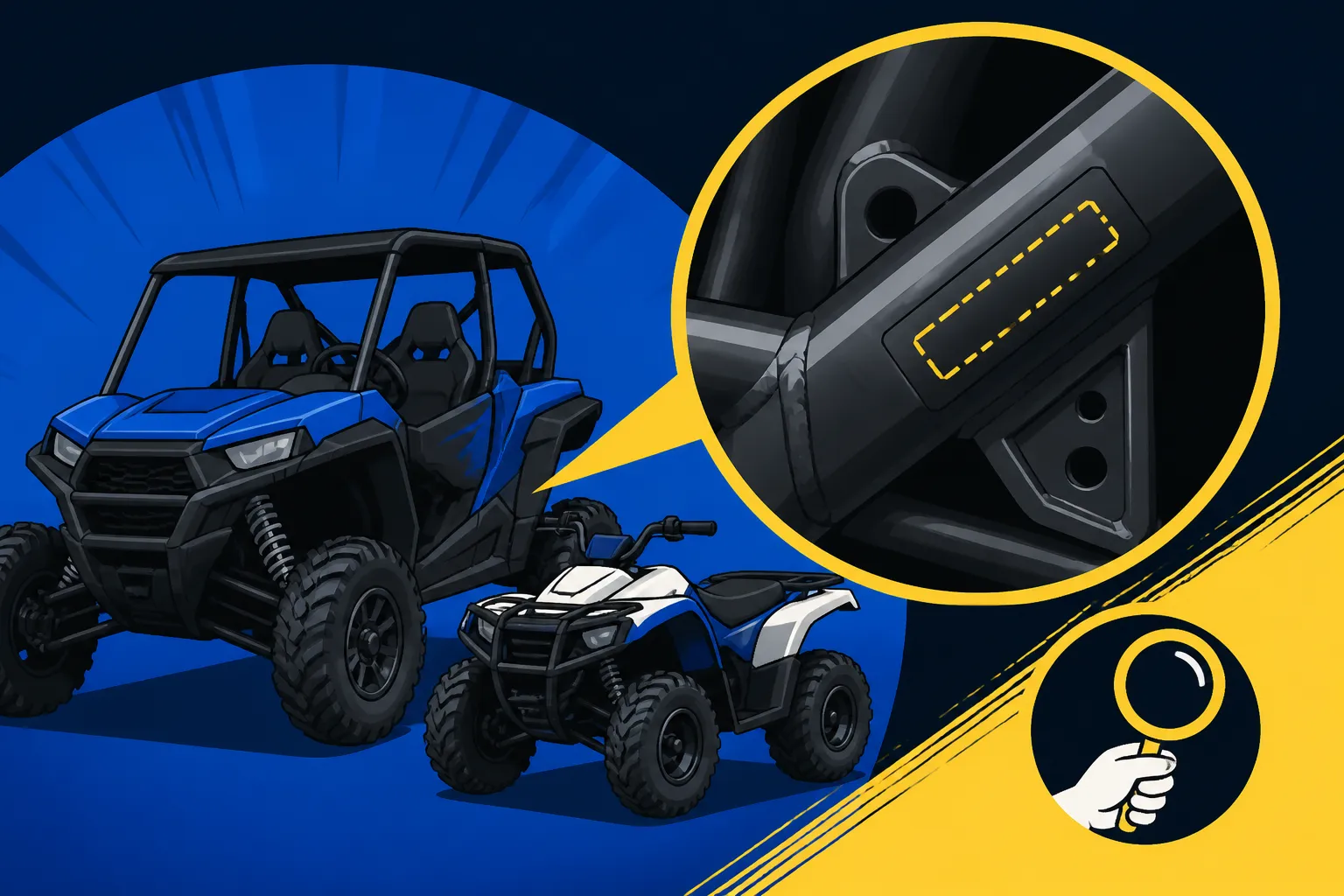
The first and often easiest place to find your ATV or UTV's build date is on its compliance label. Think of this as the machine's birth certificate, usually a durable sticker or a small metal plate affixed by the manufacturer. It's designed to withstand the elements, though years of mud, pressure washing, or tough trail riding can sometimes make it a challenge to read.
Common Locations for the Compliance Label
Manufacturers typically place these labels in highly visible, yet protected, areas. The most common spots are usually on the frame, often near the steering head or on one of the main frame spars. You might also find it under the seat, on the inside of a fender, or occasionally on the engine casing itself. It's worth taking a flashlight and a rag to clean off any grime or mud that might be obscuring the view. Sometimes, it's a matter of looking from a different angle.
For example, on many utility ATVs, you'll find it on the left-front frame rail, just below the radiator. For a sport quad, it might be tucked near the footpeg. Side-by-sides often have it on the frame near the driver's seat or under the hood in the front storage area. Don't be afraid to get down on your hands and knees and really explore. If you are having trouble, a quick search for your specific make and model online might yield forums or videos showing the exact location.
What Information the Label Provides
The compliance label is a treasure trove of information, not just the build date. You'll almost always find the Vehicle Identification Number (VIN) prominently displayed here. The VIN is unique to your machine and is another critical piece of information for titling. Alongside the VIN, you should see the month and year of manufacture, which is the build date you're looking for. This might be explicitly labeled as "MFG Date," "DOM" (Date of Manufacture), or simply appear as a month/year combination near the VIN.
Other details on the label might include gross vehicle weight ratings, tire pressure recommendations, and sometimes even noise emission data. While these aren't directly related to the build date, they confirm you're looking at the official manufacturer's label. If the label is severely damaged or missing, which can happen with older, well-used machines, don't despair; there are other places to look, but this is always the best starting point.
Digging Deeper: The VIN and Frame Stamping
If the compliance label is unreadable or missing, your next best bet is to scrutinize the Vehicle Identification Number (VIN) itself, and the frame where it's stamped. The VIN is like a machine's DNA, and it contains encoded information, including the year of manufacture.
Decoding the VIN for the Model Year
Every ATV and UTV has a unique 17-character VIN, and certain positions within this alphanumeric code indicate the model year. While it's not the exact build date (month and year), it will give you the model year, which is typically sufficient for determining if your machine falls before or after the Mississippi titling cutoff of July 1, 2025. The 10th character of the VIN is the model year identifier.
It's usually a letter or a number. For instance, 'A' might be 2010, 'B' 2011, and so on, with 'X' representing 1999, 'Y' 2000, and then numbers starting from '1' for 2001. After 2009, they switch back to letters (A for 2010, B for 2011 etc). There are charts readily available online that allow you to decode this character. For example, if your 10th VIN character is 'R', that typically means it's a 2024 model year. While this tells you the model year, it's not the precise date of manufacture. However, if your model year is clearly 2024, you can safely assume it was built before the July 2025 cutoff.
Physical Stamping on the Frame
In addition to the compliance label, manufacturers almost always stamp the full VIN directly into the machine's frame. This stamping is much harder to remove or damage than a sticker, making it a reliable source when other options fail. The location of this stamped VIN often mirrors where the compliance label is found – near the steering head, on a main frame rail, or occasionally on the engine block itself for certain models.
Again, grab a wire brush or some steel wool and thoroughly clean the area. Rust, paint, and grime can easily obscure these stamped numbers. Be patient and use good lighting. Sometimes, rubbing chalk or a crayon over the area can help the raised or recessed numbers stand out. Once you locate the VIN, you can then proceed to decode the 10th character for the model year as described above. If you're still struggling to find it, consult your owner's manual; it often has a diagram pointing out the VIN's location.
| Location Type | Details to Look For | Typical Information | Reliability for Build Date |
|---|---|---|---|
| Compliance Label | Sticker or metal plate, often on frame, under seat, or fender | VIN, MFG Date (month/year), GVWR, tire pressure | High (Exact date) |
| Frame Stamping | VIN directly embossed or engraved into the metal frame | VIN (10th character decodes to model year) | High (Model year) |
| Owner's Manual | Diagrams and descriptions of VIN/label locations | How to find VIN, sometimes lists build date range | Moderate (Guidance only) |
| Manufacturer's MCO | Official document for new machines | VIN, exact manufacture date, dealer info | Highest (Exact date) |
| Bill of Sale (Used) | Should list VIN and model year, sometimes build date | VIN, Model Year (if provided by seller) | Low (Relies on seller info) |
What to Do If the Build Date Remains a Mystery
Sometimes, despite your best efforts, the build date or even a clear model year remains elusive. This is a common frustration, especially with older machines, those bought in private sales, or machines that have seen a lot of hard use over the years. Don't give up hope; you still have avenues to pursue to get the information you need.
Contacting the Manufacturer or a Dealer
Your first step if you're truly stuck should be to contact the manufacturer of your ATV or UTV. With the full VIN in hand, most manufacturers have systems in place to look up the exact build date or at least the model year associated with that VIN. This might involve calling their customer service line or using an online VIN lookup tool on their corporate website. Be prepared to provide the VIN accurately and perhaps answer a few verification questions.
Alternatively, a reputable dealership for your machine's brand might be able to help. They often have access to manufacturer databases and can look up the VIN for you. While some might charge a small fee for this service, many are willing to help a potential customer. They are well-versed in [Serial Numbers on an Older Delta Quad] and similar identification challenges. This can be a particularly valuable resource if you're dealing with a brand that might not have a strong online presence anymore.
The Role of a Bill of Sale and Title Bonds
If your machine is older and you're considering a voluntary title or dealing with a situation where mandatory titling applies but paperwork is scarce, the build date can become a sticking point. A robust bill of sale from a private transaction should ideally include the VIN, make, model, and year of the machine. If you've got this, it provides a strong foundation. When drafting or examining a bill of sale, resources like LawDepot can be helpful to ensure all critical details are covered, including a space for the build date if known. [What Your Bill of Sale Must Show] is a good guideline.
However, if you bought the machine with limited paperwork, or if the original MCO is long gone and the VIN stamping is unreadable, you might need to explore a title bond. A title bond is essentially a guarantee that you are the rightful owner, even without all the traditional documentation. It's a procedure for when [Mississippi Title Bonds When Papers Are Gone], and it's something your county tax collector can explain further. While a bond doesn't magically produce a build date, it helps you move forward with the titling process when critical ownership documents are missing, allowing the state to then assign a date or work with the model year.
Consulting Your County Tax Collector
When all else fails, or if you simply need official guidance, your local county tax collector's office is your best resource in Mississippi. They are the folks who will ultimately process your titling application, and they've likely seen every conceivable scenario when it comes to missing or unclear information, including the build date. Bring whatever documentation you have – an old bill of sale, photos of the machine, and any partial VINs you've found.
They can advise you on the specific requirements for your situation, whether it falls under [Mississippi Machines Built After July 2025] or [Mississippi Machines Built Before the Cutoff]. They can tell you if a model year from the VIN is sufficient, or if you truly need a precise month and year. They can also guide you through the process of obtaining a title bond if necessary. This personalized advice from the experts who handle these applications daily is invaluable. They'll help you understand [Mississippi Title Questions Collectors Hear] and guide you on the next steps, ensuring you're compliant with Mississippi law.
Disclaimer
This article is for general informational purposes only and does not constitute professional advice. Laws, prices and regulations vary by location and change over time. Consult a qualified professional for guidance on your specific situation.