Buying an ATV in Mississippi: Taxes and Fees
Buying an ATV in Mississippi means looking beyond the sticker price. Sales tax, a required point-of-sale fee and the title fee add to a retail purchase, while trail access and ongoing ownership bring separate costs. The key is to sort out which charges apply to your machine and transaction before you agree to a price.
Mississippi ATV taxes and fees at a glance
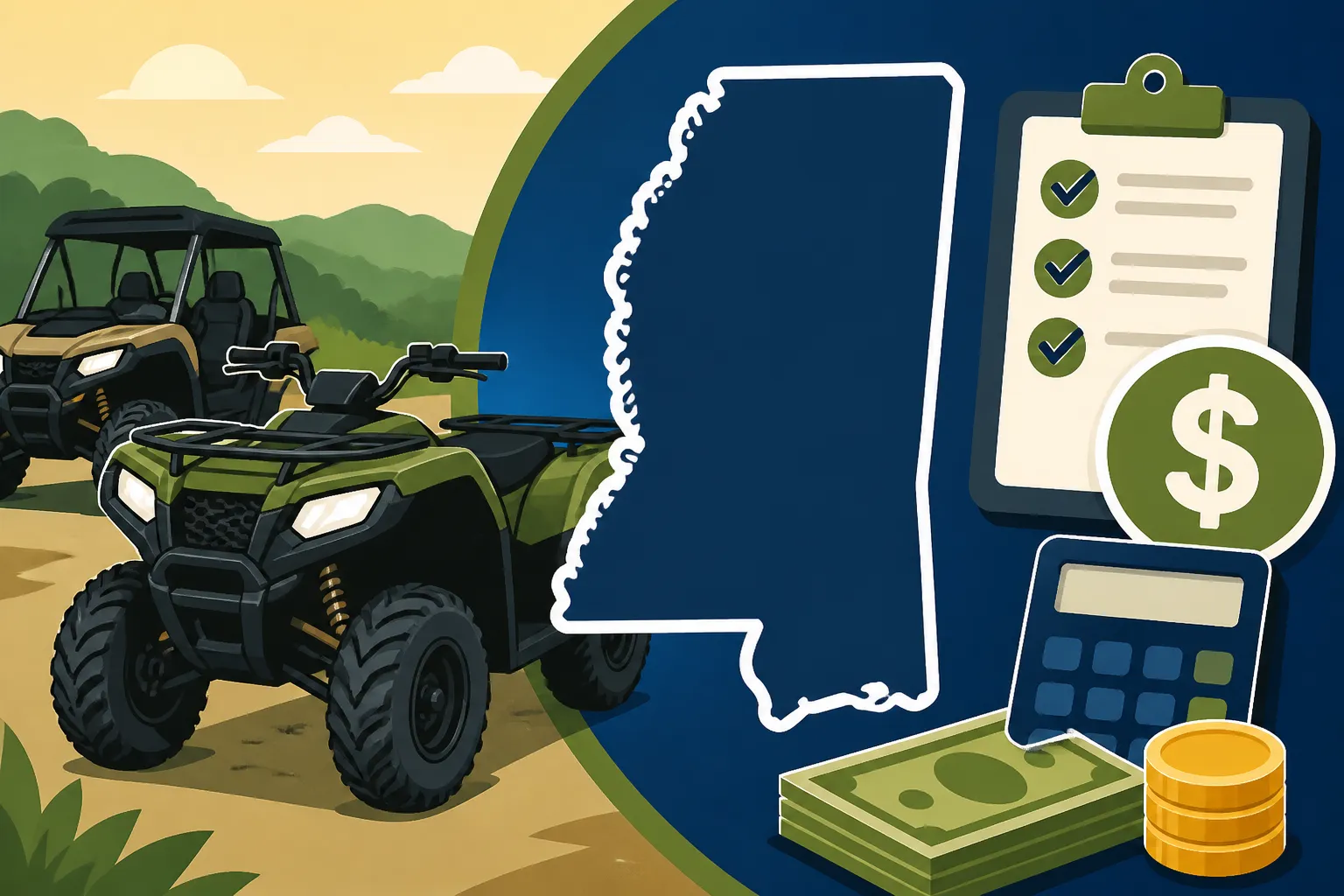
According to the Mississippi Department of Revenue, retail sales of ATVs are subject to a 7% sales tax, retail ATV purchases carry a mandatory $50 point-of-sale fee for the trauma care system, and a title requires a $9 fee (as of November 2026). These charges have different purposes: the sales tax is calculated as a percentage, the point-of-sale fee is a fixed retail-purchase charge, and the title fee relates to titling.
| Charge or cost | What it covers | What to confirm |
|---|---|---|
| 7% sales tax | Tax on the retail sale of an ATV | Ask what sale amount the dealer is using to calculate tax |
| $50 point-of-sale fee | Mandatory fee on a retail ATV purchase that funds the trauma care system | Confirm that it appears separately on the purchase paperwork |
| $9 title fee | Fee for a vehicle title | Ask whether the dealer is handling the title paperwork |
| National Forest pass | Access under the conditions and trail limits set for the pass | Check which pass and trails fit your machine |
| Dealer and delivery charges | Possible charges shown on a dealer quote | Request an itemized, out-the-door figure |
| Insurance and upkeep | Ongoing ownership costs that depend on your situation and use | Get quotes and plan for maintenance before buying |
The table separates known charges from costs that can vary. The Mississippi Department of Revenue figures apply to retail ATV purchases and titles as described above. They do not tell you what a dealer might charge for delivery, setup or paperwork, nor do they establish what tax or fees apply to every used or private-party transaction.
The total due at the dealership is also not the same as the total cost of owning a machine. If you plan to ride National Forest trails, for example, a pass may be another cost. A machine that does not fit the relevant trail rules may not be usable on those trails even if you have bought a pass. Insurance, gear, fuel, transportation and repairs are separate budget items.
A useful way to start is to request an itemized quote and identify each amount by name. Ask which lines are tax, mandatory state fees, title charges, dealer charges and optional add-ons. That makes it easier to compare offers and spot charges you want explained before signing. For a closer look at one line of the purchase, see [Mississippi Taxes ATVs at 7 Percent] and Mississippi Title Cost in Your Total.
How to estimate the retail purchase total
For a retail ATV purchase, a basic estimate can be organized without guessing at a dealer’s other charges:
- Start with the retail sale amount shown by the seller.
- Calculate the 7% sales tax using the amount the seller says is taxable.
- Add the mandatory $50 point-of-sale fee for a retail ATV purchase.
- Include the $9 title fee if the purchase requires a title.
- Add any other charges only after the seller identifies what they are for.
According to the Mississippi Department of Revenue, retail ATV sales are taxed at 7%, a mandatory $50 point-of-sale fee applies to retail ATV purchases, and a vehicle title requires a $9 fee. Ask the seller to show these separately so you can check that each part of your estimate matches the paperwork.
The sales tax is percentage-based, so it changes with the sale amount used for the tax calculation. The point-of-sale fee and title fee are fixed amounts in the facts above; they do not rise just because the price of the machine is higher. That difference matters when you compare a more expensive model with a lower-priced one: the percentage tax changes, while those stated fixed fees remain the same when they apply.
Do not assume you know the taxable amount from an advertised price alone. A dealer quote may include other amounts, and the information available here does not specify how every possible discount, accessory, delivery charge or trade-in affects the calculation. Ask the dealer to identify the taxable sale amount and explain any adjustment. If something is unclear, confirm the treatment with the Mississippi Department of Revenue before relying on an estimate.
Read the quote line by line
A useful quote makes the machine price and added charges easy to distinguish. Look for the retail sale amount, sales tax, the point-of-sale fee, the title fee and any additional dealer charges. If the quote combines several items into a single line, ask for a breakdown.
A dealer may describe a charge using a label you have not seen before. Rather than assuming it is a government fee or an optional add-on, ask who receives it, whether it is required for the sale and whether you can decline it. Compare the written answers, not just a verbal estimate.
The amount you pay to complete a purchase can differ from the advertised price. A written Mississippi Dealer Out-the-Door Price quote is more useful for comparison because it shows the total the seller expects you to pay for the transaction. Check whether that quote includes title handling or whether the title fee is listed separately. Also look into Mississippi Dealer Doc Fees and Mississippi Dealer Freight Charges if those lines appear; their labels alone do not tell you how they are calculated or whether they are negotiable.
Keep the estimate separate from the final figure
An estimate helps you set a budget, but the signed paperwork controls what you are agreeing to pay. Before signing, check that the machine description matches what you are buying and that the figures in the contract match the quote. Make sure you understand any optional products or services listed, such as an extended service plan or accessory package.
If a charge is described as mandatory, ask what makes it mandatory and who requires it. The state charges named above should be recognizable on the paperwork, but a dealer may also have its own charges. The Mississippi Department of Revenue identifies the ATV sales tax, point-of-sale fee and title fee; it does not define every dealer charge a particular business may list.
Keep copies of the quote, purchase agreement, payment record and title-related paperwork. Having the documents together can help if a figure changes between the quote and delivery, or if you need to ask the dealer or tax collector about a title issue later.
ATV, UTV, used-machine and private-sale questions
The stated tax and point-of-sale facts specifically address retail ATV sales. A side-by-side or UTV may be described differently in a dealer’s documents, and the facts here do not establish which tax or fee treatment applies to every machine marketed as a UTV. Before paying, ask the seller how the machine is classified for the transaction and confirm the treatment with the Mississippi Department of Revenue if needed. Do not assume that a fee listed for an ATV automatically applies to every off-road machine, or that a similar-looking vehicle is exempt.
This is particularly important when a dealer uses terms such as ATV, UTV, ROV, side-by-side or off-road vehicle interchangeably in advertising. Marketing language may not answer how a machine is categorized for a tax or title transaction. Ask for the machine’s exact description on the purchase paperwork and the reason the seller is applying a particular tax or fee.
Private-party and used purchases need their own check. The facts above specify the 7% tax and mandatory point-of-sale fee for retail ATV purchases, but do not settle every tax or fee question for a private sale, gift, inheritance, auction purchase or machine brought into Mississippi. The seller’s account of what they paid is not enough to establish what you owe now. Confirm the requirements for your specific transaction with the Mississippi Department of Revenue and the office handling the title. For a private transaction, see Mississippi Sales Tax on a Private ATV Sale and Mississippi Use Tax on a Machine Brought Home.
Ask the seller for the documents that show what is being transferred and what is known about the machine. Read the paperwork before handing over payment, and make sure the names, machine description and sale details are consistent. If the seller cannot explain how title paperwork will be handled, pause and check the process before completing the sale. A bargain can become expensive if ownership documents are incomplete or the transaction’s tax treatment is misunderstood.
A few questions help clarify the situation:
- Is the seller a dealer or a private individual?
- Is the machine being sold as an ATV, UTV, side-by-side or another vehicle type on the paperwork?
- Is a title required for this machine and transaction?
- Which office should answer questions about the tax treatment?
- What documents will the seller provide, and when?
- Are any charges being collected in addition to the sale amount, tax and stated fees?
The answers can change how you should compare the offer. A private seller’s price may appear lower than a dealer’s advertised price, but you still need to account for the transaction costs and paperwork that apply. Conversely, a dealer quote with more visible line items is not necessarily more expensive; compare the actual total and what each amount covers.
If the machine is financed, ask how the financing paperwork affects title processing and whether any lender-related amount is included in the quote. Do not treat the loan payment as the complete cost of purchase. The down payment, taxes, fees, interest, insurance and maintenance all affect what ownership costs over time. For financing-specific questions, Financing an Off-Road Machine in Mississippi may help you think through the loan separately from the tax and title charges.
Dealer quotes, add-ons and payment decisions
A dealer quote is easier to evaluate when it distinguishes required costs from optional choices. Ask for the written out-the-door amount before deciding on accessories or financing. If a seller gives a monthly payment instead of the total purchase figure, request both. A payment can make a purchase feel manageable while obscuring the full amount being financed or the charges due before delivery.
Separate the quote into categories:
- The machine itself, including any stated discount.
- Sales tax and the mandatory point-of-sale fee where they apply.
- The title fee and any title-handling service the dealer offers.
- Dealer charges such as documentation, freight, setup or preparation.
- Optional add-ons, protection plans and accessories.
- Financing terms, if you are borrowing.
Ask the dealer to explain whether each item is required to complete the purchase, required by the state, or optional. These are different things. The $50 point-of-sale fee is described by the Mississippi Department of Revenue as mandatory on retail ATV purchases. A separate dealer service charge should not be treated as that state fee unless the paperwork clearly says so and the dealer explains it.
A useful comparison is not simply one dealer’s advertised price against another dealer’s advertised price. Compare the machine configuration, what is included, the tax and fees, and the amount due to complete the transaction. Make sure both quotes refer to the same type of machine and similar equipment. If one offer includes accessories and the other does not, compare the value of those items separately rather than treating them as free.
Decide on accessories before they are added
Accessories can be useful, but a collection of small purchases can push a budget beyond what the initial quote suggests. Decide which items solve an immediate need and which can wait. For example, hauling equipment may matter if you do not have another way to transport the machine, while cosmetic additions may be easier to postpone.
Ask whether a dealer-installed accessory changes the quoted price or the amount used for tax calculation. The facts here do not specify how every accessory is treated in a retail ATV transaction, so do not guess. Request the dealer’s explanation and confirm the tax treatment if the answer affects your decision.
You can also compare accessories outside the dealership. Amazon may be one place to compare options such as straps, storage gear or riding equipment, but check fit, compatibility, shipping and return terms before ordering. A low listed price is not useful if the item does not suit the machine or the intended trail use. Keep accessory costs separate from the required state charges in your budget.
Decide how to pay without losing sight of the total
Cash, a loan and a dealer financing offer can produce different payment schedules, but the purchase still has a total cost. If you finance, ask for the amount financed, the payment schedule, the interest cost and the effect of any optional products rolled into the loan. Review whether the machine itself, taxes, fees and accessories are all included. Avoid comparing loans only by their monthly payment.
If you plan to trade in another machine, ask the dealer to show the trade-in value and explain how it is reflected in the quote. The facts provided here do not specify how a trade-in affects the taxable amount, so do not assume the tax is calculated on a particular net figure. Request a written explanation and confirm it with the Mississippi Department of Revenue if necessary.
A payment plan should leave room for costs that arrive after purchase. Insurance, fuel, maintenance, protective gear, repairs and transport are not represented by a monthly payment alone. If the purchase would leave no money for those needs, consider a less expensive machine or delaying optional add-ons.
National Forest passes and trail access
Buying a machine does not, by itself, provide access to every trail. If you expect to ride in Mississippi National Forests, check the relevant pass requirements and the machine’s dimensions before you buy. A pass and an eligible vehicle are separate parts of the decision: having a pass does not make a closed trail open, and a trail’s limits may rule out a machine that is otherwise a good fit for your needs.
According to the Forest Service, special passes for National Forests in Mississippi include the Mississippi Adventure Pass and the Mississippi Annual Forest-wide OHV Pass. The Forest Service says the annual OHV pass allows use of trails open to vehicles 50 inches wide or less. If you are considering a wider side-by-side, do not assume that the annual pass gives it access to those trails. Check the width limit for the exact trail and machine before choosing a model.
The Forest Service lists designated OHV trail riding areas in several ranger districts: Little Tiger ATV/Motorcycle Trail on the Chickasawhay Ranger District; Bethel OHV Trails and Rattlesnake Bay ATV Trail on the De Soto Ranger District; and Chickasaw ATV/Motorcycle Trail on the Tombigbee Ranger District. Confirm current access, conditions and applicable requirements with the Forest Service before traveling. A designated area is not a guarantee that every route is open on the day you arrive.
According to the Forest Service, the Mississippi Annual Forest-wide OHV Pass costs $60 (as of November 2026). Holders of an Interagency Senior Pass, Interagency Access Pass, Golden Age Passport or Golden Access Passport can receive a 50% discount on any National Forests in Mississippi pass, according to the Forest Service. Ask which documentation is required and how the discount is applied when you obtain a pass. For the pass options and budgeting details, see [Mississippi Forest Pass Costs Added Up].
Trail conditions can affect whether a planned ride is possible. The Forest Service says motorized vehicle trails close when conditions are wet to prevent trail damage and erosion into streams. Check conditions before loading up, and be prepared to change plans if a trail is closed. A pass does not override a closure.
Think of forest access as a recurring-use cost rather than part of the machine’s purchase price. If you ride elsewhere, different parks or landowners may have their own fees and rules. A machine suited to a forest trail may not suit a private park, and park access should be checked with that park rather than inferred from a National Forest pass.
Before buying a machine for a particular trail, confirm:
- The trail permits the vehicle type you intend to use.
- The machine fits the trail’s width limit.
- The pass covers the intended riding area.
- The trail is open under current conditions.
- Any separate site rules or day-use requirements are understood.
This check can prevent a costly mismatch. A larger machine may offer more room or capability for your intended work, but if the trails you want to ride have a width restriction, its size can limit where you use it. A smaller ATV may fit more easily but may not provide the seating, cargo capacity or utility you want. Choose based on the actual riding and work you expect to do, not on an assumption that one machine suits every setting.
Budgeting for ownership beyond the purchase
The dealer’s total is only the starting point. Build a separate ownership budget around how you will transport, store, ride and maintain the machine. These costs vary by equipment, use, location and riding style, so treat them as items to investigate rather than fixed amounts.
Transportation and storage
If you do not ride directly from home, consider how the machine will reach the trail or property. You may need a suitable trailer, towing equipment, secure tie-downs or access to a hauling service. Confirm that your vehicle can safely handle the loaded trailer and that the trailer is appropriate for the machine. Do not assume the machine’s purchase quote includes transportation after delivery.
Storage also deserves a plan. A machine kept outdoors may need more protection from weather and theft than one stored in a secure building. Think about where it will sit, how you will secure it and whether you have room for a trailer and riding gear. Storage-related spending may include a cover, locks, a shed or other improvements, depending on what you already own.
Insurance and risk
The facts in this article do not establish a universal insurance requirement for every machine or use. Ask an insurance provider what coverage is available and what it would cover in your circumstances. Make sure the conversation includes where you ride, whether the machine is financed, how it is stored and who may operate it.
Insurance is not a substitute for trail permission or safe riding. It is one part of managing the financial risk of ownership. Compare policy coverage and exclusions rather than focusing only on a quoted payment. If another person may ride the machine, ask whether that changes the coverage or the insurer’s requirements.
Maintenance, fuel and repairs
Routine maintenance depends on the machine and how it is used. Review the manufacturer’s maintenance schedule and ask what service the dealer recommends. If you plan to ride in mud or water, ask what inspections and cleaning are appropriate afterward. Heavy use can mean more wear on parts, so a low purchase price should not be the only factor in your decision.
Fuel and trail-day supplies are recurring costs. Your use will determine how often you ride and how much fuel you need, so build an estimate based on your own plans rather than a generic claim. Gear, tools and recovery equipment may also be useful, but you can prioritize purchases around actual riding conditions and safety needs.
For a used machine, look at service records and inspect its condition before you buy. Ask about repairs, storage and the type of use it has seen. A price that is lower than a comparable machine may reflect deferred maintenance or missing equipment. If you cannot assess the machine yourself, consider getting a qualified mechanic to inspect it before you complete the sale.
Plan for the way you will actually ride
A first-time buyer may be tempted to buy for the most demanding use they can imagine. That can mean paying for capacity they rarely need. On the other hand, a machine that is too small for regular work or does not fit the trails you use can lead to an early replacement. List your expected uses, such as property work, hunting access, family rides or trail riding, and compare machines against those specific needs.
Then estimate the costs attached to each use. Trail riding may mean passes or park fees, plus transport and protective equipment. Work use may call for storage, cargo accessories or towing equipment. Family use can bring additional gear and a need to check each riding area’s age and passenger rules. Those requirements are separate from the purchase tax and title charge, so do not fold them into a single vague “fees” estimate.
A practical way to keep the budget useful is to maintain separate totals for the purchase, initial setup and ongoing use. The purchase total captures the dealer transaction and title. Initial setup includes the equipment you need before the first ride. Ongoing costs include fuel, insurance, maintenance, access fees and repairs. This organization makes it easier to decide what you can afford now and what can wait. For a wider view of recurring expenses, see Mississippi Total Cost of a Riding Season.
A buying checklist before you commit
Use this checklist before agreeing to buy. It is not a substitute for confirming the rules that apply to your particular transaction, but it helps keep the main questions visible.
- Identify whether the machine is being sold as an ATV, UTV, side-by-side or another type on the paperwork.
- Confirm whether the seller is a dealer or a private party.
- Request a written, itemized quote rather than relying on a sticker price or payment estimate.
- Ask which amount is used to calculate the 7% retail ATV sales tax.
- Check that the mandatory $50 point-of-sale fee is accounted for on a retail ATV purchase.
- Ask how the $9 title fee will be paid and who will handle the paperwork.
- Have the dealer explain each other charge and identify optional products.
- Confirm how the transaction’s tax and title requirements apply if it is a private, used, gifted, inherited or out-of-state purchase.
- Check the machine’s width against the limits of the trails you actually plan to use.
- Verify the pass, trail access and current conditions with the Forest Service or the relevant land manager.
- Include transportation, storage, insurance, fuel, maintenance and safety gear in the budget.
- Keep copies of the quote, signed agreement and title-related documents.
If you are buying from a dealer, ask for time to review the paperwork. If you are buying from a private seller, do not treat a handshake or a text conversation as a replacement for complete transfer documents. In either case, a question left unanswered before payment may be harder to sort out afterward.
When you are unsure whether a charge or requirement applies, direct the question to the office responsible for it. The Mississippi Department of Revenue is the relevant source for the tax and point-of-sale information described here. The Forest Service is the source for its National Forest passes, trail information and closures. A dealer can explain its own quote, but it cannot replace confirmation from the agency responsible for a state charge or a public-land rule.
Frequently Asked Questions
What fixed charges should I expect on a retail ATV purchase?
According to the Mississippi Department of Revenue, a retail ATV sale is subject to 7% sales tax and a mandatory $50 point-of-sale fee. A vehicle title requires a $9 fee. Ask the seller to show each item separately and explain any additional charge.
Does the same tax information automatically apply to a UTV?
The stated sales-tax and point-of-sale facts specifically concern retail ATV purchases. Ask how the UTV is classified in the transaction and confirm its treatment with the Mississippi Department of Revenue rather than assuming the ATV rules apply.
Does buying a National Forest pass guarantee that a trail will be open?
No. The Forest Service says motorized vehicle trails close when conditions are wet to prevent trail damage and erosion into streams. Check current conditions and trail access before you travel.
Can a wide side-by-side use trails covered by the Mississippi Annual Forest-wide OHV Pass?
According to the Forest Service, that pass allows use of trails open to vehicles 50 inches wide or less. Check the width of your machine and the rules for the specific trail; do not assume the pass opens trails with a limit your machine exceeds.
Should I compare dealer offers by monthly payment?
Compare the written total as well as any monthly payment. Ask for the itemized out-the-door figure, financing details and a clear explanation of required and optional charges. A payment alone does not show the full purchase or ownership cost.
Sources
- Forest Service — National Forests in Mississippi | Passes | Forest Service (checked November 3, 2026)
- Mississippi Department of Revenue — Sales Tax Rates / Motor Vehicle Titles (checked November 3, 2026)
Disclaimer
This article is for general informational purposes only and does not constitute professional advice. Laws, prices and regulations vary by location and change over time. Consult a qualified professional for guidance on your specific situation.