Using a Quad to Retrieve a Downed Deer
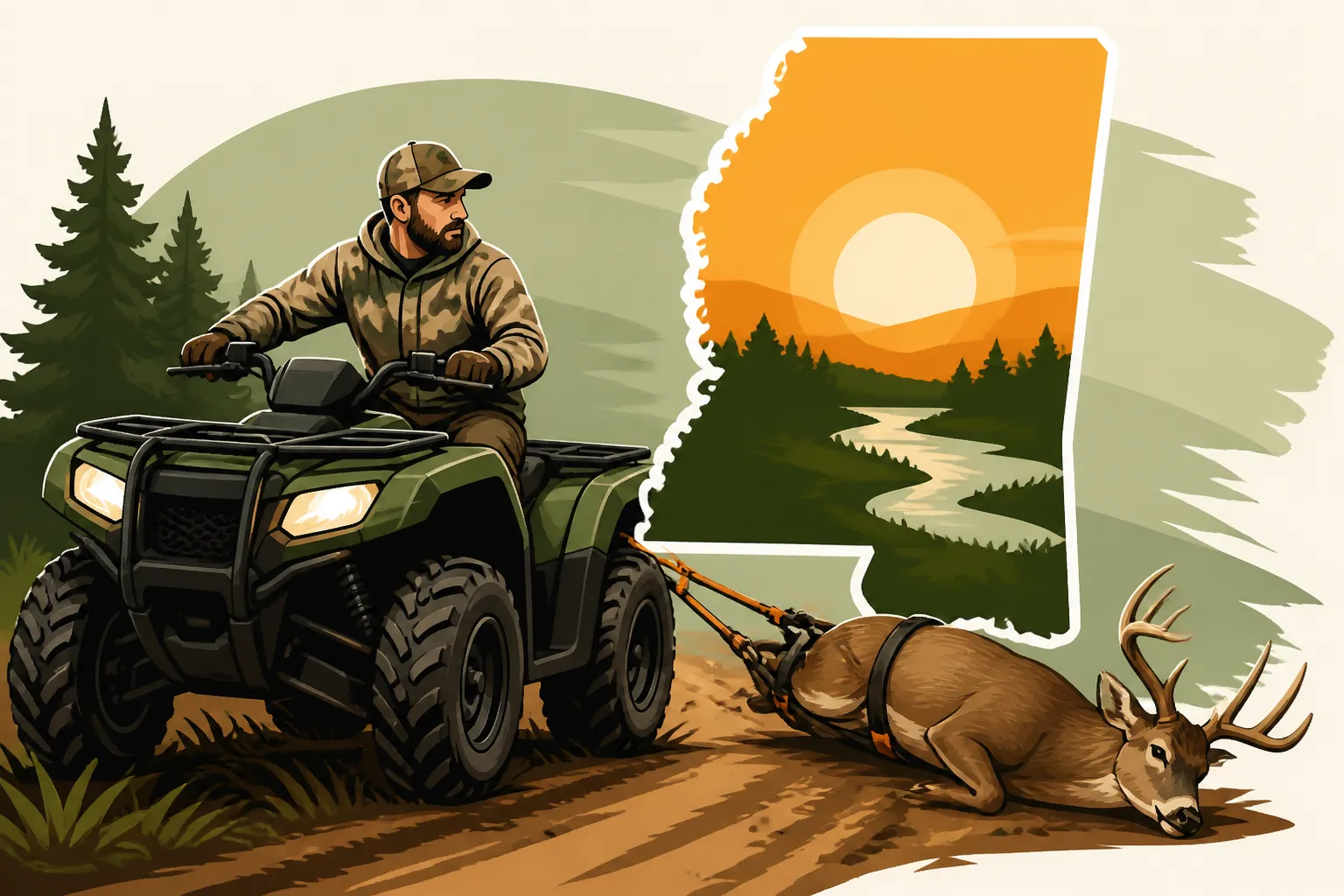
A quad can make deer recovery easier, especially when a carcass is heavy or the route back is long. But on Mississippi public hunting land, the shortest route is not always a legal one. Before you ride, check the rules for that specific wildlife management area, confirm where motorized travel is allowed, and plan how to transport the deer without creating a safety or access problem.
Check the rules before using a quad
A downed deer does not automatically give you permission to drive anywhere on a wildlife management area, or WMA. Vehicle access can be limited to designated roads, and rules may differ by area, season, road, and type of machine. A route that looks open on a map may be closed by a gate, sign, berm, or seasonal restriction.
Start with the current regulations for the WMA where you are hunting. Check the area’s official rules and posted notices, and ask the managing office if the language is unclear. In particular, find out whether ATVs or UTVs may be used to retrieve game, which roads are open to them, and whether any restrictions apply during the season. The details in Mississippi WMA Game Retrieval Rules and Mississippi WMA Designated Roads Only are useful reminders that access and retrieval are separate questions.
Do not assume that a general hunting privilege overrides a motor-vehicle restriction. A hunter may be allowed to recover a deer while still being prohibited from riding off an authorized road. Similarly, a road that is open to trucks or other vehicles may not be open to every quad or side-by-side. Follow signs and gates; do not ride around a barrier or make a new route through woods, fields, or habitat.
| Before you ride | What to confirm |
|---|---|
| WMA access | Whether the area allows a quad or UTV for game retrieval |
| Route | Which roads are open to your machine, and whether travel off-road is prohibited |
| Timing | Whether seasonal, hunting-season, or temporary closures apply |
| Machine | Any limits on vehicle type, width, or where it may be parked |
| Firearm | How it must be unloaded, secured, or transported on the machine |
| Deer transport | Whether the carcass can be moved on the chosen route and equipment |
A property owner’s permission is also not the same as permission from a public-land manager. On private ground, ask the landowner or lease manager where you may drive and whether there are restrictions on crossing neighboring property. On a WMA, follow the area’s posted and published rules even if you have permission to hunt there. For broader access considerations, see Mississippi Hunting Land Access by Machine.
Plan a legal and safe recovery route
Before starting the engine, identify the deer’s location and the nearest authorized road or parking area. If the animal is off the road, consider whether the WMA’s rules allow a machine to reach it or only to travel on designated routes. If there is no clear authorization to ride to the carcass, do not treat the practical difficulty of recovery as an exception. Contact the area manager or use a non-motorized method that complies with the rules.
A careful recovery plan can help prevent a rushed decision:
- Mark the location. Use your phone’s map, a handheld GPS, or another reliable method to note where the deer lies. Do not rely on cell service being available. A paper map or a companion who knows the route can be useful in areas with dead zones.
- Check signs and gates along the route. A familiar road can have a temporary closure or a restriction you did not notice on the way in. Do not pass a closed gate or ride around a barrier.
- Confirm the vehicle rule. Look for the WMA’s specific rules about quads, UTVs, and game retrieval. If the rules do not clearly answer your question, ask the managing office before riding.
- Secure the firearm before moving. Follow the applicable rules for transporting a firearm on a motor vehicle. Do not ride with a loaded weapon. The WMA’s requirements may be more specific than what you expect, so review Mississippi WMA Weapon Restrictions.
- Choose a route that avoids damage. Even where a road is open, soft ground, standing water, stream edges, and narrow trails can be vulnerable to rutting or erosion. Keep to the permitted route and avoid widening it to get closer to the deer.
- Use help when needed. A second person can guide the machine, watch for other hunters, and help load the deer. If the terrain is steep, wet, or unstable, a hand-carried recovery or a different route may be safer than trying to tow the animal.
If rules vary between areas, do not rely on what was allowed at another WMA last season. Regulations and closures can change, and a permission that applies to one road or one activity may not apply elsewhere. Check Mississippi WMA Road Closure Signs and contact the area office when a sign or rule leaves room for doubt.
Secure the firearm and deer for the ride
A recovery trip is still a trip on a motorized vehicle. Secure the firearm before moving, and keep it under control while loading and riding. Requirements for weapons on a WMA can depend on the specific regulation and circumstances, so check the current area rules rather than guessing. The key practical point is straightforward: do not carry a loaded firearm while riding, and do not handle a firearm casually while the machine is moving. For related context, see Mississippi WMA Weapon Restrictions.
Plan the deer’s position before lifting it onto a rack or trailer. A carcass that shifts can affect steering, braking, and stability, especially on a narrow trail or uneven ground. Use suitable tie-downs and keep the load low and balanced. Do not let the deer obscure lights, block your view, or interfere with controls. A winch or loading ramp can reduce lifting strain, but use it only on stable ground and within the equipment’s limits.
If the deer is too heavy to move safely, make another trip or get help rather than overloading the machine. A side-by-side may have more room than a quad, but that does not make it safe to exceed its capacity. Keep passengers within the machine’s designed seating, and do not carry someone on a rack or cargo area.
Be visible to other hunters and vehicles. Wear appropriate hunter-orange clothing where required, and use lights if visibility is poor or the rules call for them. Stop in a safe place before checking a map, adjusting straps, or handling equipment. Do not park in a way that blocks a road or access point.
What to do when the rules are unclear
If the WMA’s rules do not plainly say whether you can drive a quad to recover a deer, pause before riding. Ask the area manager, wildlife officer, or other official contact responsible for that land. Give them the exact area, the route you want to use, the type of machine, and whether you intend to travel on a designated road or leave it. A specific answer is more useful than asking generally whether “ATVs are allowed.”
If you cannot confirm that motorized recovery is permitted, leave the machine on an authorized road and recover the deer without it, if that can be done safely and legally. Do not assume that an emergency, a difficult carry, or a deer’s distance from the road creates an exemption. The consequences of an unauthorized ride can include a citation, damage to the land, or problems for other hunters who depend on continued access.
For a hunting lease or private property, get permission from the person who controls the land and agree on the route before using the machine. Permission to hunt does not necessarily include permission to drive across a neighboring parcel or through a closed section. Keep the machine on the agreed route and leave gates as you found them.
After the recovery, check the carcass and your equipment before leaving the area. Remove straps, flags, and other gear, and make sure nothing has been left on the road or trail. If you caused damage or encounter a road closure, report it to the appropriate land manager. Responsible recovery protects access for the next hunt and helps avoid turning a difficult carry into a preventable rules problem.
Disclaimer
This article is for general informational purposes only and does not constitute professional advice. Laws, prices and regulations vary by location and change over time. Consult a qualified professional for guidance on your specific situation.