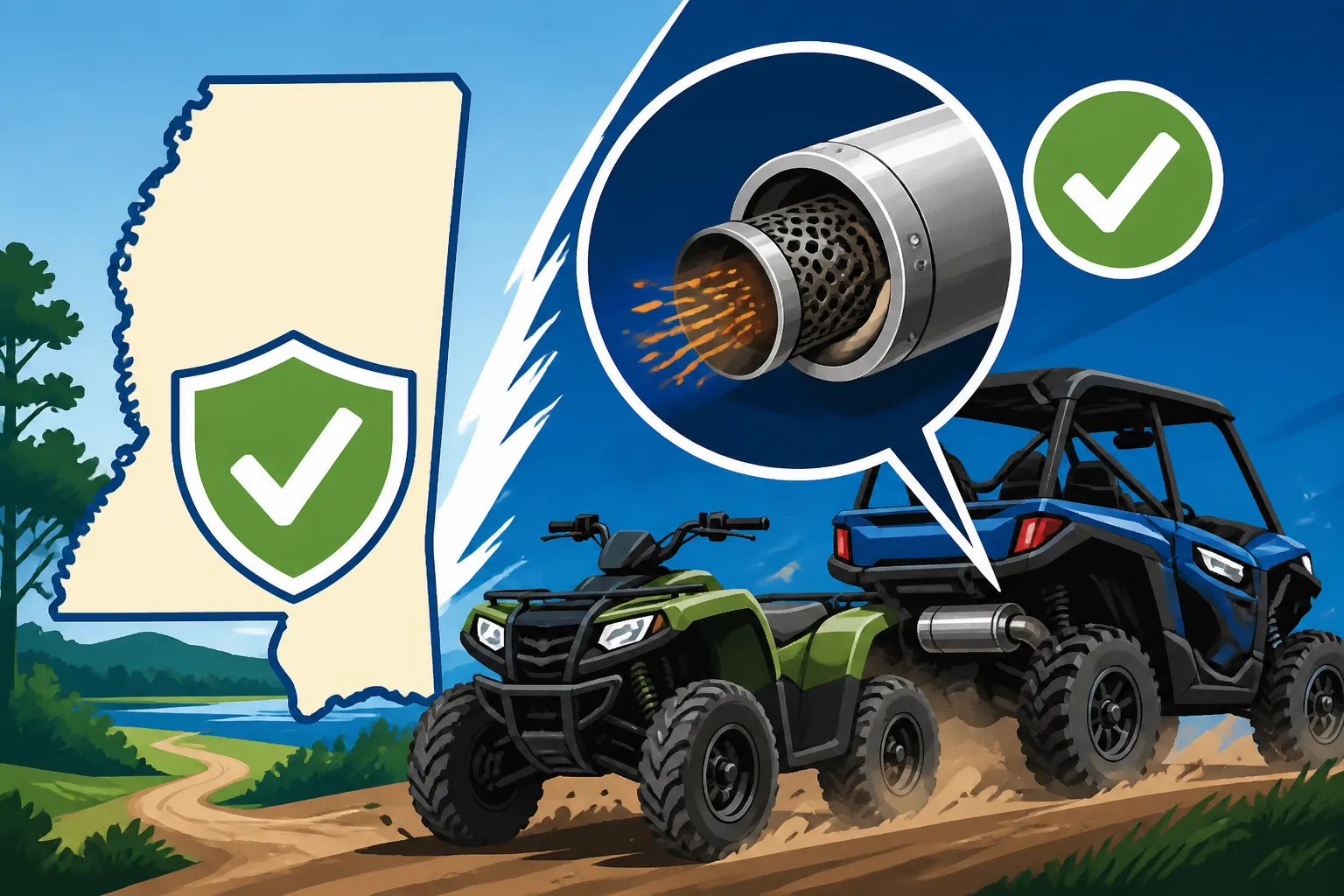
Mississippi Spark Arrestor Requirements
A spark arrestor can be easy to overlook until a trail operator asks to inspect your ATV or UTV. In Mississippi, what you need can depend on where you ride and who manages the land. Here’s how to check the right rule, identify a suitable exhaust system and avoid assuming that a pass or permit settles the equipment question.
What a spark arrestor does and when it matters
A spark arrestor is a device in the exhaust system designed to trap or cool hot particles before they leave the machine. Its purpose is to reduce the chance that exhaust could ignite dry grass, leaves or other combustible material. It does not eliminate fire risk, and it is not the same as a muffler: a muffler reduces exhaust noise, while a spark arrestor addresses escaping sparks.
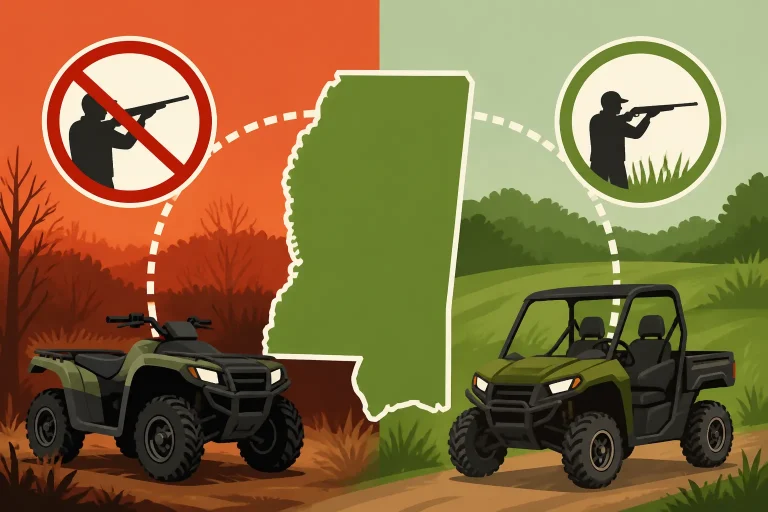
For riders, the practical question is not just whether a machine has something that looks like a screen in its exhaust. It is whether the riding area requires a spark arrestor and whether the installed part meets that area’s standard. Requirements may vary between public land, state parks, private parks and other managed riding areas. A rule that applies at one destination should not be assumed to apply everywhere—or to be the only rule that matters.
Check the rules for your specific destination before you haul the machine. Start with the land manager or park operator, and ask directly whether a spark arrestor is required for your ATV or UTV. If you are riding in a national forest, see Mississippi National Forest Riding Explained and confirm current requirements with the appropriate forest office. For a state park, Mississippi State Park ATV Rules is a useful starting point, but the park can confirm its current equipment checks.
Spark arrestor requirements are separate from access permissions. A forest pass, park permit, waiver or other required document does not necessarily mean the machine meets the equipment rules. Likewise, having a spark arrestor does not give you permission to ride on a closed trail or on land where machines are not allowed. Keep the equipment check separate from your access check.
| Riding location | What to check before you go |
|---|---|
| National forest | Ask the relevant forest office about current spark arrestor and trail requirements |
| State park | Confirm the park’s equipment rules and whether staff inspect machines at entry |
| Wildlife management area | Check the area’s access, route and equipment rules before riding |
| Private riding park | Ask the operator what equipment is required and whether inspection is part of check-in |
| Private property | Confirm landowner requirements and any applicable local or fire-safety restrictions |
On public land, access can also depend on where you ride. Wildlife management areas, for example, may limit machine use to designated routes or apply closures that have nothing to do with your exhaust. Read Mississippi WMA Rules for Riders before assuming that a machine allowed on one public trail is allowed throughout the area.
How to confirm the rule for your destination
The most reliable check is a direct question to the organization that manages the riding area. General online advice can help you prepare, but it may not reflect a current closure, a venue-specific requirement or a rule that applies only to certain trails or types of machines.
Use this process before your ride:
- Name the exact destination. A broad question such as “Are spark arrestors required in Mississippi?” may not get you a useful answer. Identify the forest, park, management area or private venue where you intend to ride.
- Ask whether the requirement applies to your machine. Give the staff the machine type and, if useful, its make, model and exhaust configuration. Requirements can be stated differently for different vehicles or locations.
- Ask what standard or proof they accept. Find out whether a built-in, manufacturer-installed spark arrestor is sufficient, whether an approved replacement part is acceptable, and whether staff look for markings or documentation.
- Ask whether the device must remain in its original configuration. A modified exhaust may change what the land manager considers compliant, even if the machine still has an insert or screen.
- Check for other equipment rules. A spark arrestor may be only one part of a check that also covers noise, passenger seating, helmets or other conditions.
- Recheck shortly before traveling. Rules and access conditions can change. A quick call or check with the official operator can prevent a long drive with a machine that cannot enter.
If the destination publishes rules online, use that information as a starting point and follow up when the wording is unclear. Ask a specific question: “Does this trail require a spark arrestor on an ATV or side-by-side, and what proof will staff accept?” That is more useful than asking whether the machine is “legal” in the state, because legality, land access and equipment requirements are different questions.
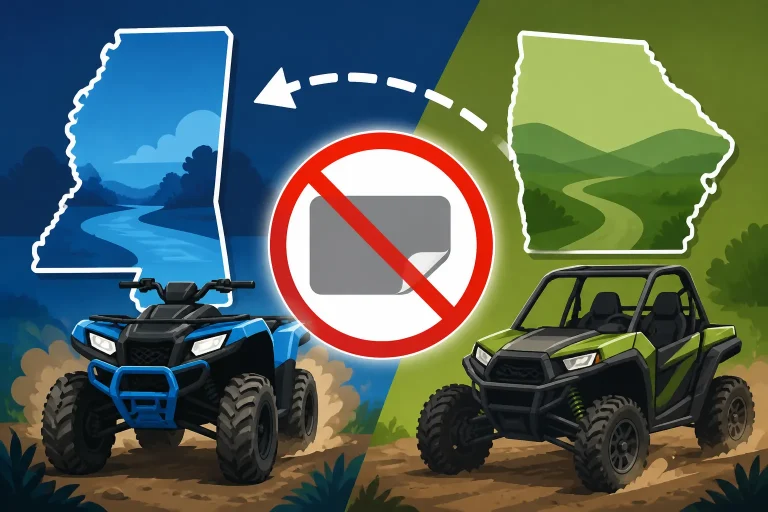
The same approach applies to visitors bringing a machine from another state. Do not assume that another state’s sticker, inspection or equipment rule automatically satisfies a Mississippi riding area. Nor should you assume that Mississippi requires every visiting machine to carry a state sticker. For access and permit questions, see Mississippi Visitors From Alabama or the page for the rider’s home state, then confirm the spark arrestor rule with the destination itself.
Checking your ATV or UTV exhaust
Start by checking the owner’s manual and the manufacturer’s information for the exact model and exhaust configuration. Some machines may have a spark arrestor included in the original exhaust assembly; others may require a separate component. Do not rely on appearance alone. A perforated plate or mesh-looking part is not automatically proof that it meets a particular riding area’s requirement.
Look for documentation identifying the exhaust or arrestor and any applicable approval or standard. If the venue requires a particular marking, ask what it looks like and where it is located. The operator can tell you whether staff inspect a stamp, part number, manufacturer documentation or another form of evidence. Keep the manual or relevant product information accessible if the equipment is not clearly marked.
If the machine has an aftermarket exhaust, confirm that the arrestor is compatible with that specific system. A part advertised as fitting a similar model may not fit your machine’s year or exhaust configuration. If you are shopping for a replacement, Amazon may help you compare available components, but verify the manufacturer’s fitment details and the riding area’s acceptance criteria before ordering. A part that physically fits is not necessarily a part that satisfies the venue’s rule.
A sensible inspection before leaving home includes:
- Checking that the exhaust and any arrestor are securely installed.
- Looking for obvious damage, missing fasteners or a loose insert.
- Confirming that the installed part matches the machine and exhaust system.
- Keeping any available manual, receipt or product documentation with your ride paperwork.
- Asking the destination whether it accepts the part or documentation you have.
Do not remove or alter an arrestor because the machine seems to run better without it. Besides potentially violating a riding-area rule, changing exhaust components can affect noise and machine performance. If a part is clogged or damaged, have it inspected and serviced according to the manufacturer’s instructions rather than improvising a fix.
A spark arrestor is also not a substitute for maintenance. Exhaust leaks, damaged components and loose hardware deserve attention even when a machine passes a basic visual check. If you are unsure whether an exhaust part is installed correctly, ask a qualified mechanic or the manufacturer’s dealer to inspect it.
Avoiding common mistakes at the trailhead
The most common mistake is treating “spark arrestor required” as a statewide yes-or-no question. For a rider, the useful answer is destination-specific: which land manager sets the rule, which machines it covers, what equipment counts and how compliance is checked. Confirm those details for every area you visit, especially when the trip involves more than one property.
Another mistake is confusing equipment compliance with road use. A spark arrestor does not make an ATV or UTV street legal, turn a closed road into an open route or override local restrictions. Mississippi road rules are a separate issue; see Mississippi ATV Road Rules Under 63-31-3 if your plans involve public roads. Trail access and road access should be checked independently.
Riders also sometimes assume that an older machine is exempt because it was built before a particular date or because it has never been inspected before. A title rule, a local riding-area rule and a fire-prevention equipment requirement are different matters. The machine’s age or title status does not, by itself, answer whether a park or land manager requires a spark arrestor.
Finally, do not treat a pass, waiver or successful entry on a previous visit as permanent confirmation. The operator may change its inspection process, and equipment may have been modified since the last ride. Before a trip, verify the current rule, check the machine and bring any documentation that the venue says it accepts. If an operator says the installed equipment does not qualify, ask what specific change or proof is needed before you unload.
Disclaimer
This article is for general informational purposes only and does not constitute professional advice. Laws, prices and regulations vary by location and change over time. Consult a qualified professional for guidance on your specific situation.