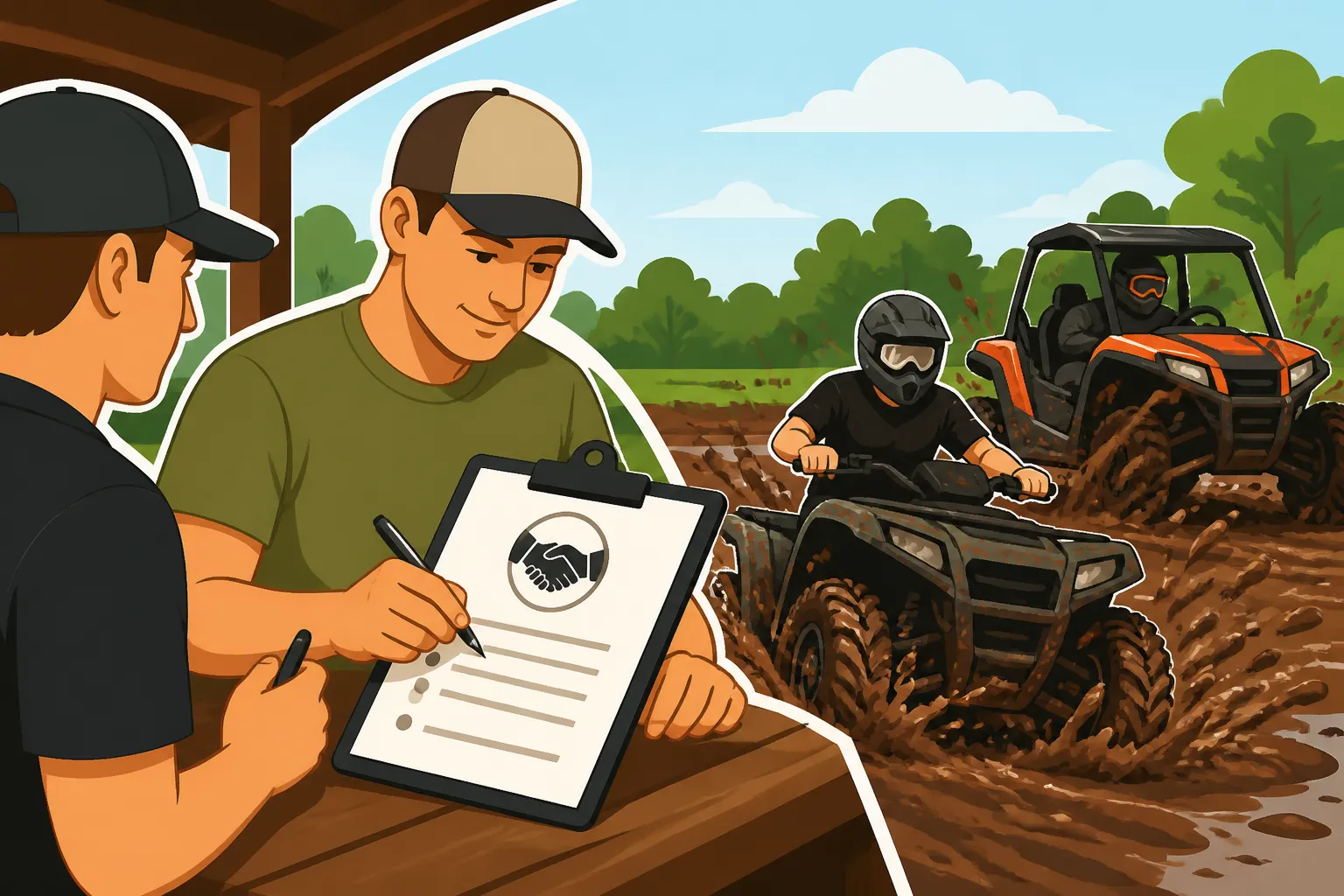
Signing a Waiver at a Private Mud Park
A day at a Mississippi mud park can start with a trailer unload and end at a check-in table, where everyone is asked to sign a waiver before riding. That paperwork can feel routine, especially when friends are waiting. This guide explains what to look for, what to ask, and how to prepare before you sign.
What a Private Mud Park Waiver Usually Covers
The risks and responsibilities the form may describe
A private riding park waiver commonly asks visitors to acknowledge that riding an ATV or UTV involves risks. Those may include rollovers, collisions, deep mud or water, changing trail conditions, mechanical problems, and contact with other riders. The form may also describe the park’s limits on responsibility if someone is injured or equipment is damaged.
Read the actual document rather than relying on a quick verbal explanation. A waiver might contain more than one section, such as a release of claims, an assumption-of-risk statement, a promise to follow park rules, or permission to use photographs. These are not necessarily the same thing. If a section is unclear, pause and ask staff to explain it before you sign.
A signature does not automatically tell you every possible legal outcome. The effect of a waiver can depend on the wording and circumstances, and rules may differ by location. Treat it as an important document, not as a formality that can be ignored because “everybody signs one.” For a general look at park paperwork and visitor expectations, see [Mississippi Private Park Waivers and Rules].
Rules that may be part of the check-in process
A waiver may refer to a separate rule sheet, posted signs, or instructions from park staff. Those rules can cover where you may ride, how fast to travel, whether passengers are allowed, what protective equipment is required, and what to do if a trail is closed. Ask whether signing the waiver also means you are agreeing to follow rules posted elsewhere on the property.
This matters at a mud park because conditions can change quickly. A route that looked manageable on arrival may become slick, rutted, or difficult to see after rain and heavy traffic. A staff member may close a section, redirect riders, or set limits on where certain machines can go. Do not assume that a waiver gives permission to ride every visible trail or mud hole.
If you are comparing a private park’s process with a state park’s, don’t assume the forms or requirements are interchangeable. State park procedures can be different; [Signing a Liability Waiver at a State Park Office] covers that separate setting.
What to Check Before You Sign
Read each section and ask about unfamiliar wording
Take a moment to look for what the waiver says about injuries, damage to your machine, property damage, emergency assistance, and responsibility for other people in your group. Check whether it includes terms such as “release,” “indemnify,” or “assumption of risk.” If you do not understand a term, ask staff to explain it in plain language. If the answer does not resolve your concern, you can ask for time to review the form or decide not to ride.
Also look for any separate photo or marketing consent. A park may ask to use images taken during an event, but that request may be distinct from the safety waiver. If you are uncomfortable with a clause, ask whether it is optional and whether declining it affects entry. Do not assume a staff member can change the wording; ask what options the park actually offers.
Finally, check that the form identifies the correct person signing and, if relevant, the correct machine or group. If you are signing for other adults, make sure the park has explained whether each adult must complete their own paperwork. A rushed check-in is a poor time to guess what your signature covers.
Clarify age, passengers, equipment, and conduct rules
When children or teenagers are riding, ask who must sign for them and whether the park has age, supervision, or riding-skill requirements. A parent or guardian should read the form and the park’s youth rules, rather than assuming one adult signature covers every minor in the group. Ask how staff handle a child who is a passenger rather than the driver, too.
Check the park’s rules for helmets, seat belts, passengers, alcohol, and machine equipment. Requirements can vary from one private property to another, and a machine that is acceptable at one park may not meet another park’s rules. Useful related topics include [Mississippi Private Park Age Minimums], [Mississippi Private Park Helmet Rules], and [Mississippi Private Park Alcohol Rules].
| Before you sign | What to confirm | Why it matters |
|---|---|---|
| Risk language | What risks the form identifies and what claims it addresses | Helps you understand the document instead of treating it as routine |
| Rules incorporated by reference | Whether posted rules or a separate handout are part of the agreement | Rules may affect where and how you can ride |
| Minors | Who must sign and what supervision is required | A child may have different check-in and riding requirements |
| Passengers | Which machines may carry passengers and where they may sit | A passenger rule may depend on the machine’s design |
| Photos or media | Whether consent is optional or separate | Photo permission may not be the same as the safety waiver |
| Emergency procedure | Who to alert and where to go after an incident | Knowing the process can save time if someone needs help |
| Copy of the form | Whether you can keep or photograph a copy | Useful if you later need to review what you agreed to |
How to Prepare Your Group for Check-In
Make sure every rider understands the plan
Before the group reaches the entrance, tell everyone that check-in may involve a waiver, park rules, and an equipment check. Give riders time to read rather than handing over a clipboard while they are putting on gloves or unloading a machine. If someone in your group has questions, sort them out before the rest of the group heads toward the trails.
It can help to name one person as the group’s point of contact. That person can ask where to park, how to report an incident, and whether the park has a designated meeting place if riders get separated. Each rider should still understand the rules and carry any information the park requires. If the group includes several families, confirm whether each household needs to complete separate forms.
For a visit around Perkinston or another rural area, plan the drive and the riding day separately. A map app such as onX Offroad can help you orient yourself and plan the trip, but it does not replace the park’s own directions, access instructions, or check-in rules. Confirm the entrance and arrival details with the park before setting out, particularly if the group is towing more than one machine.
Keep the signed paperwork and park instructions accessible
Ask whether the park provides a copy of the waiver or allows you to take a photo of it. Keep it with your trip notes rather than relying on memory, especially if the document refers to specific safety rules or emergency procedures. Save the park’s phone number and any instructions staff give you about reporting a crash or getting help.
If you use onX Offroad to organize a route to the area, keep the park’s address and entrance information separate from any route you plan to ride. A mapping app can be useful for navigation, but it cannot establish that a trail is open, that a route crosses land you are authorized to enter, or that a private park has approved a particular path. Check directly with the property before riding.
For overnight plans, ask about the park’s camping arrangements rather than assuming a day-use waiver also covers camping. Rules for sites, quiet hours, pets, and other overnight details may be separate; [Mississippi Private Park Camping Rules] offers related context. If you are bringing a machine that needs proof of insurance, ask the park what it accepts before arrival; see [Mississippi Insurance Proof at a Gate].
What to Do If You Are Uncomfortable or an Incident Happens
Decide whether the visit is right for you
You do not have to sign a form you do not understand just because your friends are ready to ride. Ask questions, request time to read, and make sure you understand any rules the waiver references. If you are still uncomfortable with the terms, you can choose not to participate. That can be frustrating after a long drive, but it is better to make a clear decision before riding than to sign while feeling pressured.
Likewise, if a rule seems unclear, ask staff before entering the trail area. For example, clarify whether a route is open to your machine, whether a passenger is allowed, or whether a closed section is off-limits even if other riders appear to be using it. Do not use another visitor’s behavior as proof that a rule does not apply.
Before leaving home, you can also check general route-planning details with onX Offroad, then verify actual access and conditions with the park. For a broader reminder about sharing trails and following local expectations, see [Mississippi Trail Etiquette Locals Expect]. Navigation tools can support planning, but the property’s current instructions take priority.
Report problems promptly and preserve useful details
If someone is hurt, get help according to the park’s instructions and contact emergency services when needed. Tell park staff what happened as soon as it is practical. If a machine is damaged or a collision occurs, note the time, location, people involved, and any witnesses. Take photographs only when doing so is safe and does not delay needed care.
Keep copies of relevant paperwork and communications. If you have questions about the waiver’s legal effect or a claim after an incident, speak with a qualified professional who can review the actual document and circumstances. A general article cannot determine what a particular form means for a specific person.
Before your next visit, use what you learned to make check-in less stressful: arrive with enough time to read, ask about rules in advance, and make sure every rider knows the park’s expectations. That preparation makes it easier to focus on the ride rather than trying to interpret paperwork at the gate.
Disclaimer
This article is for general informational purposes only and does not constitute professional advice. Laws, prices and regulations vary by location and change over time. Consult a qualified professional for guidance on your specific situation.