Mississippi Private Sale vs Dealer Purchase
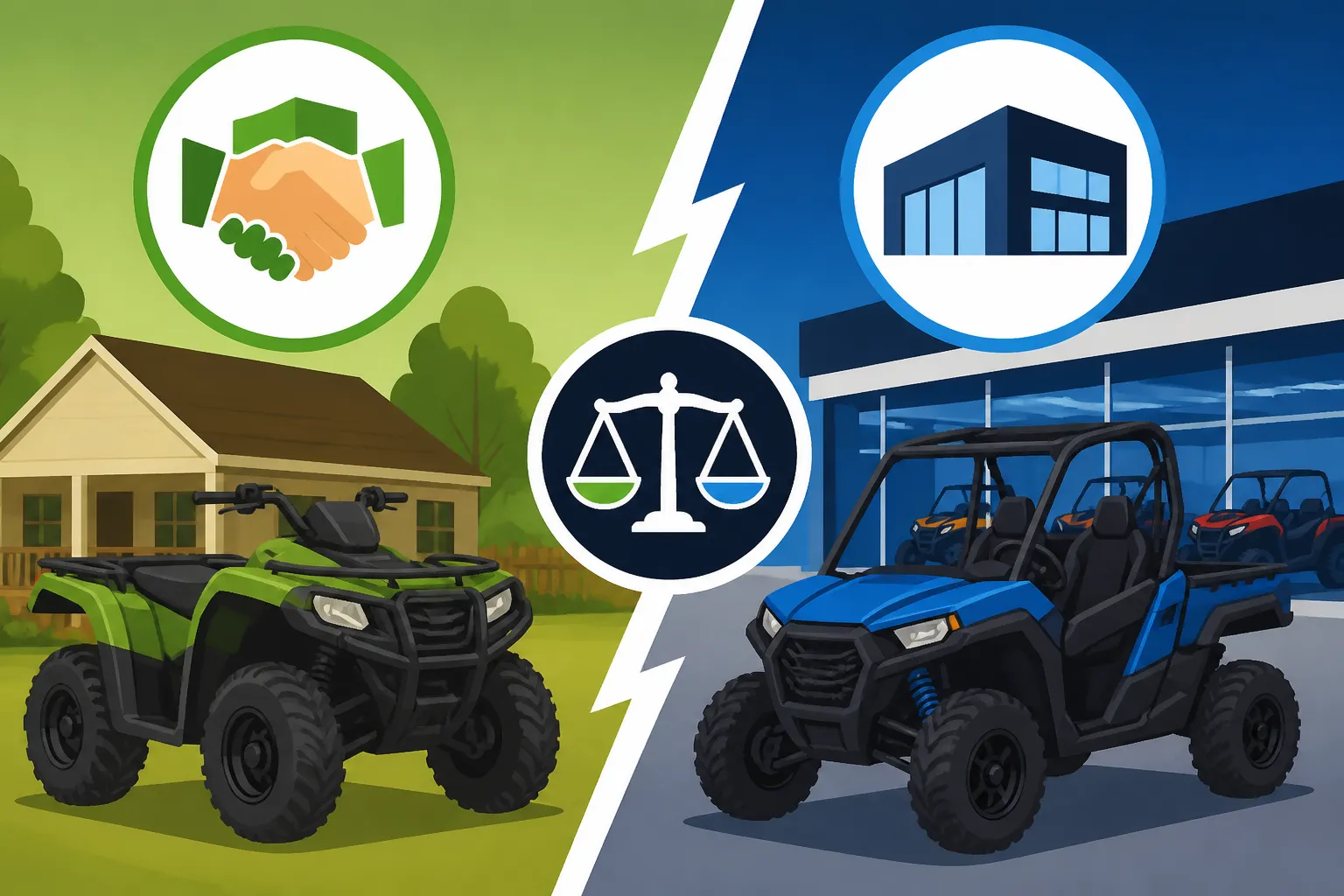
Buying an ATV or UTV in Mississippi means weighing more than the asking price. A private seller may offer a lower number, while a dealer can provide organized paperwork, financing options, and a clearer path to a new machine. The right choice depends on the machine, its documents, your budget, and how much risk you can comfortably take on.
The Main Trade-Off: Price Versus Support
A private sale and a dealer purchase can both be sensible. The difference is usually how much work and uncertainty you take on yourself. With a private seller, you are responsible for checking the machine’s condition, confirming who owns it, and making sure the sale documents are complete. At a dealership, the staff typically handles more of the transaction, but the total price may include charges beyond the advertised amount.
Neither route guarantees a trouble-free purchase. A dealer’s paperwork does not replace an independent inspection, and a private seller’s low price does not prove that a machine is a bargain. Compare the full transaction rather than focusing on the sticker or listing price.
| Purchase factor | Private seller | Dealer |
|---|---|---|
| Asking price | May be negotiable; condition and demand matter | Usually set by the dealer, though promotions or negotiation may be possible |
| Machine selection | Depends on local listings and what is available | May offer new and used inventory, sometimes with model choices |
| Inspection | Buyer arranges and evaluates it | Buyer should still inspect; available service information varies |
| Ownership documents | Buyer must verify documents and signatures | Dealer generally prepares or collects transaction paperwork |
| Tax and title steps | Buyer may need to complete more steps directly | Dealer may handle some filing, but confirm what is included |
| Financing | Often requires cash or a separately arranged loan | Financing may be offered through the dealer or a lender |
| Negotiation | Direct discussion with the owner | May involve the machine price, trade-in, or transaction terms |
| Main risk | Hidden condition or incomplete ownership history | Added costs, financing terms, or assumptions about what paperwork is covered |
A lower private-sale price can lose its advantage if the machine needs repairs, lacks usable ownership documents, or requires a costly trip to resolve paperwork. A dealer purchase can be worth more to a buyer who wants a newer machine, financing, or assistance with filing. But dealer support has limits: get every promise, charge, and responsibility in writing.
Before deciding, estimate the total amount you will spend to put the machine in usable condition and legally titled if required. Include the purchase price, tax, title-related costs, inspection, transportation, immediate maintenance, accessories, and insurance if you choose to carry it. Costs vary by situation, and the applicable amounts and procedures should be confirmed with the relevant Mississippi office and provider.
Compare the Full Cost, Not Just the Asking Price
Tax applies to the transaction, not the seller’s label
A private sale is not automatically tax-free because the buyer and seller are individuals. Mississippi tax rules can apply to an ATV or UTV purchased from a private party as well as one purchased from a dealer. The tax treatment and paperwork can depend on the type of transaction and the machine, so confirm how the tax is calculated and paid before handing over money.
For a general overview, see Mississippi Sales Tax on a Private ATV Sale and Mississippi UTV Sales Tax at a Dealer. Mississippi’s listed machine tax rate is different from the rate applied to passenger cars, so do not assume that a car-buying tax calculator gives you the right answer. Check the current instructions from the state or county office handling your transaction.
Ask the seller or dealer to identify the price used for the transaction documents. Keep a copy of the bill of sale, invoice, payment record, and any other paperwork. If the amount shown on the documents does not match what you paid, ask for a correction before the transaction is completed. Accurate records help you explain the transaction if a tax or title question comes up later.
A dealer may collect tax as part of delivery or provide instructions for paying it. Do not assume it has been paid merely because the dealer is handling the sale. Ask whether tax is included in the quoted out-the-door figure, collected separately, or due when you submit title paperwork. A private seller may not be familiar with the buyer’s tax obligations, so verify those obligations yourself.
Dealer quotes can include several kinds of charges
Ask for an itemized out-the-door quote. The machine’s advertised price may not include delivery, setup, documentation, accessories, title handling, tax, or other charges. Some charges may be tied to a service or product; others may be negotiable or optional. The important step is to identify each charge and decide whether you are agreeing to it.
Request a written explanation for anything labeled as a package, protection plan, preparation, or administrative charge. Ask whether declining an optional product changes the price of the machine or the financing terms. If a charge is required, ask whether it is already included in the advertised price. Avoid making a decision based only on a monthly payment, since a longer loan or a larger down payment can make the payment appear smaller without lowering the overall cost.
The dealer’s final paperwork should match the terms you agreed to. Compare the purchase agreement, financing documents, and any add-on forms before signing. If you do not understand a charge, pause and ask for an explanation. You can also compare a second dealer’s written quote, but make sure both quotes cover the same model, equipment, and delivery terms.
Include costs that appear after the sale
A machine that is inexpensive to buy may still need immediate work. Used ATVs and UTVs may require tires, a battery, fluids, brake service, a belt, bearings, or repairs to electrical components. Machines used in deep mud or water can have wear that is not obvious during a quick walkaround. Budget for an inspection and a repair reserve rather than spending the entire budget on the purchase itself.
Transportation matters, too. A private seller may expect you to pick up the machine, while a dealer may quote delivery separately. You may need a trailer, suitable tow vehicle, tie-downs, or help loading. If the machine has to be taken to a mechanic or county office, include those trips in your estimate.
Accessories can also add up. Common additions include a winch, skid plates, tires, a roof, a windshield, or storage. Confirm that any accessory fits the exact year and model before buying it. For example, an item found on Amazon may look right in a listing but still be incompatible with a particular trim, mounting system, or machine width. Verify fitment with the manufacturer’s specifications or a knowledgeable parts seller.
Trade-ins affect the comparison
A dealer may accept your current machine as a trade-in. Compare the trade-in allowance with what you could realistically receive in a private sale, but also account for the convenience of one transaction and the time it takes to find a buyer. The tax calculation may treat a trade-in differently from a cash discount; do not assume every reduction has the same effect.
Ask the dealer to show the trade-in amount separately from the new machine price, discounts, and tax. That makes it easier to compare the offer with a private sale. The details are covered in [Mississippi Trade-In Credit for a Quad]. If you sell your old machine privately, keep the sale paperwork and complete any transfer steps that apply to its title.
Paperwork and Ownership: Where Private Sales Need Extra Care
Establish who has the right to sell
Before paying, match the seller’s identity to the ownership documents and the machine itself. Ask to see the title if the machine has one, and check that the name and identifying details are consistent. If the seller says a title is not required for that machine, ask what records establish ownership and what documents will be provided to you.
A missing title is not a minor detail to resolve later. It can affect whether you can title the machine, resell it, or establish a clear ownership history. A seller may have a reasonable explanation, such as lost paperwork, but that does not make the issue disappear. Find out what the state requires before agreeing to buy. If the documents are incomplete, consider making the sale conditional on the seller resolving the problem first.
For a new machine, the manufacturer’s certificate of origin is an important document in the title process. Ask the dealer whether it will provide the original or submit it as part of the paperwork, and request a written explanation of what you will receive. See Mississippi Dealer Paperwork at Delivery and Mississippi Titling With a Manufacturer’s Certificate of Origin for related paperwork questions.
Confirm whether the machine needs a title
Mississippi’s title rules depend in part on when the machine was built, not simply when it was bought. Machines built after the July 2025 cutoff are subject to titling requirements described in the state’s rules. Older machines may not be required to have a title, though a voluntary title may be an option in some cases. Verify the machine’s build date and the current requirements instead of relying only on the model year or a seller’s recollection.
A compliance label or other manufacturer information may help establish when the machine was built. If the build date is unclear, ask the dealer or manufacturer for documentation before purchase. The cutoff and the difference between purchase date and manufacture date are explained in Manufacture Date, Not Purchase Date, Decides Titling.
If the machine has a title, examine it before payment. Look for an owner’s name that matches the seller, complete assignment information, any recorded lien, and signs of alteration. If a lender is listed, do not assume the loan is paid just because the seller says it is. Ask how the lien will be released and verify the required steps before completing the transaction.
If the machine comes from another state, ask what documents are needed to title it in Mississippi. A title or registration record from the seller’s state may not, by itself, answer every question about Mississippi requirements. For that situation, see Mississippi Title for an Out-of-State Machine.
Put the sale in writing
A bill of sale is useful even if the machine’s title or another ownership record is also transferred. It documents who bought and sold the machine, when the transaction happened, what was sold, and what amount was paid. Include the machine’s make, model, year if known, vehicle identification number or serial number, and any included parts or accessories. Both parties should keep a copy.
Do not leave key details blank or accept a description so vague that it could apply to several machines. Check the serial number on the machine against the paperwork before signing. Photographing the identifying label or stamped number can help preserve a record, provided the number is visible and the photo does not substitute for checking the documents.
If the machine has no title, a bill of sale may help document the purchase, but it does not necessarily replace other required proof. Find out what the state or county office will accept before you buy. The steps vary with the machine and its history; Mississippi Title Without a Bill of Sale and Mississippi Title Bond Procedure discuss common paperwork complications.
Ask about liens, co-owners, and name changes
A machine can have more than one owner or an outstanding lien. Every person whose signature is required should sign the documents correctly. If a lender has a security interest, arrange for the lien to be paid and released using a process that protects both sides. Do not rely on a promise that the paperwork will be mailed later without confirming how the transfer will be completed.
A mismatch between a title and the seller’s legal name also needs explanation. A name change, inheritance, business ownership, or a prior sale that was never completed can create extra steps. Ask the appropriate office what documentation will resolve the discrepancy before you transfer money.
If the seller cannot explain the ownership chain or refuses to provide the available documents, walk away. A low price is not compensation for a machine you may be unable to title or resell.
Condition Checks for a Used ATV or UTV
A private seller may let you inspect the machine at home, on a farm, or at a riding area. A dealer may have a service department, but that does not mean every used unit has received a complete mechanical inspection. In either case, inspect the specific machine you will receive, not a similar model or a photograph.
Start with identity and visible condition
Compare the identification number on the machine with its paperwork. Make sure it is readable and appears unaltered. A missing, damaged, or inconsistent number is a reason to stop and ask questions before proceeding. Do not assume a seller can resolve the problem after the sale.
Inspect the frame and bodywork for cracks, bent sections, fresh paint over damaged areas, missing fasteners, and mismatched panels. Look underneath for dents, weld repairs, oil leaks, damaged guards, and signs of impact. A clean machine is pleasant to inspect, but a recent wash can also make leaks and mud-related wear harder to see. Ask whether it has been cleaned recently and why.
Check tires for uneven wear, cracking, cuts, plugs, and mismatched sizes. Inspect wheels for bends or damage. Look at the seats, controls, footwells, and cargo areas for wear that seems inconsistent with the seller’s description. On a UTV, examine doors, seat belts, cab components, and cargo bed attachments. Make sure the seating arrangement and accessories match how you plan to use it.
Ask about how it was used
Ask the owner how the machine was used, where it was stored, what maintenance has been done, and whether it has been submerged, rolled, or modified. Specific questions tend to get better answers than a general question such as “Is anything wrong with it?” Ask for service records, receipts, and manuals if available. Records do not guarantee good maintenance, but they give you something concrete to evaluate.
Hours and miles can help describe use, but neither figure tells the whole story. A machine with relatively low hours could still have been used hard in mud or neglected between rides. A machine with more use may be in better shape if it was maintained consistently. Look for consistency between the meter, wear on controls and seats, maintenance records, and the seller’s account.
Ask about modifications and whether original parts are included. A lift, altered tires, snorkel, performance parts, or electrical additions may affect handling, reliability, or future service. Confirm that the machine starts and runs as expected with its current setup. If the changes concern you, ask a mechanic familiar with the model to evaluate them.
Arrange an independent inspection
For a significant purchase, an independent inspection can uncover problems that are difficult to spot during a brief viewing. Agree in advance on who pays, where the inspection happens, and what happens if the machine fails. A seller who refuses every reasonable inspection request may have a legitimate scheduling issue, but the refusal still raises the risk for the buyer.
Ask the mechanic to check the engine, drivetrain, brakes, steering, suspension, charging system, cooling system, and any accessories that matter to your intended use. On a belt-driven machine, ask about belt condition and evidence of water or mud contamination. On a machine used for towing or work, pay attention to drivetrain strain and hitch condition. The right inspection varies by model and use.
Do not let a short test ride replace a mechanical evaluation. If you are allowed to test it, do so only with the owner’s permission, in a suitable area, and without taking it onto a public road unless that use is lawful. Listen for unusual sounds, check for warning lights, and try the controls. A test ride should not be an excuse to ignore missing paperwork or a mismatch in the identification number.
Match the machine to the job
A lower-priced sport quad may not suit frequent hauling or hunting-camp work. A large side-by-side may be more machine than you need for narrow trails or a small property. Before comparing listings, write down the jobs you expect the machine to do, the number of riders, your trail access, and the width and weight restrictions of places you may visit.
For example, the limits at a riding area can rule out a machine before price matters. Check the requirements of each trail or park rather than assuming that every ATV or UTV is allowed. The riding environment also changes maintenance needs: mud, sand, water, and long storage periods can affect tires, bearings, belts, electrical connections, and corrosion.
Financing, Negotiation, and the Dealer Experience
Decide on financing before shopping
A dealer may offer financing through a lender, while a private seller generally expects payment directly or through financing arranged by the buyer. A bank or credit union may be willing to consider a private-party purchase, but the lender’s rules can differ. Confirm that the loan can be used for the exact type, age, and condition of machine you want before you commit to a seller.
Compare the total amount to be repaid, not just the payment. Review the interest rate, loan length, down payment, required insurance, fees, and any add-on products. Ask whether a quoted figure assumes a particular down payment or trade-in. A longer loan can reduce each payment while increasing the total cost and leaving you with a balance after the machine has lost value.
If you are considering a private-party loan, ask the lender how it handles payment to the seller, title documents, and any lien it will place on the machine. A seller may be uncomfortable waiting for a lender’s process, and a lender may require specific documents. Set expectations before signing a bill of sale or arranging pickup.
Negotiate around the actual machine and terms
For a private sale, use comparable machines and inspection results to support an offer. Consider condition, equipment, maintenance history, ownership documents, and the cost of any work the machine needs. A seller may have a firm price or may reject negotiation; keep the discussion respectful and be prepared to leave if the numbers do not work.
Do not treat a seller’s original purchase price as proof of today’s value. Ask what is included and whether the listed accessories are part of the sale. If the seller has spare parts, tools, or a trailer, identify each item in writing so neither party assumes it was included when it was not.
At a dealership, negotiate the written out-the-door price instead of discussing only a monthly payment. If you have a trade-in, ask for the machine price and trade-in value to be shown separately. Compare the quoted terms with another offer, and make sure each dealer is pricing the same trim and equipment. If the dealer changes the figures during paperwork, ask for the reason before signing.
Know what dealer support does and does not mean
A dealer may help with ordering parts, arranging service, explaining controls, or submitting paperwork. These benefits depend on the dealer and the specific transaction. Ask which services are included, which are optional, and whether any promises are written into the purchase documents.
Warranty coverage is not the same as a guarantee that every repair will be covered. Read the warranty terms, including the coverage period, exclusions, maintenance obligations, and process for making a claim. Ask specifically how the warranty treats mud, water, modified machines, commercial use, and damage from improper operation. Do not assume that an extended plan duplicates the manufacturer’s coverage or will cover the problems most likely for your use.
A dealer’s used machine may come with limited or no warranty. Ask whether it is sold as-is and what the dealer has inspected or repaired. Request service records and the written terms for any remaining manufacturer coverage. If the answer is vague, get clarification before the purchase.
Consider the cost of convenience
Dealer support has value when it saves time or makes a complicated purchase easier, especially for a new machine with required manufacturer paperwork. But convenience is worth paying for only if you know what you receive. If the dealer handles title filing, ask whether you must sign additional forms, what documents you will receive, and how you can follow up if the title does not arrive.
A private sale can be straightforward when the seller has clear ownership documents, the machine passes inspection, and both sides agree on a complete bill of sale. It becomes more difficult when the seller is out of state, the title is missing, a lien has not been released, or the machine has changed hands without completed paperwork. The time you spend resolving those issues is part of the real purchase cost.
A Practical Buying Process for Either Route
Use the same basic sequence whether you are meeting an individual seller or shopping at a dealership. It keeps excitement from pushing paperwork and mechanical checks to the end.
- Set a total budget. Reserve money for tax, title steps when applicable, inspection, hauling, immediate service, and equipment. Decide the maximum price you can pay without using money set aside for repairs.
- Choose the right type and size. Match the machine to the work, passengers, terrain, storage, trailer, and riding areas you plan to use.
- Check local rules for the intended ride. A title does not authorize road use, and a machine that can be titled may still be restricted from particular roads or trails. Check landowner rules, park limits, and applicable local requirements.
- Ask for identification and ownership documents early. Request the machine’s identification number and ask whether it has a title, lien, manufacturer’s certificate of origin, or other ownership records.
- Confirm the title rule for that machine. Establish the manufacture date and verify whether it must be titled. Ask the relevant office what documents it requires for that specific purchase.
- Review the complete price. For a dealer, request an itemized out-the-door quote. For a private seller, calculate tax and other transaction costs rather than treating the agreed price as the final total.
- Inspect the machine. Review its physical condition and records. Arrange an independent mechanic’s inspection when the price or risk warrants it.
- Agree on written terms. Put the price, machine description, included items, payment method, and any conditions in writing. Make sure the bill of sale and title assignment are complete.
- Handle payment and documents together. Use a payment method that both parties understand, and do not release funds without the agreed ownership documents. If a lien or lender is involved, follow the documented payoff and release process.
- Keep a complete transaction file. Save the advertisement, messages, bill of sale, invoice, title documents, payment confirmation, inspection report, and tax or filing receipts.
- Finish required filing promptly. Follow the current instructions and deadlines given by the appropriate office. If a dealer submits paperwork, ask how to check on its progress and what to do if something is delayed.
- Prepare before riding. Arrange suitable transportation, protective gear, maintenance, and insurance if you want coverage. Do not treat ownership paperwork as permission to ride anywhere.
This sequence does not make every deal safe, but it helps expose problems while you still have the choice to pause or walk away. If the seller pressures you to pay before you can verify ownership, inspect the machine, or read the documents, slow down. A legitimate opportunity should withstand basic checks.
Which Option Fits Your Situation?
A private purchase may suit you if you can inspect the machine carefully, understand the ownership documents, and handle the sale steps yourself. It can also make sense when the seller has a well-maintained machine with records and a clear price. The trade-off is that you have fewer built-in services and must be comfortable checking the transaction from end to end.
A dealer may be a better fit if you want to buy new, need financing, prefer help with manufacturer paperwork, or want to compare multiple machines in one place. The trade-off is that the out-the-door cost may be higher than the advertised price, and dealer support should never be taken for granted. Confirm the terms in writing.
| Your situation | A private sale may fit if | A dealer may fit if |
|---|---|---|
| You are comfortable evaluating used equipment | You can inspect it or hire a mechanic and verify the ownership chain | You want access to dealer service or a more structured transaction |
| You have a firm cash budget | You can account for taxes, repairs, and hauling without draining your reserve | A complete written quote fits your budget |
| You need financing | Your lender accepts private-party purchases and the timing works | The dealer’s financing terms are competitive and clearly explained |
| You are buying a new machine | The seller can provide all required manufacturer and ownership documents | You want the dealer to coordinate delivery and paperwork |
| You found a machine with missing papers | You are willing to wait until the seller resolves the problem before payment | The dealer can document the machine’s ownership and filing path |
| You need a specific work or trail setup | The machine’s modifications and condition meet your requirements | Inventory, accessories, and available service match your needs |
The best deal is not always the one with the lowest sale price. It is the machine that fits your use, has a defensible ownership history, passes a reasonable inspection, and can be purchased within a total cost you understand. If either option leaves important questions unanswered, keep shopping.
Frequently Asked Questions
Is a private ATV sale in Mississippi tax-free?
Do not assume it is tax-free because the seller is an individual. Mississippi tax may apply to a private-party purchase. Confirm the current tax process and amount with the appropriate state or county office before completing the sale.
Is buying from a dealer safer than buying from a private seller?
A dealer may offer more structured paperwork, service, or financing, but that does not guarantee the machine is mechanically sound or that every charge is necessary. A private sale can be a good purchase when the machine is inspected and ownership documents are complete. Check the machine and terms either way.
Should I buy an ATV without a title?
First determine whether the machine is required to have a title and what documents establish ownership. If a required title is missing, ask the relevant office how the issue can be resolved before paying. A bill of sale may help document a transaction but does not automatically replace every required ownership record.
What should I get from the seller?
Get a completed bill of sale, the title or other applicable ownership documents, and any available maintenance or lien-release records. Confirm that the identification number on the machine matches the paperwork. Keep copies of the payment record and all signed documents.
Disclaimer
This article is for general informational purposes only and does not constitute professional advice. Laws, prices and regulations vary by location and change over time. Consult a qualified professional for guidance on your specific situation.